


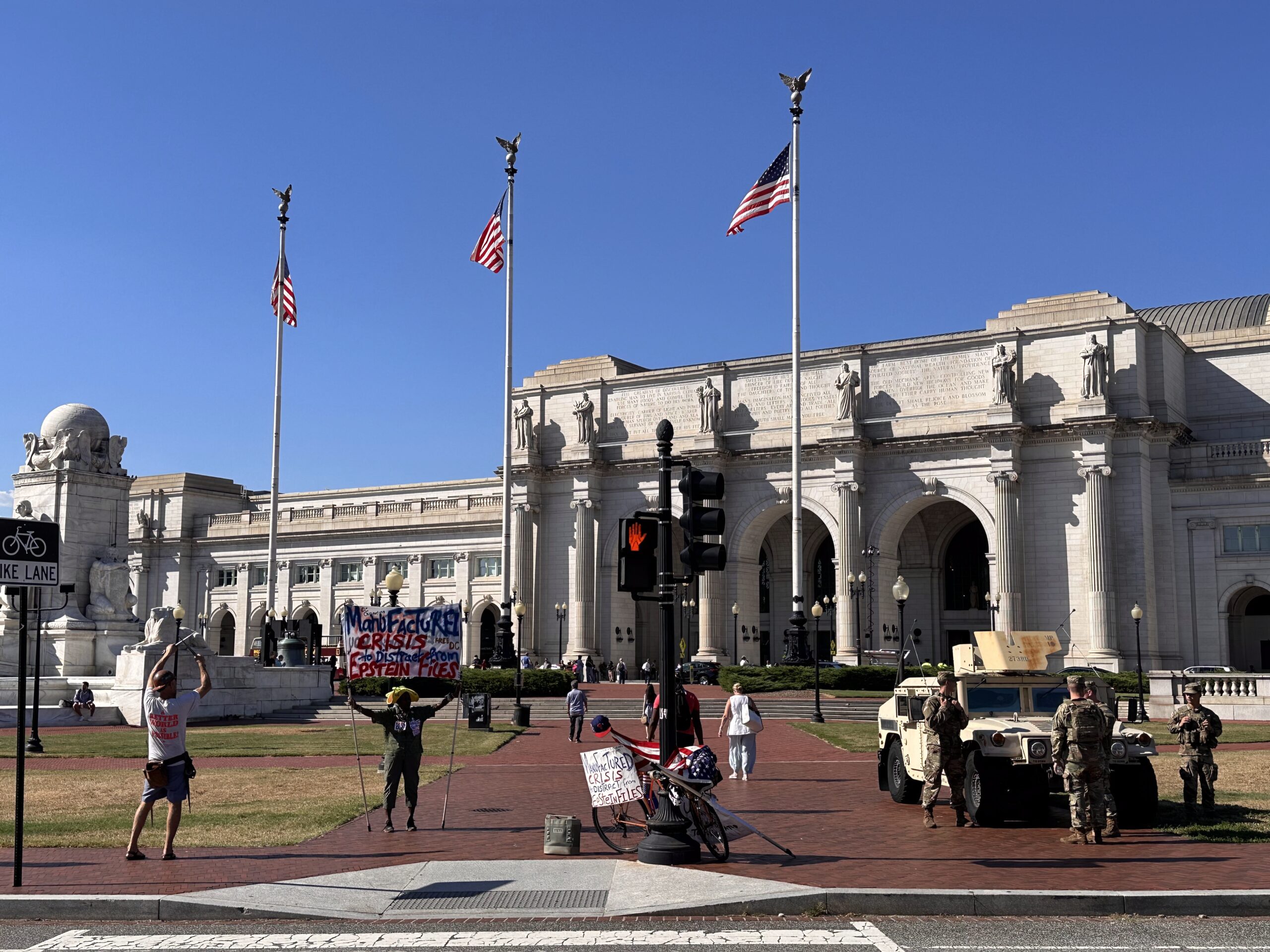
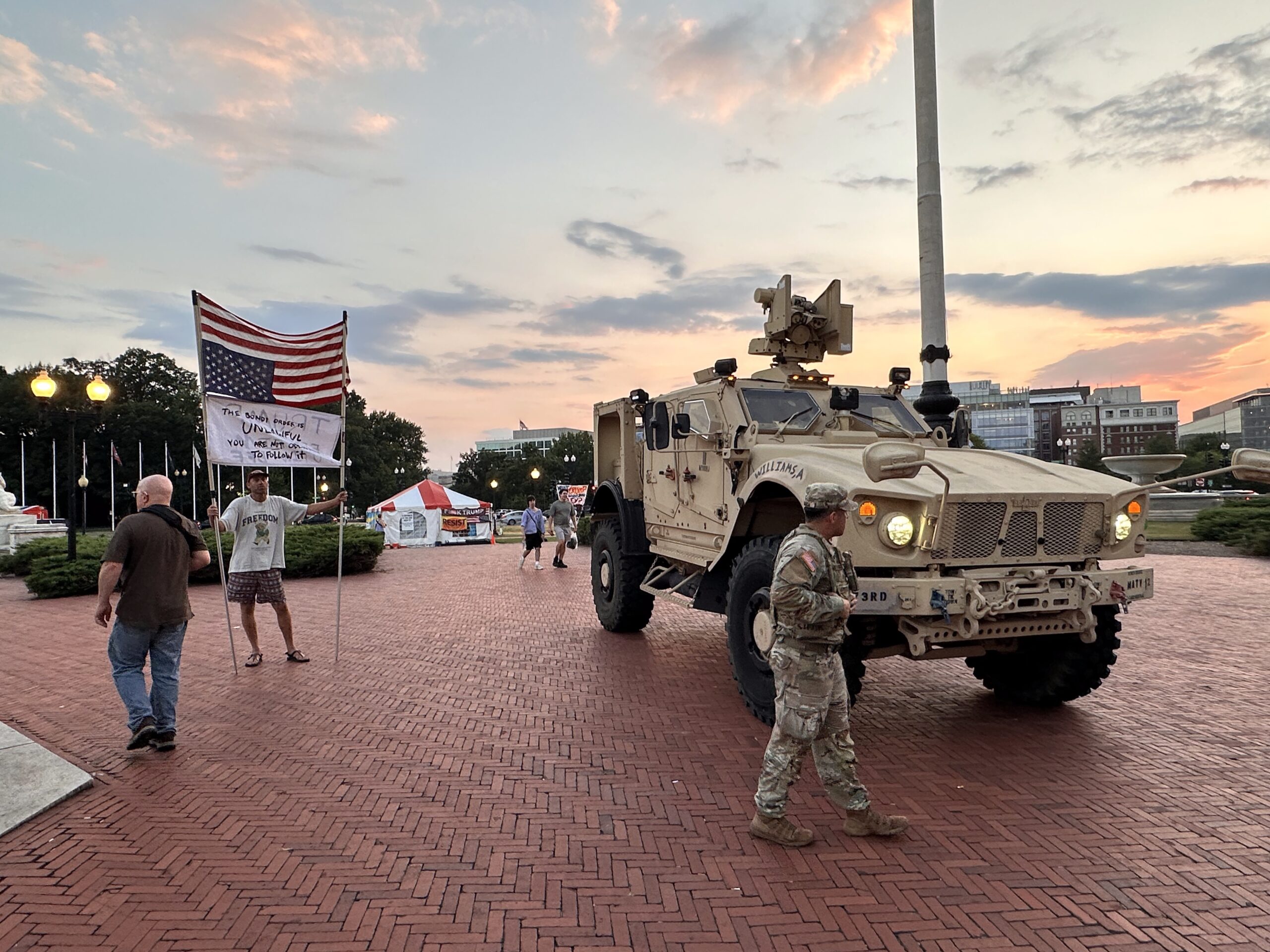
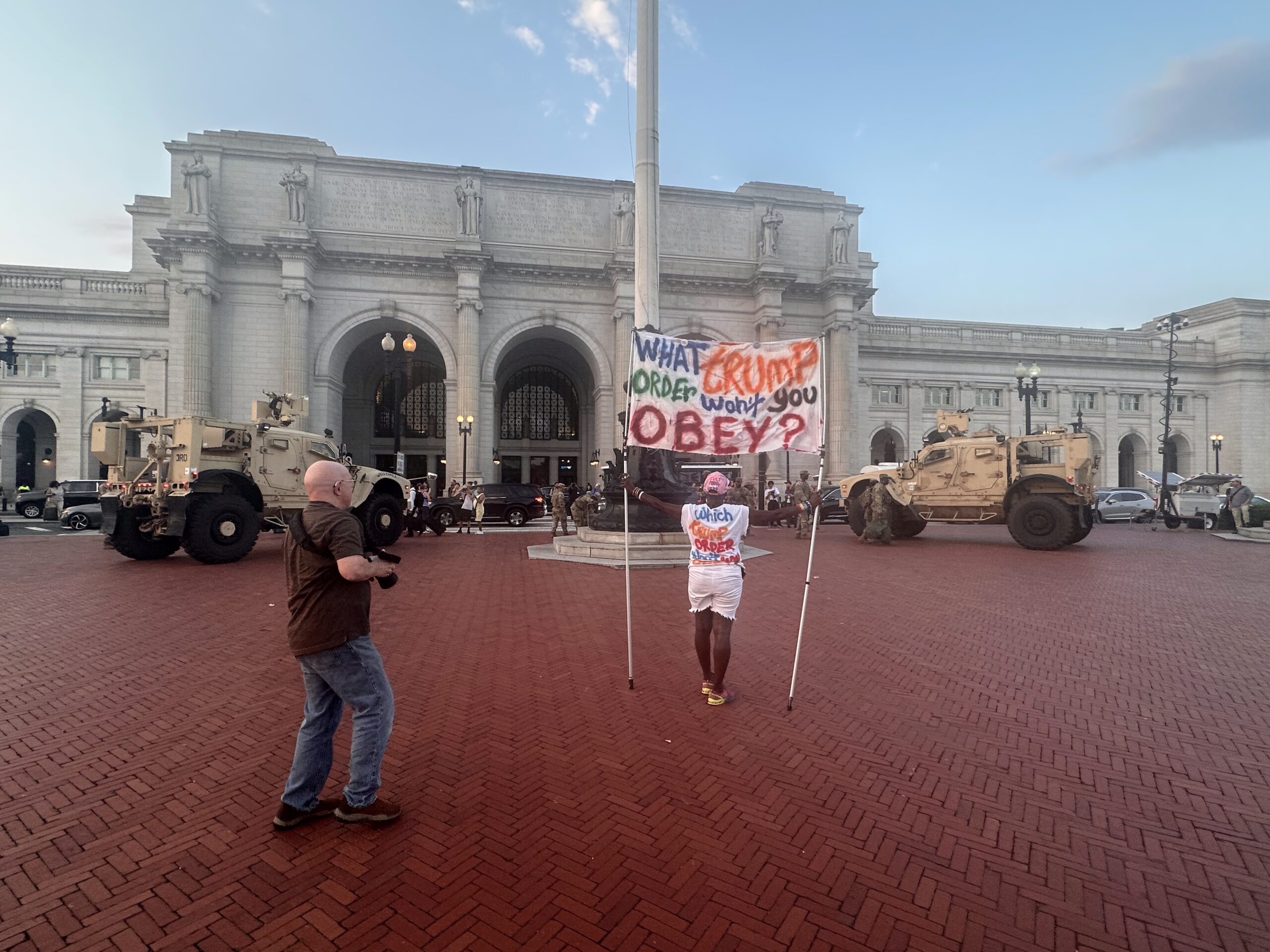

Earlier this month, when the Donald Trump administration pushed to federalize Washington, D.C., sending the National Guard, the FBI, Immigration and Customs Enforcement (ICE) and the Drug Enforcement Administration (DEA) to “fight crime,” I mounted my bicycle and pedaled toward Union Station, where trains in and out of the city converge. The neighborhood apps that D.C. residents rely upon for local events and community announcements were exploding with news of a “city takeover.” Footage abounded of uniformed and plainclothes law enforcement standing in large numbers at corners, sometimes making an arrest, drawing crowds of impromptu protesters. Images of the National Guard troops who were posted at the train station looked especially sinister, the scenes reminiscent of garrison towns I have long left behind, so I wanted to see what had become of D.C. for myself.
The District of Columbia is barely 70 square miles in size and home to about 700,000 residents. But it is part of the greater DMV metro area, which includes D.C. as well as parts of Maryland and Virginia, and is home to over 5.5 million people, many of whom work in or commute through the district. Among the things we worry about in the city are your garden-variety urban concerns in today’s America: the cost of living, parking and, randomly, a measles scare after one confirmed case of a person who arrived in March by train at Union Station.
As for crime, well, it’s a city. Always lock your bike, secure your wallet and, when riding the metro, keep your cellphone close. Like any American city, drug dealing and gun violence keep the local police busy, even though many of the city’s illegal firearms come from places outside the district, like Virginia, where gun laws are lax and gun shops ubiquitous. A combination of high rent, lack of a safety net and a mental health epidemic often rooted in drug addiction push too many people toward homelessness which, unfortunately, is another signature of contemporary American life. The unhoused will seek shelter in encampments throughout public parks. But overall, statistically, crime rates in D.C. are at their lowest in years.
It was in this context that Trump began verbally berating D.C. for its “out of control crime,” a statement both disingenuous and apocryphal. It was also in this context that the city I have grown to call home began to remind me, overnight, of Damascus during the war in Syria.
At Union Station, I found the National Guard and the heavy equipment they drove into the city parked across from the train station. The guard’s most intimidating armored vehicles faced the main door, so that upon arrival in the nation’s capital you were met with the military’s mine-resistant, ambush-protected vehicles (MRAPs), as if the military were protecting the city from your presence. Granted, the MRAPs had no guns mounted on their roofs — not as of this writing, anyway — but if we are to stick to the warped logic that seems to govern the country today, perhaps it would have made more sense for the army’s equipment to face outward, as if they were protecting you, though I wouldn’t know from what, or whom.
In the background of these optics, a continuous wail of sirens originated from afar. I assumed it was another sinister layer to add to our current state of manufactured dystopia, and made a mental note to cycle toward it later and investigate.
For now, I was looking at an unarmed army, carrying out their marching orders to mobilize in their own city (their arm patches indicated they belonged to the D.C. National Guard), with no clarity about their role or how long they could expect to stay here. Other than a few with batons and zip ties, the rest of the guards wore patches indicating they belonged to service support units, such as medical, transport and logistics. At least one was from the Chemical, Biological, Radiological and Nuclear, or CBRN, branch. All looked bored, sweating uncomfortably in the blazing sun.
There is also no clarity as to what role they will play now that they have begun to carry arms, starting today, after Defense Secretary Pete Hegseth authorized them to do so. Trump has also indicated that other cities will be next, starting with Chicago, which has a metro area population of almost 10 million. Will we soon see a day when the U.S. military directly engages civilians in cities on U.S. soil, policing, arresting and, God forbid, shooting at us?
An Assad regime insider once told me that intimidating the populace did not require harassing every single citizen. An authoritarian regime only has to flex its muscles here and there, ensure that such news is widely circulated and then sit back and rely on the people to cower to its authority and police themselves. That the U.S. is already descending toward authoritarianism is no longer a matter of opinion. But how far we descend depends on the extent to which people capitulate to the bullying, as too many of the country’s top institutions have already started doing.
I have seen this movie before, and it is heartbreaking. We are witnessing the erosion of trust and respect between the people and the authorities entrusted with their protection.
I remember when I lived in the parts of Damascus that were under Assad’s control and the contingency planning I relied upon in case I was detained, arrested or disappeared by the regime, given that I was reporting undercover on the war. Now, I find myself in a similar state of mind, saving a lawyer’s phone number on my speed dial and sharing with trusted friends emergency numbers and protocols for our respective homes, pets and other loose ends, “just in case.” Conservatives and Trump supporters will dismiss this as the “hysteria” of a liberal city, but they are blind to a new reality for anyone who feels vulnerable because of their visa status (including those here legally), national origin or skin color, no matter how law-abiding they are.
In this familiar movie, I also recognize another ugliness that is rearing its head: the contempt that some law enforcement, namely ICE, show toward the public. The Trump administration claims that 300 people have been arrested in D.C. since Aug. 7 for illegal immigration status, a tenfold increase for ICE. Many of these arrests focused on easy targets, such as delivery drivers on mopeds, including one instance when an ICE car ran the moped over, injuring the driver before arresting him as he limped along on one foot.
An overwhelming majority of D.C. residents strongly disapproves of the federalization. People grow visibly upset at the sight, not just of ICE, whose actions are impossible to defend, especially in a city rooted in international culture, but these days at the sight of any law enforcement or anyone in uniform. Lately, it has not been unusual to be approached by random D.C. residents who, unsolicited and visibly shaken, tell you, “Be safe under fascism” and “Free D.C.” These are the rips and tears in the social fabric that threaten to seed a permanent hatred, followed by a permanent split.
Back at Union Station, a few protesters circulated the scene, as locals and the few tourists now seen around town snapped photos of the National Guard troops, who stood at ease or strolled through the park. I’ve since seen them elsewhere in D.C., casually walking through well-manicured touristy areas and national monuments. If they were sent here to “fight crime,” they were nowhere to be found in the dicey parts of town.
“Why are they here? To wave and say hi? What’s the purpose?” one D.C. police officer asked me, rhetorically. He asked to remain anonymous because he was not authorized to speak to the media on the record. “I get that they’re supposed to be seen to deter crime,” the officer continued. “But the National Guard can’t do anything without us. It’s pointless for them to be here.”
The main issue with crime in D.C. isn’t so much that it is happening at a high rate, one officer explained, but that a revolving door of arrest and release, due to lax laws and an overstretched legal system, keeps offenders on the street and makes them grow more emboldened. “We catch these guys and they keep getting released, which is bad for morale,” the officer said.
As a result, egregious offenses sometimes go unpunished. I have personal experience with this. A few months ago, a shootout took place in the alleyway behind my home. Unfortunately, this is not a unique occurrence in D.C. The perpetrators shot more than 30 rounds, including two that shattered my window and lodged in the wall of my hallway. Miraculously, no one was hurt — not in my home or among my neighbors, who also saw their windows shatter. The perpetrators, all of them juvenile, were unharmed, or so they appeared on neighborhood security camera footage as they made their escape. And yet, none seems to have been arrested for the illegal discharge of a weapon. Last month, in a nearby neighborhood, there was another shooting, this one involving 200 rounds. Again, miraculously, no one was hurt, and the perpetrators were juveniles still at large. Over and over, the profile of local crime is familiar. It’s rooted in the country’s gun culture, and it’s racialized, with offenders too often under the age of 18. Crime spikes in the summer months, when young people are out of school and city youth programs remain inadequate. And, of course, unlike what plays out in the imaginations of Fox News viewers and Trump supporters in red states, city crime does not involve “illegal immigrants” running amok and wreaking havoc.
Many on the police force complain about an under-resourced police department, blaming the “defund the police” protest movement that started in 2020, which led to millions of dollars of cuts to the police budget that year. To them, federalizing the police has been helpful, at least with regard to the FBI now accompanying local police on patrol calls.
“We love it,” one officer told me during a patrol in which I was allowed to accompany law enforcement, adding that, unlike the National Guard, “the FBI are useful because they can make arrests.”
At one sketchy gas station located at a corner in the northeastern quadrant of D.C., where I have often seen loitering youth and drug deals, half a dozen FBI cars accompanied as many D.C. police cars to arrest one man for alleged possession of illegal firearms and illicit drugs. The suspect will now appear in District Court, which means he will face federal charges — which come with at least a 48-hour hold, as opposed to the usual next-day release in D.C. — and tougher sentencing than he would have in the D.C. courts.
Not too far from there, at a corner in the popular Union Market area, I came upon another swarm of FBI and Metropolitan Police Department cars arresting a man for — you guessed it — alleged possession of illegal firearms.
What would have been a routine arrest in D.C. had turned into a public spectacle, with dozens of locals surrounding the scene and shouting obscenities at law enforcement, heckling them and telling them to “go home,” adding, “you serve the constitution, not Trump.” There was a lot of “wake up and quit your job,” and many boos and jeers directed at the men and women in uniform. One thread of insults that I found especially alarming reminded me of the sectarianism that can grip a nation, though in the context of the U.S. today it goes along ideological and geographic lines, with elitism, coastalism and reactions to both mattering more than sect. “Go back to Alabama,” a young man shouted from the sidewalk at the FBI crew members, who were part of the arresting officers amid stopped traffic in the middle of the street. Replace “Alabama” with any red state, and these points of friction have become commonplace throughout the city, the mix of optics and politics of authoritarianism already producing their toxic brew.
Though it has barely been three weeks, there is consensus among city cops that crime has tamped down during this period, as if offenders have been stunned into a state of paralysis. “They don’t know what to do. They don’t know how the feds operate, what technology they have, what unmarked cars they drive,” the officer said. “So they’re laying low.”
But the federal takeover of D.C. also seems to have left everyone else stunned, paralyzed and “laying low.” Businesses are complaining of low foot traffic, and restaurants are already seeing a 15% drop, a decrease that was evident even during Restaurant Week last week. During my daily walks and bike rides, the city has appeared eerily empty. Out-of-town friends are already inquiring with me about whether they should cancel plans to visit, and colleagues are wondering if they should move the venues for upcoming conferences out of D.C., especially if they are expecting an international audience.
“Other countries would love to have the freedom protections we’ve enjoyed here, and yet here we are. We’ve squandered it with eyes wide open,” a D.C. resident lamented to me.
Back at Union Station, I went to investigate the continuous sirens that wailed in the background. I found the source to be a small group of people protesting the genocide and famine in Gaza. They wore ear protection, as did I before I was able to approach them. There was an irony to the loudness of their protest, a reminder of the urgency of our era, with crises real or manufactured, no matter where in the world.
Sign up to our mailing list to receive our stories in your inbox.