


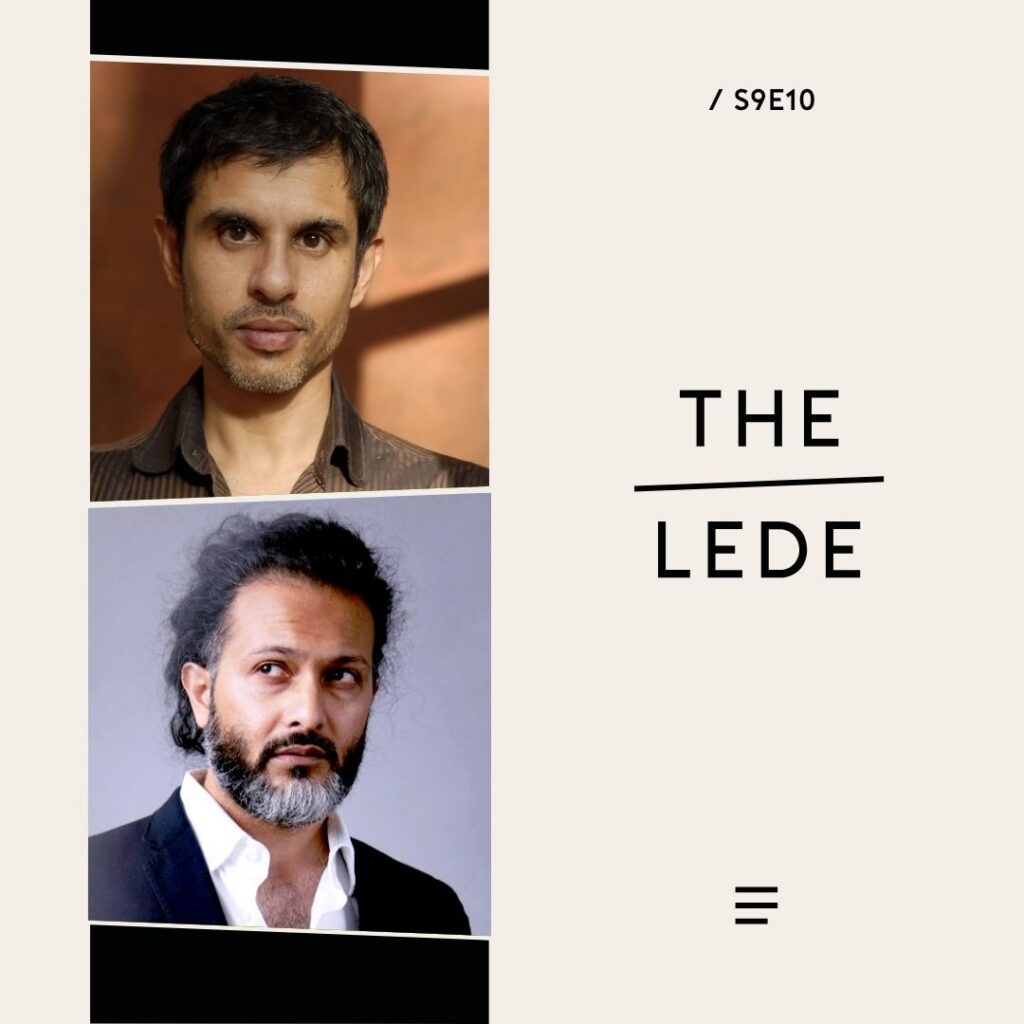
Hosted by Faisal Al Yafai
Featuring Rana Dasgupta
Produced by Finbar Anderson
Listen to and follow The Lede
Apple Podcasts | Spotify | Youtube | Podbean
That we are currently living through a moment of profound transition and crisis, as evidenced across the globe by everything from political uncertainty in the United States to the ongoing conflict in Iran, often seems self-evident. “We are in a moment where something seems to be breaking,” the writer Rana Dasgupta tells Faisal Al Yafai on The Lede. “The stories that we cherish and that are deeply ingrained in our media and our university life have told us that we’ve essentially reached the end of our political evolution. We don’t need to invent anything else. And so the idea that our existing political architecture might be in crisis — we’re not prepared for that at all.”
In his new book “After Nations: The Making and Unmaking of a World Order,” Dasgupta explores the fundamental building block of our modern political system: the nation-state. The nation-state, Dasgupta argues, is no longer able to deliver on the kind of promises it made to citizens at the liberal high points of the mid-20th century. “The period after 1945 was utterly exceptional, and we should not be surprised if it’s retreating,” he says.
“A lot of what is described in contemporary political discussion as fascism is not really that. It is more just the state being itself.”
The disintegration of the modern political system is often diagnosed as a descent toward authoritarianism or fascism, but Dasgupta disagrees. “A lot of what is described in contemporary political discussion as fascism is not really that,” he says. “It is more just the state being itself.”
Despite his bleak assessment of the present, Dasgupta maintains a belief in what he calls “political creativity” — the human capacity to build new social and political systems in response to crisis, which has often been restrained by the nation-state. “Human beings are amazing at creating new social systems to address problems, and we should sort of unleash our creativity,” Dasgupta says. “The nation-state has killed it because there’s no way to innovate.”
Al Yafai and Dasgupta consider Dasgupta’s manifesto for a new political architecture, as set out in his book, covering everything from the potential of technology to a universal digital citizenship. “There might be lots of people in the world that would like to have a parallel citizenship that is not granted by a nation-state, but simply exists in a blockchain or something like this that allows them to demonstrate that at two different moments in time, they’re the same person,” Dasgupta says.
Nevertheless, he resists any accusation of optimism. “I think that human beings can think their way out of worse problems than this,” he says. “But that’s not to minimize the real apprehensions that I have, and many others have, right now.”