


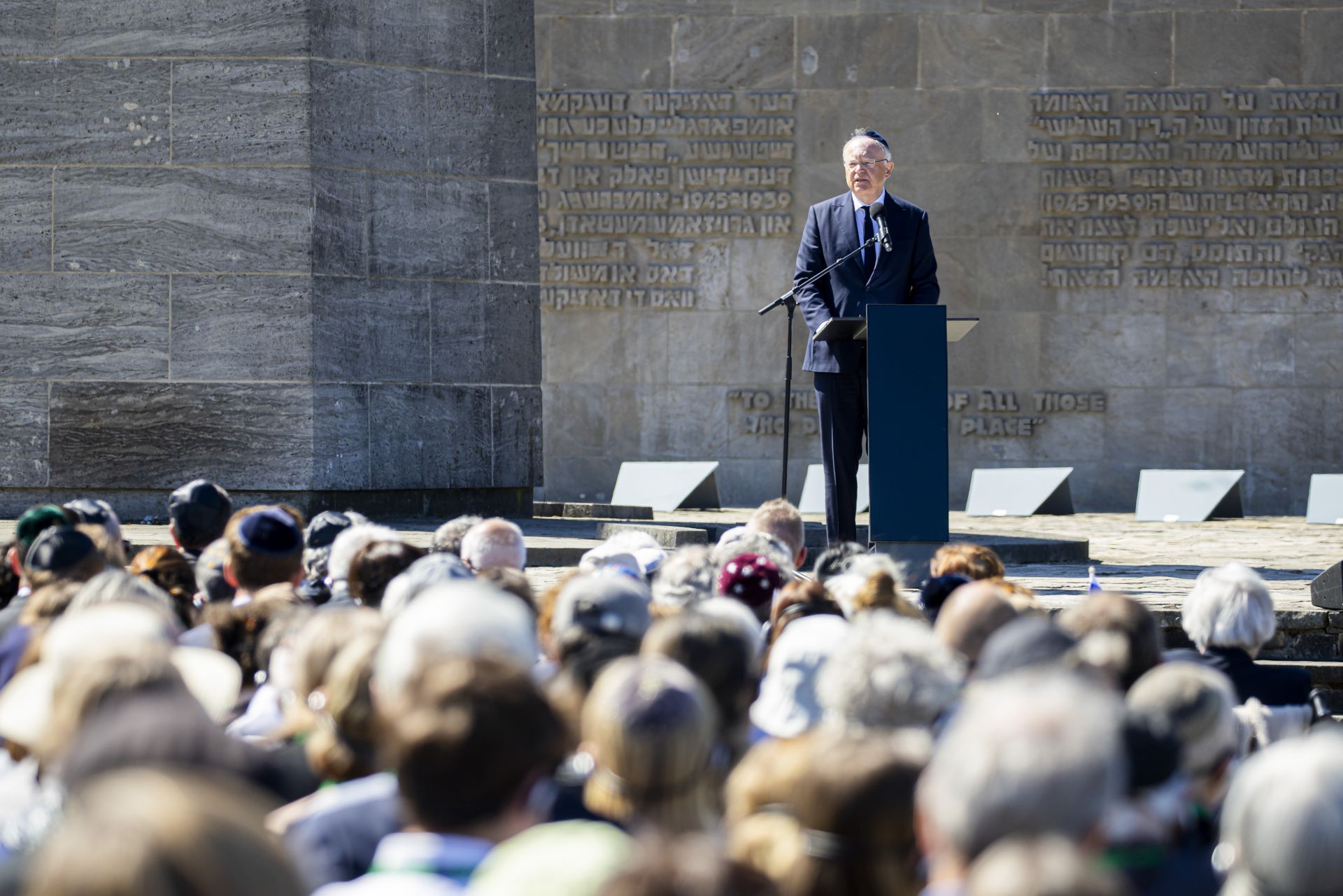
My 83-year-old mother survived a Nazi concentration camp as a child. She has been plotting potential escape routes her entire adult life. She is a citizen of the United States, but spent years working to get me a second passport, “just in case.” She worries about my safety because, as a high-visibility advocate of Palestinian civil and human rights and a senior staffer at a prominent, left-wing civil society organization in Washington, D.C., I could be targeted by the Trump administration. Last spring, she was invited by the German government to a ceremony marking 80 years since the liberation of Bergen-Belsen, the Nazi concentration camp in which she and her family had been imprisoned when she was a toddler. She wanted me to accompany her, but was concerned about the risks; the news media had reported several incidents of U.S. immigration officers detaining American citizens involved in the Palestine movement when they reentered the U.S. after traveling abroad. In the end, we decided that we would go to Germany, but we each bought a burner phone before leaving for the airport.
My mother received the invitation for this trip during what turned out to be the final year of the Biden presidency and accepted for both of us, without hesitation. She had never been back to the concentration camp where she learned to walk and where she spoke her first word — “achtung.” We both knew that the trip would probably be our only opportunity to finally make sense of that chapter of our family history, and to come to terms with how it had shaped us. Partly because my mother has so few memories of her own, since she was so young during the Shoah, the legacy of my family’s experience in Nazi-occupied Europe had always felt somewhat surreal. The opportunity to see where it happened and to meet other child survivors who shared her experience was a compelling one for us both.
During the second day of our trip to Bergen-Belsen, we rented a car to visit old friends of mine from Israel. They had gone into self-imposed political exile in Germany over a decade earlier, for reasons of ideology and conscience. I, too, had left Israel for political reasons just three years before this trip to Germany. My wife and I had concluded that continuing our political work from within the country was too risky given the rise of authoritarianism in Israel, particularly because we had young children.
Now, with President Donald Trump deconstructing everything that had always made the U.S. feel safe for people like me, and the Alternative for Germany (AfD) party — the closest thing to the Nazi party that Germany has seen in 80 years — securing its largest ever share of the vote in Germany’s Feb. 23 election, just a few weeks before our trip, we were all beginning to imagine, and plan for, the worst. And all this was playing out against the background of Israel’s ongoing, grinding war in Gaza, which prominent experts in international human rights law like Theodor Meron, the International Criminal Court judge who also survived the Holocaust as a child, described as genocide.
The irony of four Jews having this conversation in Germany, during a Holocaust commemoration tour no less, wasn’t lost on any of us. Two months after that trip, at home in Washington, I woke up to news that employees of Democracy for the Arab World Now (DAWN), the human rights organization I work for, had been banned from entering Israel, specifically because of my work. Even if I had wanted to, returning to Israel, though I am a citizen, was no longer an option.
My mother was born in Rotterdam in August 1942, during the Nazi occupation of the Netherlands. By then, the third year of the occupation, Jews had been forced out of their jobs, and the Nazis had imposed a long list of restrictions. Jews were not allowed to travel by public transportation, play sports or sit on public benches. They could not own bicycles, cars, radios or telephones. Nor could they visit the homes of non-Jewish friends or attend non-Jewish schools. They were also forced to wear yellow stars sewn to their clothes. A year or so later, my mother, her parents and her maternal grandmother were in one of the final groups of Jews to be rounded up in the Netherlands for deportation.
Like most other Dutch Jews, they were first sent to Westerbork, a transit camp in the Netherlands near the German border. From there, the majority of Jewish prisoners were sent to Auschwitz, the Nazi death camp in the Polish town of Oswiecem, where nearly all were murdered, while a smaller group was sent to a new camp at Bergen-Belsen, in Germany. The Nazis had originally established this new camp to imprison Jews whom they believed held value as hostages who could be exchanged for Germans imprisoned by the Allied powers. Within months, however, the Nazis designated Bergen-Belsen a concentration camp.
The Jews who were sent to Bergen-Belsen’s exchange camp referred to it as the Star Camp, because in that subsection of the larger camp the prisoners were allowed to wear their own civilian clothes, rather than camp-issue striped prison uniforms, as long as they wore the yellow star. Some were there because they were dual nationals. Another group had influential relatives in the U.S., while yet another was composed of Jews who had worked in the diamond business, which the Nazis briefly tried to keep running from inside the camp. One of the largest groups, which included my mother and her family, was of those spared from certain death at Auschwitz because they had visas to emigrate to Palestine. But by the end of 1944, the Nazis had exchanged just 2,300 prisoners out of the 120,000 people who passed through the camp. My mother and her family were not among them. For a while, hoping to squeeze some value out of them, the Nazis kept the remainder of the prisoners in the Star Camp alive, but just barely.
Bergen-Belsen was not an extermination camp. It did not have gas chambers or crematoria for the burning of corpses. At Bergen-Belsen, the Nazis killed people slowly — with starvation, lack of sanitation and the unchecked spread of communicable diseases like typhus. Anne Frank and her sister Margot died of typhus at Bergen-Belsen when they were 16 and 19 years old. When the British army liberated the camp in 1945, they found tens of thousands of unburied corpses and mass graves with tens of thousands more, while thousands more died in the weeks after liberation from malnutrition and disease. In all, the Nazis killed 52,000 of the 120,000 people who passed through Bergen-Belsen.
After the war, my mother and her parents returned to the Netherlands, but they did not feel welcome. In the face of lingering antisemitism and limited opportunity, they made their way first to Mexico. Most of my German-born grandfather’s family lived there. They had fled Frankfurt for the Netherlands after the Nazi government imposed the 1935 Nuremberg Laws, which stripped German Jews of their citizenship and voting rights; four years later, incredibly, they managed to obtain passage to Mexico on a ship that left the Netherlands on May 9, 1940, one day before the Nazi invasion on May 10. A year or so after arriving in Mexico, my mother and her family moved to Brooklyn.
The lessons I was taught about the Holocaust as a child had little to do with my own family’s story. Instead, they took the form of lofty ideas typical of progressive North American Jewish communities, framed as “never again means never again for anybody.” I was taught that it was my duty to oppose injustice wherever I found it. Those lessons and values played a significant role in deciding the trajectory of my life choices and career; they are the reason I chose to work as a journalist during the 16 years I lived in Israel, where I eventually became editor-in-chief of +972 Magazine, the prominent Palestinian-Israeli media cooperative with an editorial mandate defined by opposition to Israeli policies that prominent human rights organizations like B’Tselem describe as apartheid. In later years, I became obsessed with the question of why my grandfather didn’t leave Europe in time. This lingering question became more personal as I began to wonder whether I would know when it was time to leave, given similar circumstances.
Almost nothing is left of the Bergen-Belsen concentration camp. Shortly after the British army liberated the camp in May 1945, they burned it to the ground to stop the spread of the raging typhus epidemic. Today, the site of the camp is covered in large swaths of manicured grass, paved paths and mounds marking mass graves. The harrowing memories of the place are preserved in photos printed onto poster boards, put on display for visitors to bear witness. We walked through the place, reading the captions that described the innumerable horrors that took place there. One of the first photos our guide showed us that morning was an image of local German townspeople taking a Sunday stroll along the camp’s outer fence, gawking at the emaciated prisoners. Most of the people we were with happened to be American, and the conversation quickly turned to how much regular Germans knew of the industrialized extermination project at the time. The guide told us that local teenagers would sometimes throw half a loaf of bread over the fence just to watch grown men fight over a few scraps and crumbs.
A man in his 50s who was on our trip accompanying his own mother, herself a child survivor, said the photos reminded him of scenes of white people in the American South festively gathering to watch lynchings of Black people. I remembered a photo from 2014, during the military incursion Israel called Operation Protective Edge, that showed Israelis sitting on couches they had hauled up to small hilltops overlooking Gaza, drinking beers and smoking while they watched the Israeli air force’s bombardment of the territory.
Throughout our trip to Germany, most of the conversations I had with other survivors and their families reliably returned to fears and intergenerational traumas in the context of the Trump presidency; the rise of nationalism, authoritarianism and uncertainty in the U.S. and around the world. But although this was at the height of devastating reports of famine and genocide emerging from Gaza, everyone in our group, especially the Jews, seemed to make a concerted effort to avoid mention of Palestine.
This was in the spring of 2025. Israel had yet again closed off the Gaza Strip, refusing to allow humanitarian aid to enter. Images of emaciated children led the news around the world — except in Israel, which reported almost nothing of the devastating impact of the war on Gaza’s civilian population, and in Germany, which, in its guilt-driven support for Israel, had become a hostile place for anyone — including Jews — who demonstrated solidarity with Palestinians. At that time, at least one prominent Jewish writer had already been denied entry to Germany for writing about the genocide in Gaza. I debated whether I should make any kind of pro-Palestinian statement while visiting Germany. I packed a watermelon lapel pin, a symbol of support for Gaza, but never took it out of my bag. I decided that I was in Germany for another reason and that I should do more listening than talking.
At our final dinner in Celle, a small German city about 20 minutes’ drive from Bergen-Belsen, my mother and I went out to dinner with another child survivor and his family, and a couple of Dutch Holocaust historians. The historian who sat across from me had spent the majority of her career researching and documenting the stories of Jews who survived the Holocaust in hiding, and the non-Jewish families who sheltered them. I told her about the fears I had for myself and my family, friends and neighbors back in the rapidly changing U.S.
I told her that I had been spending many nights awake with worry, wondering if my family would be able to hide undocumented neighbors from the prying tactics of ICE in our home in the suburbs of Washington. I told her how parents at my son’s school started organizing patrols to protect immigrant families from the swarm of ICE agents who descended upon the local schools during the morning drop off, armed, masked and in plain clothes.
I didn’t tell the Dutch Holocaust researcher about my friend Mounir (a pseudonym), a Palestinian citizen of Israel who lives in Jaffa. He was arrested and jailed for the dubious crime of sheltering West Bank Palestinians who had infiltrated Israel in search of work or an escape from domestic violence. Nor did I tell her about the time my roommate brought home four friends from the West Bank city of Jenin and the shame I felt at fearing I might be caught “harboring” Palestinians. One of the people my roommate brought into our home was just a boy, a teenager, but he calmly told me about the brutal beatings meted out by Israeli police who had caught him on previous occasions in Israel without a permit.
Everywhere we went in Germany, my mind was flooded with thoughts of what historical survival lessons might be relevant now. Every time our bus drove past a patch of trees or through a German forest, I thought about the partisan resistance fighters camped out in the woods 80 years earlier. It would be impossible, I concluded, to do the same in the age of geothermal satellites and drones. The same would likely be true of trying to hide someone in an attic, or even underground.
When the British army finally arrived at Bergen-Belsen in the spring of 1945, my mother and her family weren’t there anymore. The Nazis had put the thousands of prisoners who survived in the Star Camp onto three trains and sent them eastward. The train my mother and her family were on wandered Germany for weeks, trying to avoid bombed-out bridges and Allied airstrikes. When the SS officers on board realized they were trapped between the Red Army advancing from the east and U.S. forces from the west, they abandoned the train and its human cargo on the outskirts of a small German town called Trobitz.
On the last day of our tour, the organizers took us to Trobitz. Unlike the weeks-long train journey my mother had made 80 years earlier, our bus ride took only five hours. I knew very little about Trobitz, although my family’s story there had been one of the more frequently discussed parts of our oral history. I knew that the Russians had liberated my family and the others from the train. I knew that they stayed in homes the Russians requisitioned from local German families, which was where they began to recover from the physical and psychological traumas of the preceding years. Not everyone on the trains had the good fortune to reach one of those requisitioned homes. An elderly Dutch survivor told me during the bus ride that morning that he and his siblings survived the journey but that his parents “never left the tracks.” Like hundreds of others, they died on the train of starvation and disease.
Unlike Bergen-Belsen, the small town of Trobitz is still standing. The day we visited, the local townspeople held a memorial ceremony for the Jews who died on that train and in their small town in the weeks that followed their liberation by the Allied forces. After a quick lunch, we were ushered to a ceremony at the local church. My mother and the other child survivors, all elderly now of course, were seated in the blazing sun in the church’s garden, where the local mayor said a few words in German and various people laid wreaths. It turns out that there is a mass grave outside the church where, on orders from the Russians, they buried many of the Jews who didn’t survive the journey.
My mother and I wondered aloud which house she and her family had been housed in. Years earlier, while stumbling home drunk through Tel Aviv with a Palestinian friend and talking about all of the Palestinian homes Israelis had taken for themselves after the 1948 war, she half-jokingly pointed at random buildings and said, “That one’s mine, and that one, and that one.” I suggested to my mother that we just pick a random house to help ourselves visualize the stories that she barely remembered.
The parallels were impossible to ignore. After lunch, an elderly German man, who had been 8 years old that day in 1945 when the Jews arrived, told us his story — a complementary experience of terror. While that moment in 1945 had been one of liberation for the Jewish prisoners of Bergen-Belsen, for hundreds of residents of Trobitz it was the beginning of a brutal occupation. The Red Army soldiers who liberated my family, the man soberly recalled, had gone on to ransack his father’s small store, rape his sister and kick them out of their home, presumably to house a family like mine. And yet, there was sympathy in his telling of the story. The Jewish survivors were so emaciated and were dying in such numbers, he said, that even as the lives of the German townspeople were being stolen from them, they saw and understood that the Jews who had been given their homes were in even worse condition. Six weeks later, U.S. army trucks showed up to take the surviving Jews west, back to the Netherlands. But the Soviets remained as an occupying force for nearly 50 years.
Walking through Trobitz that day, I thought about how that short moment, when the Russians arrived from the east and the Jews from the west, changed the course of that tiny town’s future in ways that nobody could have imagined.
I had arranged for my mother and me to stay an extra night in Berlin to process everything before dropping back into the hustle and bustle of life back home. After checking into our hotel in Potsdamer Platz, we went out looking for a cafe to have breakfast. When we sat down, there was an Israeli man having a loud conversation in Hebrew one table over, on speakerphone. Inside, the barista, a young Italian woman, struck up a conversation with me, and when she found out I lived in Washington, began commiserating with me about how sad and scary it is to see what’s happening in the U.S. It’s the uncertainty that’s scariest at the moment, I told her. Nobody knows what comes next, or whom they’ll come after.
Become a member today to receive access to all our paywalled essays and the best of New Lines delivered to your inbox through our newsletters.