


Shortly after 7-year-old Julia Ioffe and her family emigrated from Moscow to the United States in 1990, her mother, Olga, discovered she was pregnant. Struggling to find work and adapt to American life, Olga opted for an abortion. Back home, shoddy contraception meant abortion was the primary form of birth control, with the average Soviet woman undergoing between three and seven terminations in her lifetime. Because it was common, free and had been available for so long (the Soviets were the first country in the world to legalize abortion, in 1920), there was no stigma. Olga knew her own mother, Emma, had had several abortions.
Yet when Olga told the women at her local American synagogue, they were shocked. The temple ladies were enlightened and liberal, Ioffe explains in her family memoir and feminist history of Russia, “Motherland” (published in October 2025). “But they had never had to make that choice, and they had certainly never met a woman who spoke of it so matter-of-factly, as if she needed to have a tooth pulled.” It was a startling lesson in the gulf between the U.S. and the Soviet Union when it came to gender roles and understandings of feminism.
Later, growing up in Maryland, Ioffe would be regularly reminded of this chasm. When her mother requalified as a medic, she realized female doctors in the U.S. were a rarity — unlike in the Soviet Union. And there was puzzlement over local women who styled themselves as “homemakers.” Ioffe was convinced that holding down a job in addition to raising a family was the only acceptable path. “Not working was for American women,” she writes, “and I grew up believing that there was something pathetic about it.”
In many ways, “Motherland” is Ioffe’s way of trying to bridge the gap between the country she calls home and the one her parents left behind. She tracks the impact of the 1917 Russian Revolution, untangles the lives of her female ancestors and analyzes authoritarianism under Vladimir Putin, which she has covered as a reporter for many years. While her perspective is unique, Ioffe’s approach has much in common with two other recent books: Lea Ypi’s “Indignity,” which reimagines the life of her grandmother growing up in multicultural Thessaloniki in northern Greece before moving to Albania and suffering persecution under Enver Hoxha’s totalitarian regime, and Olia Hercules’ “Strong Roots,” which uses family history to evoke the cuisine of Ukraine and the country’s historical trauma, including the current war with Russia.
Despite their focus on the past, “Strong Roots,” “Indignity” and “Motherland” are all far from being dusty tales of family history. Ypi, a philosopher and political theorist; Ioffe, a journalist; and Hercules, a food writer and chef, are all concerned with the here and now of the countries about which they write. All of them regularly appear in Western media as commentators: Ioffe speaking about Putin and Russia, Ypi about the Albanian migrants who have been scapegoated by right-wing commentators, journalists and officials in the U.K, and Hercules about Ukraine amid the ongoing war.
All three writers were born in the countries about which they write: Hercules in southern Ukraine, Ioffe in Moscow and Ypi in Albania. But they all moved to the West at a young age (Ioffe to the U.S. and Hercules and Ypi to the United Kingdom). Ioffe is the only one who hasn’t previously written about her family. Ypi’s first book, “Free” (published in 2021), recounted her childhood in Albania following the death of Hoxha and the transition to market capitalism and democracy. And Hercules has mined her family’s cooking traditions and stories for several previous recipe books.
Perhaps inevitably, grandmothers are central to “Indignity,” “Motherland” and “Strong Roots.” Ypi decided to write “Indignity” when a photo of her grandmother, Leman Ypi, honeymooning with her husband in the Alps in 1941 was posted online by a stranger. The public profile Ypi had acquired from her first book meant the photo went viral, with people speculating that Leman Ypi could have been a “communist spy” or a “fascist collaborator.” Ypi had never seen the photo before, and it launched her on a journey to rescue her grandmother “from the trolls,” assuage her guilt at not having known Leman Ypi better when she was alive, and “to see if the past is already history, or not quite yet.”
Ioffe writes about both her grandmothers, Khinya and Emma. But she was closer to Emma, who helped her with research, and to whom “Motherland” is dedicated. “She was my prince,” Ioffe writes of Emma. “I, her Cinderella, loved her madly.” Similarly, Hercules’ “Strong Roots” is anchored by the lives of two grandmothers, Liusia and Vera, to whom she was close, and whose cooking was inspirational. She even compares her affection to a form of religion, writing, “I have never prayed to a crusty old man sitting on a cloud, instead I plead with my dead grandmothers in my head.”
Of course, for Hercules, Ypi and Ioffe — all women in their early-to-mid-40s — focusing on grandmothers is a convenient way to explore how individuals experienced the tumult of the 20th century. Ioffe’s grandmothers, born in 1929 and 1935, respectively, witnessed the fallout from the Russian Revolution and World War II. The childhood of Ypi’s grandmother, who was born in 1918, was defined by the collapse of the Ottoman Empire that led to her fateful decision to relocate to Albania. Hercules’ grandmothers, one born in Siberia in 1928, the other in present-day Ukraine in 1921, saw firsthand how successive waves of Russian colonial violence were inflicted on Ukraine. All of them outlasted the political entities that defined their lives: Leman Ypi died in 2006, over a decade after the end of the Hoxha regime, and Ioffe’s and Hercules’ grandmothers lived through the collapse of the Soviet Union.
Yet focusing on women and how they are treated also allows the authors to challenge accepted narratives. Ypi and Ioffe, for example, use their family stories to cast doubt on simple ideas of progress. As a young girl in the ethnic melting pot of Thessaloniki, Leman Ypi was taught about the emancipatory ideas of the French Revolution by her aunt Selma, who chafed at her financial dependence and condemned forced population transfers in conversations with supercilious men. Three decades later, it was the “shadow of Selma” that loomed over Leman Ypi as she found herself contemplating suicide as a forced laborer in rural Albania, her child in foster care and her husband a political prisoner doomed to spend years in Hoxha’s camps. Similarly, Ioffe’s history of Russian and Soviet women is an antidote to linear progress. “Motherland” shows how the spectacular progress of the 1917 revolution was gradually rolled back over the course of a century. The only requirement Putin had for his wife Lyudmila, she writes, was “mute obedience.”
Ioffe also uses the stories of her grandmothers to challenge conventional thinking. Notably, she turns the tables on Josef Stalin’s successor, Nikita Khrushchev, who is usually considered to have ushered in a brief spell of political liberalization. In reality, Ioffe points out, Khrushchev was parochial and conservative in his views about families, and he jettisoned some of the key Bolshevik reforms, helping to create tens of millions of isolated women struggling to combine domestic responsibilities with a job. “For more than half of the Soviet Union, its women, his policies were a giant step backward,” she writes. “My grandmothers had husbands … but Khinya and Emma were each in her own way an odinokaya mat’, a lonely mother.”
For all three authors, grandmothers are a much richer seam to mine than grandfathers (who feature in their books more as walk-on parts). Not only would focusing on grandfathers have made for a more conventional history, but these men were, typically, less central to their families, and died earlier. Ioffe’s grandfather, Yura, died aged 47, and Ioffe’s mother did not cry at his funeral. “Her father mostly worked, slept and listened to music, a ghostly but exacting roommate,” Ioffe writes. Ypi’s grandfather, Asllan, died just a few months after she was born. And Hercules’ paternal grandfather, Lyonya, was the second husband of her grandmother, Vera. He was a heavy drinker, prone to violence, and the couple eventually separated. Vera became a twice-divorced single mother at 40.
The authors are also concerned to save the stories of women from being lost, correcting how the past tends to overlook female actors or downplay their roles. In “Motherland,” which proceeds chronologically through the 20th century, Ioffe recounts the lives of the wives and partners of Soviet, then Russian, leaders. These famous and powerful women, she contends, have been given far less attention than they deserve. She argues, for example, that both Vladimir Lenin’s wife Nadezhda Krupskaya and his mistress Inessa Armand “have been treated unfairly by historians, most of them male.” She also highlights the viciousness of Lavrentiy Beria, one of Stalin’s most notorious henchmen, who drugged and raped scores of women and young girls. These crimes, Ioffe says, have been “glossed over” by “mostly male” historians who treat them “either as a salacious footnote or not worthy of serious scholarly inquiry.”
Instead of berating historians, Ypi’s focus is on how it’s possible to tell stories that have left few traces in the present (an issue, inevitably, affecting more women than men). Ypi frames this as a quest to establish her grandmother’s dignity — or what “makes humans human.” In a chance encounter in Thessaloniki, Ypi, a professor at the London School of Economics, is patronized by a man studying for a doctorate in history, who tells her she is unlikely to discover anything of significance about her grandmother in the archives. “If you know her father’s name, her grandfather’s, any uncles, ask for them instead,” the student advises. “Basically, they have to be men. I gave up researching women. Women and archives. Good luck with that. You’re better off writing a novel.”
Ultimately, that is what Ypi decides to do — ditching conventional memoir narrative for a mix of fact and fiction. In a twist only revealed at the end of the book, she muddies the waters further by revealing there was another Leman Ypi, who even Hoxha’s secret police confused with her grandmother. Ypi only discovered this new character at a late stage and, instead of “cancelling one and immortalizing the other,” she weaves together the two narratives, her grandmother’s shadowy twin ending up as a symbol of something much bigger. Ypi writes, “I see in her a woman not so different from many other women I’ve encountered, in books and life, often at the mercy of men, trapped between conflicting obligations.”
While primarily historical, all three books reach deep into the present. In “Motherland,” Ioffe tracks the slow unwinding of the Bolshevik feminist experiment through the Putin era, during which she claims (somewhat reductively) that the “pinnacle” of female fantasy is “to become a stay-at-home wife.” More convincingly, she argues that Russia’s decriminalization of domestic violence in 2017 was part of a process of sanctioning violence that would culminate in the full-scale invasion of Ukraine. In other words, allowing violence against women in the family helped prime Russians to prosecute a genocidal war.
Similarly, the story of Ypi’s grandmother, which unfolds against the backdrop of imperial disintegration, population transfer and rising nationalism, echoes into the present. Leman Ypi was Muslim and Albanian, spoke Greek and French, and was raised in Thessaloniki among Armenians, Jews, Greeks and Turks. When asked by her future husband what she made of Albania after moving there aged 18 in 1936, she replies, “beautiful, tormented, and boring.” In other words, Tirana was drab in comparison to the multilingual and multiethnic Thessaloniki with its art deco buildings and refugee camps. The specter of plurality hangs like a rebuke not only over Albania’s arrested development under the brutal Hoxha (whom Leman Ypi met before he became the Albanian leader) but the country’s subsequent embrace of the free market. Ypi jokes that the religion of her extended Albanian family is now capitalism.
Nevertheless, it is “Strong Roots” that is most defined by the present: above all, the ongoing war in Ukraine. The “big war,” which began in 2022, brought many things into sharp focus for Hercules, she says, including what it meant to be Ukrainian. She characterizes the book as a “complicated grief response” and relates how the fallout from the fighting profoundly affected her family. Not only did her parents flee Ukraine in the first weeks of the full-scale invasion, but the family home in the occupied town of Kakhovka was commandeered by Russian soldiers, her brother joined Kyiv’s Territorial Defence Forces, and the apartment block where her grandmother Liusia once lived was damaged by a missile. The family used to speak Russian together; now they’ve switched to Ukrainian.
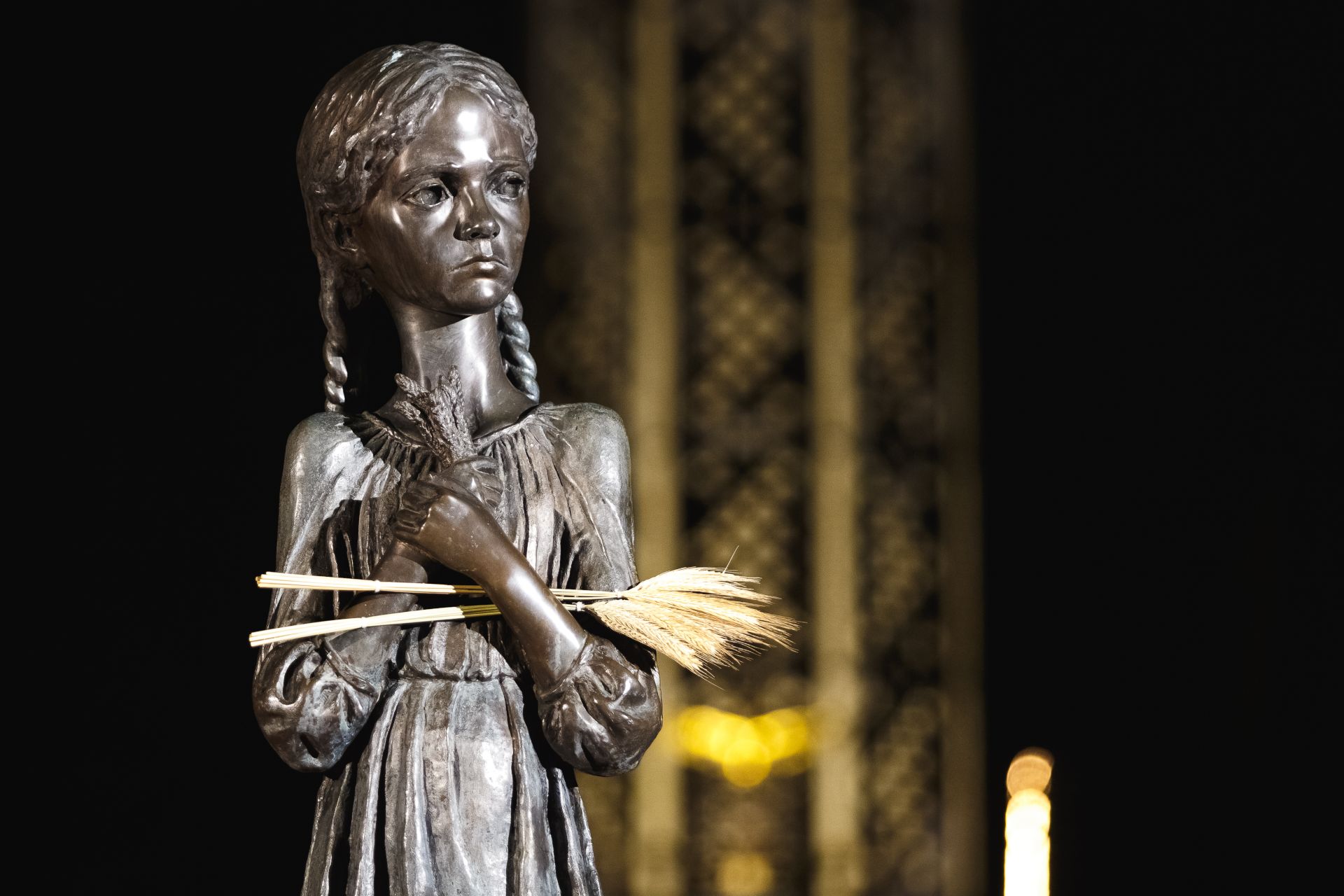
While Hercules writes about several of her female ancestors, including Vera, who was born in Russia before relocating to the Ukrainian city of Mykolaiv via a stint in Uzbekistan, and her mother’s sister, Zhenia, a patriotic schoolteacher, it is her maternal grandmother, Liusia, who is at the heart of the book. Born in Bessarabia (a region now shared between Moldova and Ukraine), her suffering in the Soviet Union was particularly egregious. “Close to 3.5 million people died in Southern Ukraine between Liusia’s birth and the day that she spoke her first proper sentence,” Hercules writes of the terrible drought in the early 1920s. Later, during Stalin’s war on the Ukrainian peasantry, known in Ukraine as the Holodomor, the 9-year-old Liusia, along with her six siblings and mother, was packed onto a cattle train and shipped to northern Russia, where she survived by begging. Shortly after the end of World War II, her husband, Viktor, was jailed for eight years for stealing food, leaving Liusia to survive another famine on her own — this time with four children to support as well.
Initially, Hercules was puzzled as to why there were formal family photographs of Liusia and the kids from this period. But her mother told her Liusia arranged them because she believed she might die, and she wanted her children to have something by which to remember her.
Liusia’s story, though, is not simply one of survival: It is life-affirming. And this affirmation is expressed by Hercules through food, a passion for which links women of different generations in the family and culminates in her own successful career as a chef. Perhaps surprisingly, Hercules does not reflect on how Liusia’s experience of starvation colored her attitude toward cooking. It seems inevitable that there were scars. But, for Hercules, a love of food is something innate to the Ukrainian national character that has endured for centuries. This love is a primordial characteristic, not just a response to Moscow-inflicted starvation. “A vegetable patch and an orchard are burnt into our country’s DNA,” Hercules writes.
Ultimately, Hercules conjures Liusia’s story into a symbol of Ukrainian life triumphing over death — specifically, Russian death. It’s a story, she says, that helped her process the cruelty unleashed in 2022. But she also wants it to be a lodestar for her family, and for Ukraine. While Liusia was unique, Hercules writes, she was “also like millions of other Ukrainian women of her generation: with straight backs and reverence for life.”
Retaining ties to the places where their ancestors were born, lived and died means Ypi, Hercules and Ioffe are all able to weave the personal and political together to particularly vivid effect — whether that’s the redemptive nationalism of “Strong Roots,” the questioning in “Indignity” of the very viability of evoking past lives, or “Motherland’s” mission to serve as an antidote to male-dominated histories. Leman Ypi used to tell her granddaughter that “what matters is not what we remember, but how.” By taking women who were at the center of their respective families and putting them at the center of a story of the 20th century, these writers are ensuring that form is also the message.
Become a member today to receive access to all our paywalled essays and the best of New Lines delivered to your inbox through our newsletters.