


In a scene late in “Palestine 36,” writer-director Annemarie Jacir’s powerful and moving film about the Great Arab Revolt of 1936-39, the driver of a bus filled with prisoners from the Palestinian-Arab village of al-Bassa is ordered to drive out of town. Yet, a few frames earlier, we watched as British mandatory soldiers planted a mine in the same road. Would the British really dispatch a bus to a road that’s been mined?
Yes, they would, as we discover seconds later when the bus detonates the mine, killing many of its passengers, who had been arrested en masse after arms were found in the village.
As shocking and startling as that scene was, such an atrocity really occurred, in September 1938, in a village of that name. That’s something I learned reading Oren Kessler’s 2023 book, “Palestine 1936: The Great Revolt and the Roots of the Middle East Conflict.” Kessler adds that when the officer (and later field marshal) Bernard “Monty” Montgomery, who soon after the incident assumed command of the British 8th Infantry Division in Palestine, heard about the atrocity, he suggested to a subordinate that the troops might “just go a wee bit easier in the future.”
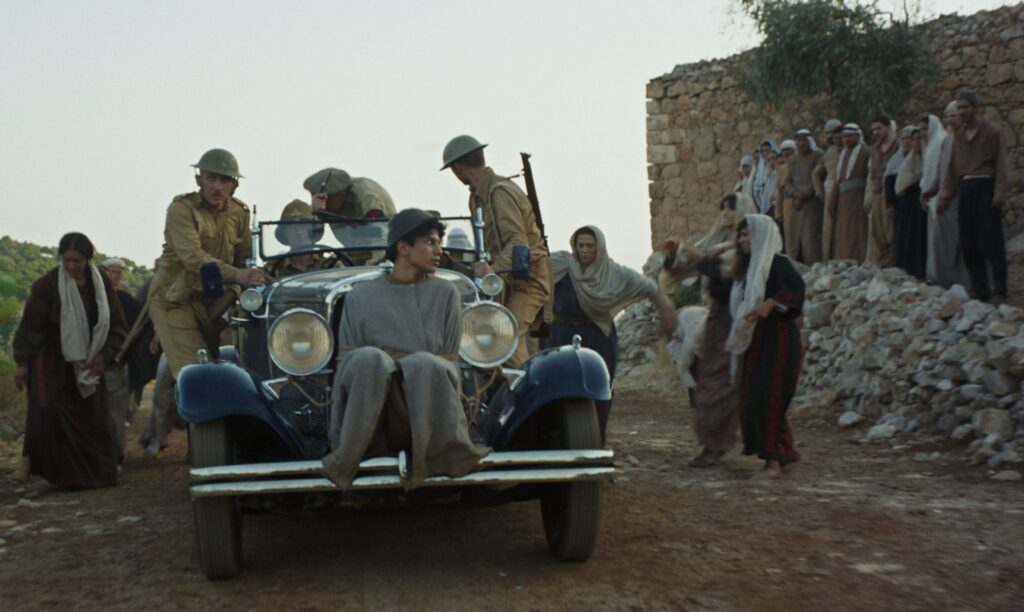
Jacir’s film, an international co-production shot in Arabic and English in Jerusalem, the West Bank and Jordan (where it was forced to move filming after the start of the Gaza war in October 2023), depicts several other unnerving war crimes. These include the tying of a young Palestinian to the grille of a British police vehicle, presumably to serve as a human shield (or perhaps just to humiliate him). That, too, was an actual British practice in Palestine.
Further evidence of the lengths to which Jacir went to ensure the historical accuracy of her film comes in an early scene in which British High Commissioner Arthur Wauchope, played to great effect by Jeremy Irons, inaugurates the new Palestine Broadcasting Service at a ceremony in Ramallah. His speech is both optimistic and condescending, and, I learned later, excerpts the actual remarks made by Wauchope on that occasion. The station’s programming would be devoted not to politics, he said, but to “the spread of knowledge and culture,” with members of each community free to remain “true to his own tradition.” That was in March 1936, just weeks before the outbreak of the uprising.
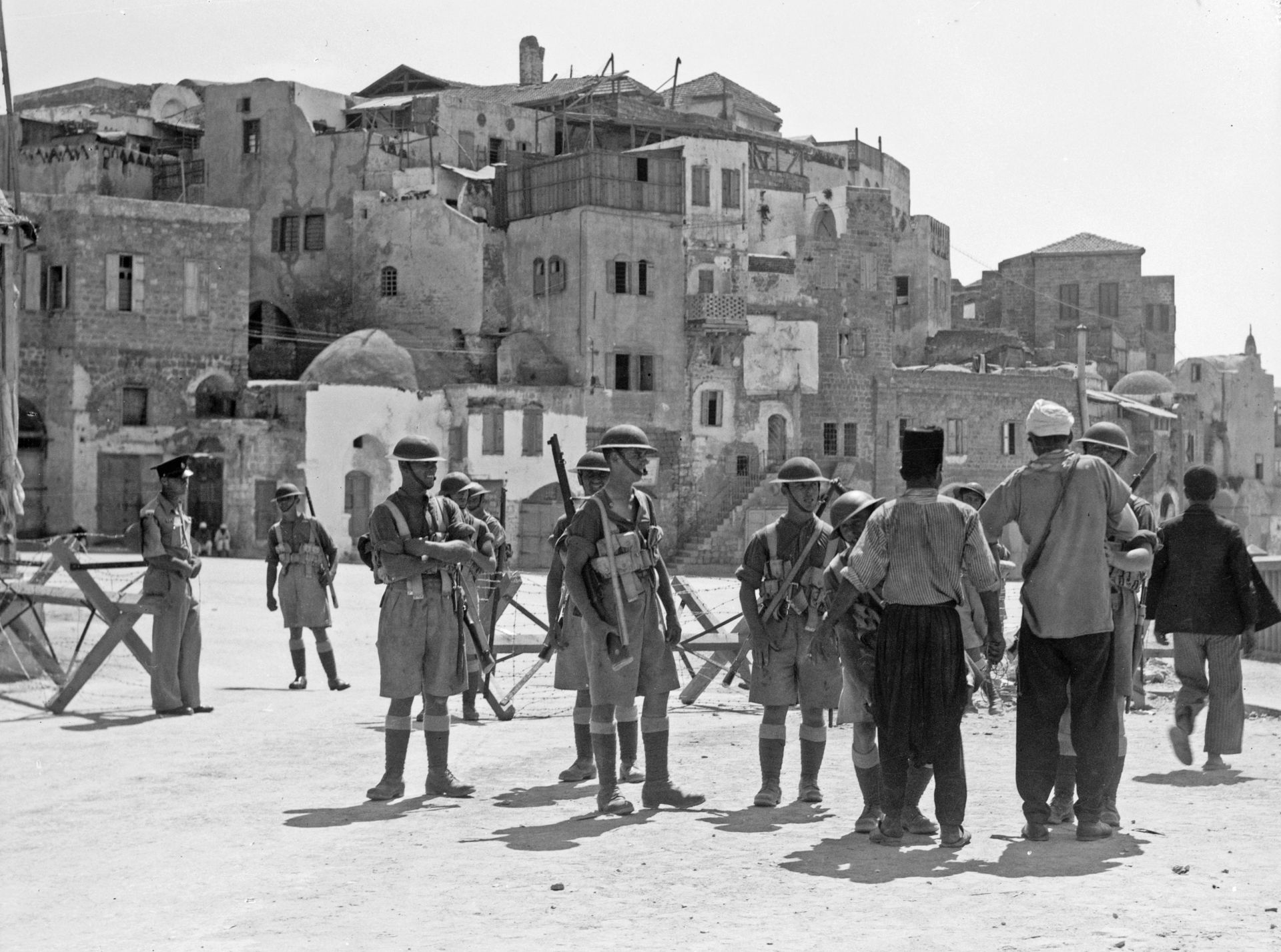
If the Great Arab Revolt sounds only vaguely familiar, you’re in good company. Unlike a war with a clear beginning and end, the revolt was a chain of separate but intertwined events that began with a paroxysm of intercommunal violence in mandatory Palestine in April 1936, and was overtaken by the start of World War II a little over three years later. The principal motivation for the revolt, however, was Arab fury and frustration with the British over the rising level of Jewish immigration, and most of the violence was between Arabs and the British.
The initial acts of violence were followed by a national general strike. It was neither the first nor the last such strike, but it was unprecedented in that it continued for six months. And even if it’s largely overlooked in histories of the Israel-Palestine conflict, the revolt marked a seminal period. In Zionist history, the revolt is part of a continuum of immigration, settlement and growth in military capacity, from which the movement emerged far better prepared for statehood than it had been a few years earlier. For the Arabs, it was an important stage in the emergence of a Palestinian national identity, while at the same time, it also constituted a “self-inflicted wound that weakened Palestinian ability to cope with future challenges,” in the words of Palestinian-Israeli historian Mustafa Kabha. For the British overlords of the colony, the revolt elicited a zigzag series of responses, reflecting the United Kingdom’s ambivalence and inconsistency about its role in Palestine. Seen, however, in the context of the shrunken empire with which the U.K. emerged from the postwar period, its eventual withdrawal from Palestine can also be presented as an enlightened chapter in the history of decolonization.
Following the Allied victory in World War I and the collapse of the Ottoman Empire that had ruled Palestine for four centuries, the newly formed League of Nations assigned a “mandate” to govern the country to the U.K. By then, however, Britain had already promised both Jews and Arabs, separately, that Palestine would ultimately be theirs. In the case of the Jews, it was in the Balfour Declaration, in 1917, that the British foreign minister expressed his country’s support for “the establishment in Palestine of a national home for the Jewish people,” though no timetable was specified.
Less explicit and, according to the British, misinterpreted, was another promise made during the Great War, by the high commissioner in Egypt, Henry McMahon, to Hussein ibn Ali, the sharif of Mecca, that following the war, and contingent on their fighting with the Allies during the war, the Arab people would be granted independence. The British long argued that the territory in question did not include Palestine, but this remains a subject of debate to the present day.
When the British Mandate took effect, there were no quotas governing Jewish immigration to Palestine, and over the next decade, the number of Jews who arrived, most of them in flight from rising antisemitism in Europe, reached about 120,000. With the rise of Hitler in Europe in the 1930s, however, a stream of immigrants turned into a torrent, so that by 1935, there were nearly 400,000 Jews in the country, constituting about 30% of the population.
And it wasn’t just immigration numbers that alarmed the Palestinian population. As Kessler lays out in his book, land sales to Jews (legal but often serving to render unemployed the Palestinian fellahin who worked the farmland for absentee landowners) doubled between 1933 and 1935, in both number and acreage, and “the country’s Jewish-dominated banking, industrial, and construction sectors flourished even as much of the world remained sunk in depression.”
In a recent interview with BBC radio, Jacir spoke with pride of the role initially played by Palestinians in welcoming Jews, explaining that “Palestine has always been a place of safety” and that it was “a very mixed, multicultural, multireligious place.” The problems began, she said, “when it became a project to get rid of the Palestinians — to transfer the Palestinians elsewhere — then it became something else.”
“Palestine 36,” the film, acknowledges the situation facing Europe’s Jews by means of archival footage of refugees disembarking at Jaffa port in the 1930s, with the original narration explaining that they have fled a Germany where Jews are no longer safe. (This is just one example of the film’s elegant use of scenes from contemporary newsreels and other film clips, cleaned up and colorized.)
Jacir accomplishes a difficult dramatic feat in presenting the major events and developments of the revolt’s first years by way of a handful of central fictional characters, each of them representing another population group with a role in the revolt, but without the movie coming off as overly contrived or didactic. Mythical is more like it, with breathtaking cinematography, scenes divided by slides announcing poetic titles like “Rebellion begins with breath” and “Palestine is not for sale,” and each of the main characters confronted by a fateful situation that forces them to decide just whose side they are on.
The strike and subsequent actions not only pitted the Arabs against the British, but also divided urban Arabs from rural ones, and landowners from fellahin, with little central coordination between them.
If British policy and Jewish immigration supplied the background to the revolt, it was accelerated by a feedback loop of accelerating violence by the most radical players among both Arabs and Jews, and the increasingly harsh responses of the British. “Palestine 36” barely mentions Hajj Amin al-Husseini, however, the senior Muslim religious leader in the country, who almost immediately assumed leadership of the revolt, and held on to it even after going into exile in Lebanon, mainly by virtue of his willingness to use violence against anyone who challenged his authority.
Throughout the revolt, and really throughout his life — he died in 1974 — al-Husseini, a rabid antisemite who collaborated with Hitler and the Nazis during World War II, remained uncompromising: He saw no place for the Jews in Palestine, even during the Holocaust, and made the strategic error of not playing nice with the British in order to bring them over to his side. Even when the British superseded the Peel Commission’s recommendation to partition the land with the White Paper of 1939, which froze the idea of partition and greatly limited Jewish immigration, al-Husseini still said no. This despite the fact that the White Paper was endorsed by “nine out of 10” Arabs, writes Kessler, quoting an Arabic newspaper editor of the time. The Palestinians continue to pay a price for his recalcitrance to this day.
Also mentioned only in passing is Izz al-Din al-Qassam, a militant preacher from Syria who, long after he was killed in battle by British police in 1935, maintained legendary status for his willingness to challenge the British and the Zionists in the name of Islam. At the time, Zionist leader David Ben-Gurion described al-Qassam’s death as “a watershed moment in the development of Arab consciousness.” (The military wing of Hamas today bears his name.)
Members of the Irgun militia, who were followers of the Revisionist leader Ze’ev Jabotinsky and the ideological predecessors of Israel’s Likud Party, which is today led by Prime Minister Benjamin Netanyahu, played a similar role on the Jewish side. They carried out murderous attacks on both innocent Palestinians and against British officials and soldiers.
In contrast, both Ben-Gurion and Chaim Weizmann, the latter of whom represented the Zionist cause vis-a-vis world leaders, were politically agile and effective in courting British support. They, too, are absent from the film.
A British Royal Delegation, informally called the Peel Commission because it was headed by Lord William Peel, arrived in Palestine with the task of investigating the causes of the political unrest. It released its findings in July 1937. Characterizing the conflict as “irrepressible,” the commission, as noted, recommended partitioning the land between Arabs and Jews. It proposed a demarcation that would leave most of the Jews where they were, but would require the transfer of the Arabs of Galilee to the territory designated for them. Although al-Husseini agreed to call off the general strike while the Peel Commission did its work, it resumed after the commission’s disastrous call for the partition of Palestine. And the intercommunal violence only worsened.
From Kessler’s book, we learn that Ben-Gurion always played the long game. He accepted the Peel Commission’s recommendations, despite the limits they would have placed on immigration at a time when hundreds of thousands of Jews were scrambling desperately to escape Europe, even as most of the world’s states had closed their doors. He also held fast to a policy of “havlagah,” the Hebrew word for “restraint,” in employing armed action, even as the Jewish community in Palestine was steadily building up its military capacity.
Ben-Gurion wrote in his diary of his conviction that, “This is not a final agreement,” explaining that he saw in the Peel plan “an almost decisive phase in the beginning of complete redemption, and an unrivaled lever for the gradual conquest of all of the Land of Israel.”
Though nearly every event in “Palestine 36” has a basis in the historical record, the main characters, as noted, are fictional, representing different Palestinian positions. On the one hand, there is Khaled (played by Saleh Bakri), a stevedore in Jaffa Port who witnesses how Jews are smuggling arms into the country in cement barrels. He is alarmed by what he sees, but is reluctant to take up arms for the Arab cause. Only when his British bosses cheat him out of overtime pay, and have him beaten when he complains, does Khaled join the revolt. The next time we see him, Khaled is part of a mounted force that holds up a passenger train. Khaled boards and politely requests of passengers, many of them also Palestinians, to turn over any cash or valuables they are carrying.
Khaled is followed into the ranks of the rebels by the fresh-faced Yusuf (Karim Daoud Anaya, in his screen debut), an innocent not much older than 20 who commutes from his home in the village of al-Bassa to Jerusalem, where he works for the newspaper editor Amir (Dhafer L’Abidine). Amir cares more about the good life than the national cause. Though he is willing to publish nationalist columns by his firebrand wife, Khuloud, as long as she uses a male pseudonym, he also takes payment from the Zionists for publishing columns for them; these appear under an Arabic byline.
Yusuf’s bewilderment over all that he witnesses in the two worlds he inhabits turns to angry resolve after his own father is shot dead gratuitously by Jews from the kibbutz that is under construction next door to his village, and which is encroaching on its land. That tragedy is followed by an act of collective punishment in the village by the British occupiers, who choose this moment to show up in search of “armed bandits.” Soon after, Yusuf joins Khaled in fighting the British.
In the history books, the Great Arab Revolt went on until the outbreak of World War II in September 1939. By that time, the British and the Zionists were concerned with preventing the Axis forces from overrunning Palestine, and so, to a lesser extent, were the Arabs. Everything else took a back seat to the goal of defending against the Germans and their allies.
The action of “Palestine 36” ends two years before World War II erupted, with a quasi-apocalyptic scene in which the village of al-Bassa is destroyed by the British (a historical event), and one surviving girl from the village makes her way, barefoot, to Jerusalem.
Perhaps in contemporary terms, a Palestinian girl surviving the destruction is a hopeful note. But in learning about the revolt, in particular by way of Kessler’s book, I could only be struck by the ability of the most extreme players to hijack any possibility for peaceful resolution of admittedly difficult conflicts. That has not changed, and that is not a cause for hope.
Become a member today to receive access to all our paywalled essays and the best of New Lines delivered to your inbox through our newsletters.