


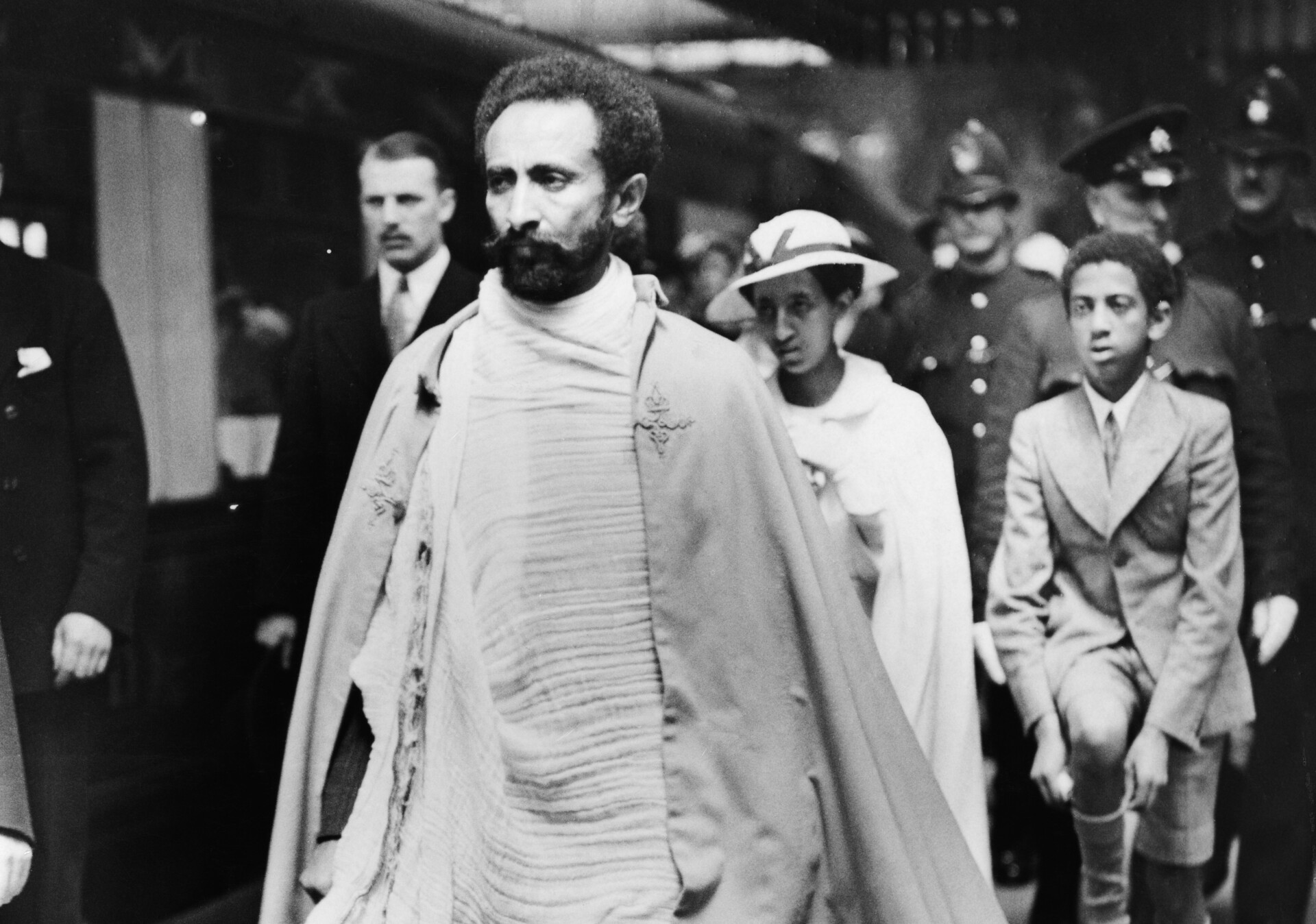
“As we were looking out through the windows straight across, the countryside reminded us of the hills of Harar,” the former Ethiopian Emperor Haile Selassie wistfully recalled in his memoir, “My Life and Ethiopia’s Progress.”
But the emperor wasn’t writing these homesick sentences from anywhere near the hills of Harar; rather, he was in the genteel city of Bath, England, where he was exiled between 1936 and 1940. The city in southwestern England, known for its Roman baths and medieval abbey, gave refuge to the emperor after Italy, under Benito Mussolini, invaded Ethiopia. He lived in Fairfield House, on the town’s western outskirts, and the period he spent there proved to be transformative for his political program.
Although well documented in various photograph and newspaper archives, Haile Selassie’s exile in Bath is not well known to the modern public. Fairfield House is not included among Visit Bath’s list of historic sites, nor does it feature on Time Out or The New York Times’ lists of places to visit in the city. (There was a subtle irony in Haile Selassie fleeing the Italian occupation and ending up in Bath, which was formerly a Roman city, and living in Fairfield House, an Italianate villa.) “A lot of biographies of the emperor … only give a small amount of space to the exile as if it was an insignificant period, but I would argue it had a massive impact on him,” Keith Bowers, author of “Imperial Exile” — the first and only intensive study of Haile Selassie’s time in England — told me.
Indeed, despite spending profligately and consequently facing financial difficulties that led to a dependence on the British government and private donors for funding, the emperor accomplished a great deal during his exile in Bath. He rallied British organizations to back the Ethiopian cause and sought financial aid for those who had fled before Italy’s advances to Palestine, British Somaliland and other British colonies. In addition, he befriended British campaigners, including the prominent women’s rights activist Sylvia Pankhurst, who championed his cause, committing to such an extent that she eventually moved permanently to Ethiopia.
In the summer of 1936, Haile Selassie gave a powerful, symbolic speech at the League of Nations condemning Italian aggression and asking European nations for their support. He made waves among activist groups in Britain and many student groups embraced the emperor: He was conferred honorary life membership by the Cambridge Union, the world’s oldest continuously running debating society, and a group of students at the University of Edinburgh nominated him as rector. It was an active time for Haile Selassie, during which he built and developed a strong network of support and used his platform. Far from being a break in a quiet English town, these few years in exile were vital to his cause.
Just as Haile Selassie’s time in England is often relegated to the margins in his life story, military action in East Africa is a similarly overlooked part of World War II. When Mussolini became Italian prime minister in 1922, he was determined to colonize Ethiopia to expand his country’s empire and regain its prestige after Ethiopia had defeated Italy in the 1896 Battle of Adwa, preventing its colonization. But historians devote more attention to the war’s European and Japanese fronts, rather than its African one, to the detriment of understanding both Mussolini’s colonial project in Africa and Ethiopia’s resistance.
It was a tricky moment for Britain diplomatically. The Italian Ambassador Dino Grandi warned that any British governmental skepticism of Italy’s claim to Ethiopia “would have an exceedingly bad effect in Rome.” This included any recognition of Haile Selassie’s title as the country’s emperor, a claim that Italy rejected. Nevertheless, Britain offered him asylum.
Haile Selassie, who had traveled to Europe in 1924 as Ethiopia’s prince regent, was already famous in the West. “The press covered him a lot, the national press, the regional press, which was very well read in those days,” Bowers, a former BBC producer, told me. The emperor was seen as a reformer, modernizing Ethiopia by developing its education, financial and military sectors, and the country was admitted to the League of Nations in 1923. His coronation as emperor in 1930 was the subject of significant Western press coverage, and European and North American representatives attended the event. But most significantly, his resistance to Italian occupation symbolized a non-Western nation standing up to the injustices of Western colonialism, garnering global attention as Europe was catapulted into war. When he fled from the Italians occupying his country, it was a British warship that rescued him, underscoring his existing influence even before he set foot on English shores.
Perhaps because of Italy’s warning to Britain, or perhaps simply because he was so famous, Haile Selassie was officially classified as an “incognito” visitor by the British authorities to minimize public scrutiny around his exile, according to the economic historian Lutz Haber, who wrote an article for Bath History on the emperor’s time in the city. But the world already knew of his plans: On June 3, 1936, before settling in Bath, the emperor arrived at London’s Waterloo Station to jubilant fanfare. “Outside the station, there was a wild rush by Londoners to catch the first glimpse of the monarch who has been front-page news for nearly a year,” said a Reuters newsreel documenting the event.
Later in the same month that he arrived in England, Haile Selassie was already on the move, with similarly exuberant attention from crowds. “This is a journey of hope,” Haile Selassie told them, as he left to give a speech at the League of Nations in Geneva, where he was also greeted by cheering crowds of Europeans. Yet his hope was for naught: Despite the Emperor’s passionate address on June 30, 1936 — still referred to as his “greatest hour” — when he rebuked Italy for its use of chemical weapons and condemned the league for failing to intervene, the league neglected to act. In the words of Paul Henze, author of “Layers of Time: A History of Ethiopia,” the speech won Haile Selassie “applause from the assembly and worldwide sympathy, but not much else.” The very next month, the league overturned its sanctions against Italy and all but one of its member nations recognized Italy’s claim to Ethiopia.
This setback didn’t stop the emperor’s advocacy for his country. He returned to England to continue his political organizing, settling in Bath. “From London one reached the world,” the emperor declared in one of the unfinished chapters meant for his memoir.
Britain was indeed strategically positioned. France and Switzerland were too close to Italy: An exile in either country could cause problems between neighbors, especially for Switzerland, which maintained a policy of neutrality in the years leading up to World War II. In addition, the U.K. “had the power, military power, and strategic position in order to potentially liberate Ethiopia,” said Ras Benji, an independent researcher who focuses on Haile Selassie’s imperial rule and exile and is the operations manager of Fairfield House. “It could have been quite a swift job if the British put their full mind to that cause, but at that time, they were appeasing Mussolini.”
But if London was Britain’s political nexus, why was Bath the location the emperor chose for his exile? “The main reason he chose Bath,” Ras Benji said, “was the hot springs, because the Roman baths in those days and the mineral hospital nearby were known for treating all sorts of ailments,” including the burns the emperor suffered from Italian use of chemical weapons, in particular the substance known as mustard (dichlorethyl sulphide). According to a Bath Chronicle reporter in 1936, “Bath was the only place in the United Kingdom where the monarch had felt really well.”
The surrounding quiet in Bath also offered the emperor refuge. He lived a seemingly domestic life. Although he made several public appearances in Bath, attending a garden party in Englishcombe and the Bath Dog Show, as well as visiting the Post Office Exhibition, “we did not go to the theatre or places of entertainment,” he reflected in his memoir. “Our only time of relaxation was when occasionally we conversed with our children,” who, along with his wife, joined the emperor in exile. “In the evenings we were engaged in reading books until midnight and in writing the history of our past life.” Between praying, reading and championing his cause, the emperor was known to sleep for only five hours a night, falling asleep at midnight and waking up with the lark at 5 a.m., according to Ras Benji.
Yet despite this apparently quiet life, Haile Selassie’s troubles were mounting, thanks to his “extravagant spending,” combined with purchasing Fairfield House and losing some of his assets, per Quentin Holbert, a scholar of African imperial history who wrote a dissertation on the emperor’s relationship to Britain and contributed a chapter to the recently published book, “The Second World War in East Africa, 1940-1941.” In 2005, interwar files from the Foreign Office were released detailing Haile Selassie’s financial affairs, a full 65 years after the emperor left England, shedding light on his exile. They revealed that the Foreign Office was reluctant to fund him because it would sour Anglo-Italian relations just as the British were trying to drive a wedge between Fascist Italy and Nazi Germany.
Government officials’ reactions to the emperor ran the gamut from hesitant to supportive. Foreign Secretary Anthony Eden, who would go on to become the country’s prime minister two decades later, before resigning in the wake of the 1956 Suez Crisis, was “regarded in England and indeed throughout the world as the champion of the League of Nations, and the most valiant friend of Ethiopia,” Haile Selassie wrote in a draft chapter of his autobiography. Eden’s private secretary greeted the emperor at Waterloo Station and Eden visited him in London on his third day in the city.
Despite Eden’s sympathy, the emperor was met with mixed feelings from other British officials. Then-Prime Minister Stanley Baldwin, according to Bowers, is said to have ducked under a table when he saw the emperor on a tour of the Palace of Westminster, evidently embarrassed over being associated with Haile Selassie while Britain was trying to appease Mussolini. The emperor also wrote that Baldwin was “notoriously uninterested in foreign affairs.” Neville Chamberlain, who would succeed Baldwin as premier but was then chancellor of the exchequer, delivered a speech arguing against sanctioning Italy even before the emperor gave his own appeal to the League of Nations, asking for more direct support.
“We should do nothing which could arouse Italian suspicions or be construed as provocative,” said Chamberlain, who became prime minister in 1937. His successor as chancellor, John Simon, shut down Eden’s suggestion that the Secret Intelligence Service covertly offer a financial grant to the emperor, fearing it would embarrass the government if discovered.
Instead, private organizations came to Haile Selassie’s aid. The Abyssinia Association and British Red Cross donated to the emperor and his family to “lighten the heavy responsibility which falls upon Him in administering the many [Ethiopian] officials and Exiles.” The emperor was grateful, although he confessed in his memoir that “the available assistance could not offer succour to our violated country.”
In the end, a private philanthropist, later revealed to be William Cox, came forward and offered him 10,000 pounds — worth over 800,000 pounds ($1.1 million) today, enough to ensure the emperor was “adequately provided for for the next five years,” according to the Foreign Office. The payment “depended on the Emperor discouraging any public appeal on his behalf, particularly one such as that envisaged by the Abyssinian Association, which would cause the British government considerable discomfort,” according to Graham Macklin, a researcher at the University of Oslo and expert on the history of British intelligence. After originally rejecting the offer, the emperor eventually accepted it, writing, “It is difficult for us adequately to express our feelings of respect and gratitude towards one who in wishing to remain unknown joins to his generosity a rare disinterestedness.”
But confusion abounded among government officials when the Abyssinian Association continued its appeal for funds for the emperor and his country, and Haile Selassie’s secretary claimed he had never accepted the deal — incensing officials who claimed he was “taking money under false pretences.” Committed to his cause, the emperor refused to remain silent.
Beyond politics, there were also mixed feelings about the emperor. Brig. Maurice Stanley Lush, who became a leader in the British military in Ethiopia, called him “the pawn who thought he was king,” doubting his military prowess while still acknowledging that he helped to unify Ethiopian and British troops. And although remembered as a Pan-Africanist who helped establish the Organization of African Unity, the emperor allegedly snubbed a delegation of Pan-Africanists, including Marcus Garvey, who were present at his welcome at Waterloo Station. Garvey, a Jamaican political activist who advocated the return of those of African descent to Africa, became strongly critical of Haile Selassie, calling him “at best … but a slave master.”
While in England, Haile Selassie also developed a friendship with Pankhurst, the renowned women’s rights activist and daughter of Emmeline Pankhurst, the suffragette who helped women win the right to vote in Britain. The younger Pankhurst was present with her son Richard at Waterloo Station for the emperor’s arrival. Although opposed to monarchy in principle, Pankhurst empathized with Haile Selassie and despised fascism, passionately espousing the Ethiopian cause. Later named an “honorary Ethiopian” by the emperor, she raised money to build Ethiopia’s first teaching hospital and founded the New Times and Ethiopia News to publicize Ethiopian struggles in the wake of the Italian occupation.
Ultimately, the Pankhursts moved to the quiet western outskirts of Addis Ababa — paralleling, albeit unintentionally, Haile Selassie settling in the similarly peaceful western outskirts of Bath during his exile. They devoted their life to the Ethiopian cause — Richard Pankhurst, Sylvia’s son, helped found the Institute of Ethiopian Studies and wrote extensively about Ethiopia, his mother and Haile Selassie. This fiercely English family of suffragettes and activists made a second home in Ethiopia, underscoring the emperor’s influence on their lives.
While in exile, the emperor also fundraised for Ethiopian refugees in Palestine and other British colonies, dedicating his after-lunch talks with his visitors in Bath to discussing “the fate of supporters in [Ethiopia] and the refugees in Kenya, Sudan and Palestine,” whom he assisted with payments. “The Abyssinian Refugees Relief Fund … raised substantial sums for distribution in Africa,” writes the historian Lutz Haber, adding that “the [Abyssinian] Association managed the Emperor of Ethiopia’s Fund which supported exiles in Palestine when Haile Selassie was no longer able to do so.”
The emperor eventually left England in 1940 for Sudan, where he crossed the border into Ethiopia and fought the Italians with both Ethiopian and British forces (the latter made up largely of African troops, including Sudanese, South African and other contingents), emerging victorious. The Italians left Ethiopia in 1941. The emperor reclaimed his title.
His financial struggles notwithstanding, the emperor refused to be silenced by money from the government and private donors. He continued to pursue his cause, even as he risked poverty and the ire of British officials.
In spite of the British government’s exhortations to Haile Selassie to keep a low profile, the emperor used his time in England to build a platform. Eventually, his plans succeeded: Ethiopia was indeed liberated from Italian occupation and Haile Selassie returned home. This period in the emperor’s life may be relegated to a footnote in the history books, but this mistakenly diminishes his quiet — but formative and productive — few years in Bath.
Sign up to our mailing list to receive our stories in your inbox.