


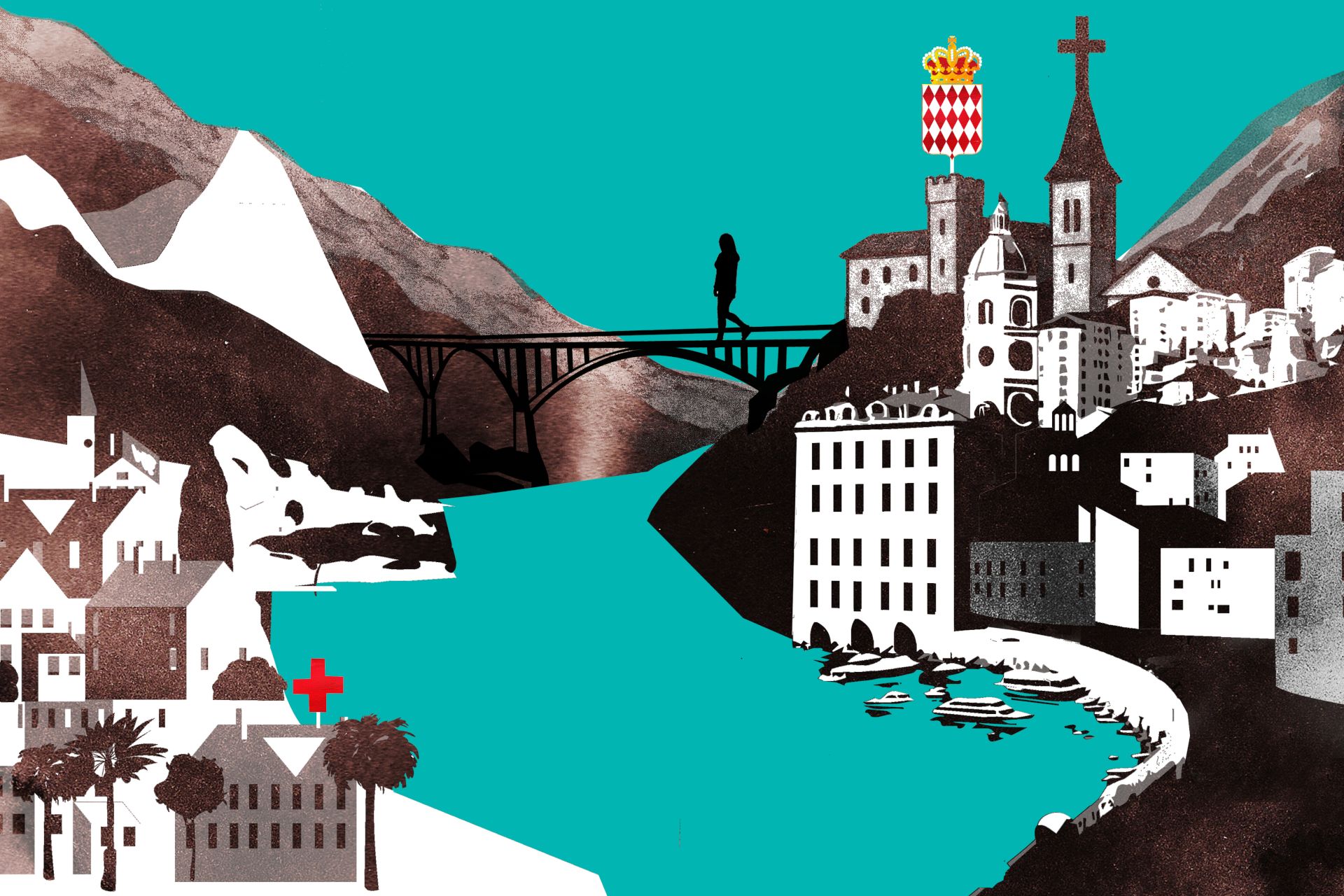
The news broke quietly, almost casually, on a November morning in the familiar columns of the daily newspaper Monaco-Matin. Between stories on traffic snarls and the ever-impressive celebrations of Monaco’s annual National Day, Prince Albert II of Monaco announced his decision to keep abortion illegal.
“I feel that the current framework respects who we are with regard to the place that the Catholic religion occupies in our country, while ensuring safe and humane support,” the prince said in a statement. His announcement was something of a surprise. Albert II had spent six months deliberating over the long-debated measure that would have legalized abortion in the principality, draft bill no. 267. He had now asked his government “to inform the National Council that its proposed law would not be acted upon.”
The unadorned sentence landed with the force of a closing door. It was the kind of statement Monaco prefers — polished, calm, delivered without spectacle — but its implications were anything but trivial. In a country where an overwhelming 80% of voters support the legalization of abortion, the prince’s veto did more than halt a bill: It pitted women’s rights against the country’s 1962 constitution, which enshrines Catholicism as the state religion and anchors the monarchy’s legitimacy within the church.
And so Monaco’s abortion limbo endures. Monegasque women, if they have the cash, may cross into neighboring France to obtain an abortion, as they have for decades, but within the borders of their own city-state, the procedure will remain out of reach — prohibited not by medicine, lawmakers or public opinion, but by the monarchy’s religious architecture.
What the announcement revealed, before anything else, was who would carry the burden of this tension: women. They are the ones whose access to care depends on leaving their own country to obtain a procedure their neighbors consider a fundamental right, whose right to make decisions about their own bodies remains subordinate to an immovable political identity shaped six long decades ago.
The ongoing standoff around abortion rights in Monaco is anchored in the very structure of the principality’s 1962 constitution and the monarchy it upholds. Article 9 of the Monegasque Constitution states, simply and unequivocally, that the Catholic, apostolic and Roman religion is the state religion. This clause is not a mere cultural vestige; it is part of the monarchy’s foundational contract, and adherence to it has allowed the Grimaldis to become, over 700 years, Europe’s longest-ruling royal family. “In breaking with the Vatican on issues like abortion,” French historian Jérôme Tourbeaux told New Lines, “the prince might lose his legitimacy, and risk upending the entire constitution.”
The researcher, author of the book “European Microstates and the Test of Modernity,” went on to explain that most Monegasques, including those who rarely step inside a church, regard Catholicism as the guarantor of the prince’s legitimacy. Such is the beloved Monegasque “specificity,” cited again and again in legislative disputes: Religion underwrites the throne; the throne underwrites stability; stability underwrites the entire socioeconomic model that distributes privileges to Monegasques — subsidized housing, protective labor laws, priority in employment.
This is also where fear enters the picture. Out of the 12 activists, historians, legislators and health care providers interviewed for this piece, five, who spoke on condition of anonymity, described Monaco as a “dictatorship,” a word they delivered in hushed tones, followed by long pauses. Several said they feared repercussions — losing subsidized housing, their jobs, their children’s jobs or the delicate protections the system provides — if they were to make this claim publicly. Two pushed back gently, explaining that the prince remains extremely popular and well-loved by his subjects: “It’s no Iran,” they both added, almost word for word. “But you learn not to say certain things.”
Less than a square mile, half the size of Manhattan’s Central Park, with a population just over 38,000, Monaco operates under a hereditary constitutional monarchy. Not bound by European Union treaties, legislative power is exercised by both the 67-year-old prince and the 24-member democratically elected National Council. Monaco’s prince is the sole European monarch to truly govern his state, while the others (from the king of the United Kingdom to the co-princes of Andorra, to the sovereigns of Belgium, Norway, Sweden, Denmark, the Netherlands, Spain and Luxembourg) have a largely moral and symbolic function. In the principality, the National Council can propose laws, but their enforceability still hinges on Albert II’s signature, or lack thereof.
This fusion of religious and political legitimacy means that any perceived challenge to Catholic doctrine in Monegasque law becomes a challenge to the state itself. Abortion, more than any other issue, sits at the center of that tension.
Monaco’s penal code of 1967 once imposed some of the harshest abortion laws in Europe. Doctors faced up to 10 years in prison for performing the procedure; women risked imprisonment and fines for procuring it. Prison sentences were handed out, and for decades, the law held firm, buffered by the intertwined identities of monarchy, religion and social cohesion.
Then, in 2009, came a controlled fracture: After five years of back and forth, Law 1359 permitted medical termination (that is, induced via abortion pill) in narrowly defined “hard cases” — rape, severe fetal abnormalities and/or threats to the pregnant woman’s life or physical health. Because the modern Catholic position states that a medical procedure needed to save the life of the mother but that may result in the death of the “preborn child” as a secondary effect is morally acceptable, the reform passed unanimously in the National Council.
This restrictive legislation on abortion remains the norm, to this day, in four of the Council of Europe’s most conservative states: Poland, Malta, Catalan-speaking Andorra and Liechtenstein.
But the 2009 victory nonetheless sparked outrage within the church, which saw the new legislation as a slippery slope to other social reforms like “abortion on demand” or gay marriage, also deemed incompatible with Monaco’s historic constitution.
Albert’s decision not to veto the 2009 legislation was labeled a “Royal Betrayal” by Catholic organizations at home and abroad. Then-Archbishop of Monaco Bernard Barsi warned: “There is a risk that all of the rest will follow, and the worst is to be feared because they will not stop trying to conform Monaco to the lowest ethical standards.”
A decade later, in 2019, the principality did indeed take another half-step. At the time, Béatrice Fresko-Rolfo was a minority member of Monaco’s unicameral parliament, the National Council, and already presided over its Commission on the Rights of Women, of the Family and of Equality. She was — and still is — a staunch supporter of abortion reform. “My older colleagues had warned me that the 2009 law on abortion had been a hard-won battle,” she told me, “but we knew we couldn’t stop there.”
Though Barsi once again warned members of Monaco’s parliament that decriminalizing abortion “would inevitably communicate the desire to forsake the denominational history of this state,” Fresko-Rolfo and her colleagues in the National Council argued it was the logical next step for women’s rights.
Without decriminalization, she told me, “our female constituents lived with two swords of Damocles swinging over their heads: If they wanted an abortion outside the confines of the 2009 reform, they had to leave the country — and, when they returned, had to live in fear of being found out and prosecuted for having legally obtained an abortion abroad.”
Law 1477 of 2019 aimed to fix this legal hypocrisy: Pregnant Monegasque women could now undergo the procedure abroad without fear of criminal prosecution upon return. The law also allowed Monegasque physicians to point patients across the border: essentially a legal permission to advise, not to act.
To this day, health practitioners on Monegasque soil face between five and 10 years in prison for performing nonemergency abortions. Though most of the gynecologists I contacted for this story declined to comment, instead referring me to the palace’s press office, one physician agreed to answer me on condition of anonymity. “It is a strange role,” they said. “We diagnose a pregnancy, discuss options and then, if they want to end the pregnancy, we send our patient abroad. It feels like abandonment.”
For years, this uneasy arrangement functioned as a kind of tacit bargain, a discreet, almost “don’t ask, don’t tell” equilibrium that allowed Monaco to adhere to its constitutional architecture while quietly relying on neighboring France to absorb and deal with women’s practical realities.
The irony is striking: Monaco avoids culpability by outsourcing the procedure to France, the protective parent-state on which the microstate relies for independence and protection. The woman bears the physical burden, France bears the ethical one and Monaco keeps its hands clean. The ritual is sanitized, hidden, politically convenient.
Monaco is an improbable place for a debate about abortion. The principality is so compact that the phrase “crossing the street” has become shorthand for what women must do if they seek to terminate a pregnancy outside the narrowly defined “hard cases.”
In the second-smallest state in the world (after Vatican City), the expression appears everywhere: in parliamentary hearings, private interviews, social media posts and the hushed complaints of physicians. Here, you can cross the entire country in under 45 minutes. You can cross the street into France in seconds. And yet, for the women seeking abortions, that small step often becomes a chasm.
Monegasque citizen and resident Juliette Rapaire, 30, discovered she was pregnant in 2020, two weeks before Christmas. She knew she was not ready to be a mother. She also knew, because her father Jean-Michel had been fighting for abortion rights since 2013 as an opposition candidate, that she could not get one at home, from her regular gynecologist.
“I typed ‘abortion’ and the name of the closest French city — ‘Nice’ — into Google, and clicked on the first site that appeared,” she said. Knowing that the procedure would not be covered by Monegasque social security, she asked to borrow her parents’ checkbook and “crossed the street” into Nice.
After the procedure, as she began to fill out a check for 580 euros ($670), the doctor told her he would only accept cash. “I couldn’t believe my ears,” Rapaire said. “It became clear to me that this crook was not only overcharging distressed Monegasque women for abortions, but that he was not declaring the procedure, and keeping the cash for himself.”
According to Claire Moracchini, who has worked for the French arm of Planned Parenthood on the Cote d’Azur for 15 years, this is a recurrent issue in the region. “Under French law,” Moracchini said, “uninsured patients cannot be charged more than 350 euros for an abortion — it’s seen as an urgent medical act.” And yet, she says, multiple gynecologists on the border with Monaco have taken advantage of the situation, promoting their sites on search engines so that Monegasque women, assumed to be extremely wealthy, turn to their practices for overly expensive abortions.
“But you shouldn’t believe what you read in People magazine,” Moracchini stressed, “not all Monegasques are bankers or royalty.” Lots of the women crossing the street into France are maids, students and care workers, and cannot afford to, as she put it, “finance these doctors’ greed.”
For years, her Planned Parenthood office on the border with Monaco has been advising Monegasque women — those lucky enough to come across its site — on where to turn for fair and safe abortions. “We assist around 10 each year,” Moracchini told me, “but we hear from patients almost every day after they’ve already been swindled.” To denounce this, she and her colleagues put out an open letter in 2023 addressed to, among others, the Regional Health Agency, the Medical Board and the French Primary Health Insurance Fund. It went unanswered, though the fund did react by sending doctors a reminder of the law. This summer, her office received complaints about two more doctors, and decided to write to them directly, with the Medical Board copied, to remind them once more. Both doctors are awaiting a hearing in the coming months.
After her own abortion, Rapaire came home disenheartened. “That experience, having to take out cash at the ATM in two batches of 300 euros to secure my future, that did it for me,” she said. Her personal experience, which motivated her to run for office alongside her father, helped to push the issue of abortion and these private abuses into public political debate.
On March 8, 2023, International Women’s Day, Rapaire staged a sit-in in central Monaco. A handful of women joined her on the steps of the Ministry of State, holding placards that read “My body, my life, my choices” or “Women’s freedom should not be a compromise.” They gathered in the kind of quiet, orderly demonstration that Monaco tolerates: no megaphones, no chanting, nothing that might trouble the state’s manicured calm. But the image was potent. Cameras clicked, some of them belonging to French reporters.
“I wanted people to see that we exist,” Rapaire said. “People assume Monegasque women don’t face these problems — that everyone owns a yacht, is protected, sheltered. But we don’t live in a bubble; we just live behind a border.”
Rapaire did not win a seat in the National Council. But her policy platform, anchored in the admission that yes, she, a Monegasque woman, had an abortion and was not afraid to say so publicly, marked the beginning of the parliamentary push that would culminate in a draft bill to decriminalize abortion in the principality.
In 2024, after Rapaire’s opponents won the election, they sent out a survey to Monegasque nationals. Among questions on quality of life, housing and schooling, voters were asked a more surprising one: “Are you in favor of a legislative evolution making the voluntary interruption of pregnancy legal in Monaco?” The result startled even seasoned legislators: 80% of respondents supported legalization.
In Monaco, where political life is generally polite, consensus-driven and slow — in 1962, the new constitution granted women the right to vote without a single placard brandished by feminists — such a number signaled the need for action.
On March 8, 2025, two years after Rapaire’s first sit-in, the National Council introduced draft bill no. 267. Fresko-Rolfo was its first signatory. The proposed reform would authorize voluntary termination of pregnancy up to 12 weeks and extend the limit to 16 weeks for victims of rape. It would mandate a three-day reflection period, to “make sure that the decision is carefully considered” and ensure the procedure, performed by licensed practitioners within designated medical facilities in Monaco, would be covered by social security. It was radically simple in any other European context, but quietly revolutionary in the principality.
“People imagine Monaco as conservative,” Tourbeaux, the historian of microstates, explained. “And it is — institutionally. But socially? Culturally? Monegasques live under France’s protection, in Italy’s orbit, in Europe’s present. The society is more modern than the constitution that shapes it.”
In early committee meetings, legislators debated the language with clinical precision. “It was essential that the text be medically grounded,” Fresko-Rolfo recalled. “We wanted it to be undeniable: This was not an attack on religion, or the constitution, but a recognition of women’s health.”
Of course, the reaction of the church was swift. Archbishop Dominique-Marie David released a pastoral letter warning that legalization would represent “a point of no return.” He argued that, without Catholicism, Monaco would lose its “DNA.”
As the bill moved through committee stages, Monaco’s Catholic hierarchy intensified its efforts. Letters circulated among parishioners. Priests delivered homilies warning that the law would “weaken the spiritual foundations of the state.” A small number of citizens were moved to write op-eds and social media posts urging lawmakers not to sacrifice the principality’s identity under Article 9 for the benefit of “imported ideologies.”
Elected officials countered by invoking another constitutional clause, Article 23, which guarantees freedom of conscience. They consulted constitutional scholars, who concluded that legalizing abortion was entirely compatible with the constitution. The church, they argued, governed the spiritual sphere while lawmakers governed the civil sphere.
Last May, the draft bill passed overwhelmingly, with 19 votes in favor and only two opposed. But the ultimate decision did not lie with the council. For the next six months, draft bill no. 267 would be in the hands of the prince and his government — to approve it, amend it or veto it as they pleased.
In mid-November, Minister of State Christophe Mirmand (a French senior civil servant on loan to Monaco) informed the National Council president that the government would not transform draft bill no. 267 into law. Days later, Albert publicly confirmed that he had made the decision himself. He acknowledged the sensitivity of the issue — saying in his Monaco-Matin interview, “I understand how sensitive this subject is, the emotion it can bring up” — but argued that the 2009 and 2019 frameworks already struck the right balance and “respected” Monaco’s fundamental identity.
As a counterpart to his veto, the prince’s government promised a sexual health roadmap: information and education relating to sexuality and maternity, including anonymous and free gynecological consultations for young women up to the age of 21 — similar to what France has offered since the 1970s.
Thomas Brezzo, the president of the National Council, whose grandmother died from a failed abortion, did not hide his disappointment. “I regret that, in our country, which we want to be a modern one, we look backward rather than allow ourselves to have a forward-looking vision,” he told the National Council.
Across Europe, royal resistance to social reform is not without precedent. In 1990, Belgium’s King Baudouin refused to sign the law legalizing abortion up to 12 weeks; the government responded by declaring him “temporarily unable to reign” and passed the bill without him, restoring him to the throne the following day. Eighteen years later, Luxembourg faced a similar impasse when Grand Duke Henri declined to sanction a euthanasia bill, prompting lawmakers to amend the constitution so the sovereign would no longer approve laws, only promulgate them.
But Monaco stands apart: Here, it seems, the sovereign’s intervention did not trigger a constitutional workaround or democratic override. It simply stopped the law in its tracks — a potent, undeniable reminder that, in the principality, royal authority is not ceremonial, but absolute.
Brezzo ended his remarks on a note of hope: “Though we have not succeeded today, let us not doubt that others will take up the torch.”
In 2022, the French town of Beausoleil — straddling the steep Provencal hillside above the glamorous sweep of Monaco’s Port Hercules — unveiled a bust of Simone Veil. A Holocaust survivor who became the architect of the landmark 1974 legislation legalizing abortion in France, Veil casts her gaze downhill toward the neighboring principality.
For the thousands who cross the border between France and Monaco each day — commuters, cleaners, bankers, nannies, bartenders, croupiers — the sculpture had long blended into the urban fabric. But in 2025, as Monaco became embroiled in its national abortion debate, the meaning of the statue seemed to sharpen.
In the right light, Veil looks almost alert: not monumental, not frozen in time, but attentive.
Become a member today to receive access to all our paywalled essays and the best of New Lines delivered to your inbox through our newsletters.