


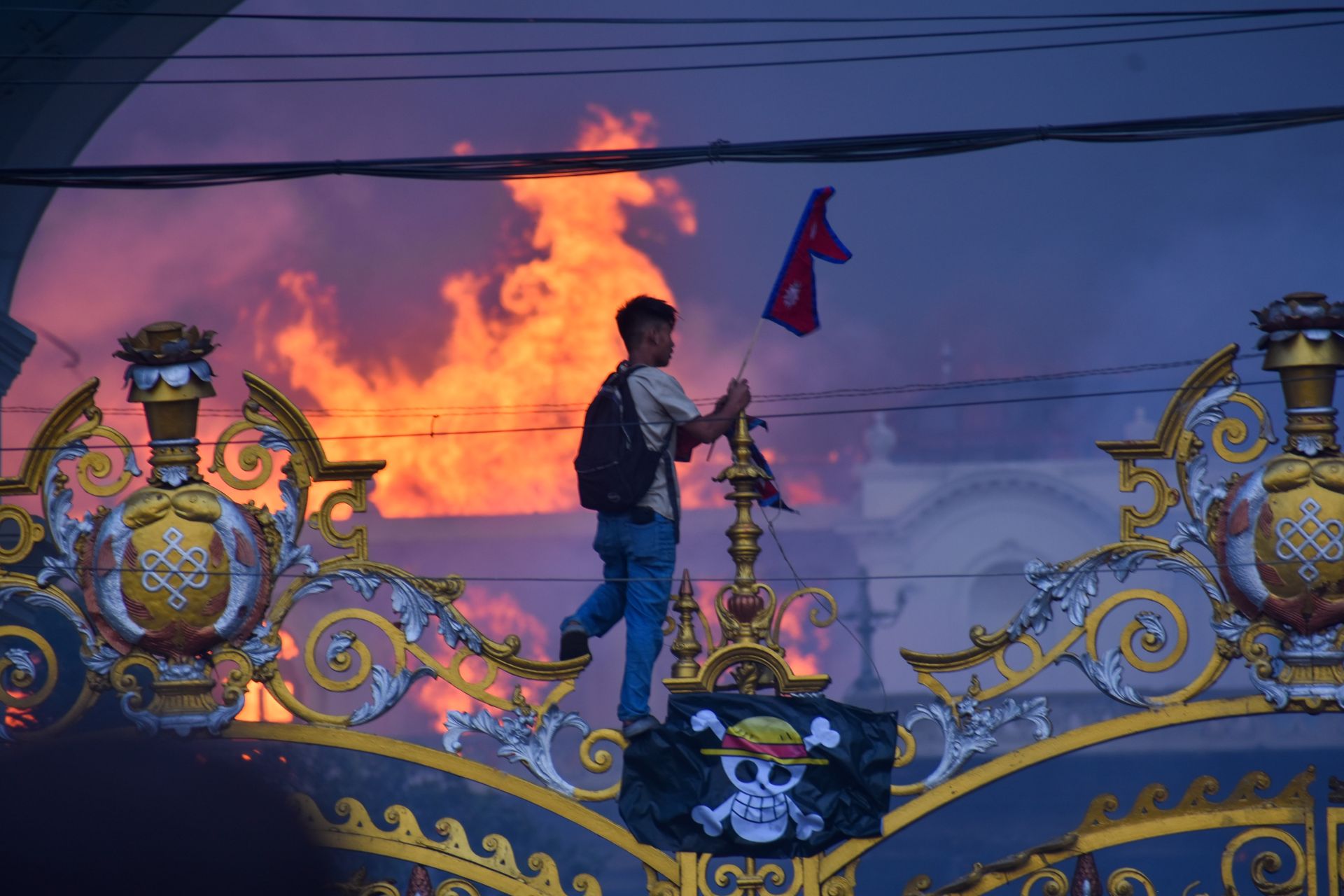
It took only 36 hours for Nepal’s government to topple. Like dominoes falling across South Asia, the tiny Himalayan nation followed in the footsteps of Sri Lanka and Bangladesh, becoming the latest country in the region to witness a popular uprising.
Those between the ages of 16 and 40, who make up nearly half of Nepal’s total population, were fed up with corrupt politicians and their wealthy children — or “nepo babies” — flaunting their lives on TikTok and Instagram. Their videos had gone viral before the protests, amplifying public anger. Then-Prime Minister K.P. Sharma Oli’s misguided attempt to suppress dissent by banning social media platforms backfired when the youth in the country simply moved to the gaming app Discord to continue organizing. The country’s diaspora, including a sizable wave of economic migrants in countries like India for better work opportunities, joined the online huddle.
On Sept. 8, as thousands across the country took to the streets, protests against the government quickly led to violence when police opened fire, leaving at least 50 people dead and over a thousand injured. Even when the initial reports put the toll at 19 deaths, it was the highest number of protest-related deaths caused by police action in a single day in Nepal’s modern history. In anger, protesters torched symbols of state power such as the Parliament, Supreme Court, the prime minister’s residence, the president’s office and other government and party buildings, along with politicians’ homes the next day.
International media initially reported the protest as typical Gen Z anger over Oli’s social media crackdown, only to quickly realize the dissent went much deeper and was rooted in frustration over corruption, nepotism, economic disparities and political elitism.
Nepal’s leaders might have ignored rising public dissatisfaction, but one cannot ignore a regional trend across South Asia, where young people have taken to the streets against their governments over corruption and lack of accountability. Once-powerful leaders had no choice but to run away due to public anger.
It started in 2022, when mass protests in Sri Lanka forced former President Gotabaya Rajapaksa to flee the country. The country was undergoing a severe economic crisis and had come to a standstill as protesters called for Rajapaksa’s resignation for months before storming Parliament. In 2024, Bangladesh followed with its “July Revolution,” when Prime Minister Sheikh Hasina fled the country after large student-led protests against the quota system favoring descendants of freedom fighters for government jobs escalated into nationwide unrest. The United Nations Commission on Human Rights estimated that 650 people died during the violence.
In Nepal, the signs of a brewing revolt were already visible in April, when I was in the country to report on the protests calling for the return of the monarchy. People wanted anything except the government that has now been ousted. The anger earlier this year was legitimate but had no clear outlet — the monarchy was one of the few alternatives left for a country trapped in a political deadlock. What has unfolded since is the expression of a deeply dissatisfied nation, venting its frustration at a political elite that has monopolized power for two decades.
A litany of scams and corrupt deals has eroded public trust, creating a serious crisis of impunity and legitimacy in Nepal. Oli, leader of the Communist Party of Nepal (Unified Marxist-Leninist), or UML, was sworn in as the country’s fifth prime minister in just five years in 2024. Nepal’s three most prominent politicians — Pushpa Kamal Dahal (known as Prachanda), Oli and Sher Bahadur Deuba — have essentially rotated through the top job since 2015. Despite belonging to different parties, politicians accepted ministerial positions without regard for ideology or policy.
In April, a 20-year-old man had told me he wanted Nepal to be like Sri Lanka and Bangladesh. As the dust settled across Kathmandu, he sent me one text: “It’s done.” Usually, people in Nepal tend to see their neighborhood as limited to India and China, but a new wave of mass protests in South Asia pushed them to look further across the subcontinent. Those who followed movements in Sri Lanka and Bangladesh saw their struggles as part of a shared regional story.
There have been consistent themes across all three countries: mass anger over corruption, strong sentiments against nepotism and oligarchy, youth disillusionment, economic strife and the role of social media in mobilizing and amplifying dissent.
Generations of Nepalese youth have left the country to study and work, only to return to find that corruption has made institutions lethargic and jobs scarce. In Bangladesh, the uprising began over similar frustrations. The government was accused of favoring those connected to the ruling party, the Awami League, for public-sector employment. In Sri Lanka, a full-blown economic collapse drove people onto the streets. But at the core of all this is a reckoning with democracy.
“These democracies didn’t prepare themselves for the aspirations of the youth,” said Rishi Gupta, a global affairs commentator and assistant director at the Asia Society Policy Institute. For young people, the status quo was no longer tolerable, and they saw the situation as a sign of entrenched political apathy. They wanted more for themselves and their country: global respect, economic opportunity and better living standards.
Gupta added that young people also did not carry the same burden of history as older generations or remember the violent ethnic conflicts that have shaped their countries’ histories. What they see is the present, which includes broken promises, stagnant economies and a political elite that appears immune to accountability.
Bangladesh survived a genocide and severe famine when it became independent from Pakistan in 1971. For decades, Bangladeshis took immense pride in their hard-won liberation, in their cultural identity — rooted in the Bengali language movement that began in 1952 — and in how they rebuilt their nation. Yet politically, the country became trapped in a cycle as Hasina’s Awami League and its bitter rival — Khaleda Zia’s Bangladesh Nationalist Party — swapped power, creating a strong and vindictive binary in Bangladeshi politics. Hasina ultimately dominated and held on to power for 15 straight years before her ouster, leaving an entire generation with no memories of another leader.
Despite economic progress, her rule became synonymous with authoritarianism as elections were marred by rigging and opposition was harassed into irrelevance. Human rights groups documented hundreds of enforced disappearances and extrajudicial killings carried out by security forces, and a Digital Security Law was used to suppress dissent and silence journalists. Corruption flourished, and oligarchs close to Hasina enriched themselves, while youth unemployment in the country soared.
In Sri Lanka’s case, it was engulfed in a civil war for almost three decades, as the Liberation Tigers of Tamil Eelam (LTTE) fought for an independent Tamil state against the majority Sinhala Buddhist state. The civil war ended in 2009, but its deep fractures remained. Entire generations of Sri Lankan youth were wiped out, with war severely curtailing economic and social development. Those connected to power grew richer, while inequality widened and the state failed to address systemic grievances. In 2022, when the economic crisis worsened, young people felt cheated of opportunity — a disillusionment that echoed the frustrations of those in Nepal and Bangladesh.
Nepal underwent a transition to a democracy from a Hindu monarchy in 2008 after decades of an armed communist uprising. Yet, for the country’s youth, the promise of that transition has remained unfulfilled. This is a generation that was raised in a democratic system but was also exposed to the wider world through social media, and young people have kept count of the ways that the state has failed them.
The extent of inequality was difficult to swallow — seeing rich Nepalis flaunting their wealth on social media only deepened resentment and fanned the flames of the anti-corruption spark that has taken root. “Despite being just a casual browser, I started getting a lot of posts and reels about corruption in Nepal because so many in my circle were engaging with the content,” said 25-year-old Shreya Khakurel, who watched the revolution unfold in Kathmandu. “Social media became an educational platform for me and others like me, which contributed to the frustration,” she said.
Hence, a new generation across South Asia has been challenging legacies and demanding a change in leadership. They want a more accountable and inclusive democracy that matches their aspirations.
In Nepal, political analysts caution that it is too early to tell what direction the country will take, especially given how volatile the past week has been. On a Discord server, young protesters debated potential replacements, and former Supreme Court Chief Justice Sushila Karki emerged as the consensus choice after three days of tense negotiation. She was sworn in as Nepal’s first female prime minister. One of her first acts was to dissolve Parliament and announce that fresh elections would be held by early 2026.
Karki, who had famously faced an impeachment motion from then-Prime Minister Prachanda in 2017 for refusing to yield to political pressure over the appointment of a police chief, was seen as the perfect candidate to lead Nepal through its precarious democratic transition. The army, which stepped in to maintain peace and mediated the handover, found itself in a central role in the country’s politics for the first time.
But the cracks are already showing. Barely two days after Karki was sworn in, members of Hami Nepal, the Gen Z protest collective that helped spearhead the uprising, began demanding her resignation after she appointed three key portfolios — home, finance and energy — without consulting the broader youth movement.
“There is a certain energy that Gen Z represents,” Gupta said. “They have the right thoughts and ideas that they’re passionate about fighting for. But how do they solve these systemic problems? They’re falling short on that. And that tells the regional story.”
Much like in Sri Lanka and Bangladesh, Nepal’s mass movement hollowed out the government’s rotten core and left behind a smoldering scaffolding. As Gupta noted, the impulse for “instant justice” often falters because newcomers to the political system quickly find themselves “essentially upholding the same systems.”
For instance, in Bangladesh, student leaders who spearheaded the protests formed a new political party — the National Citizen Party, and will now have to contest elections within the existing system. Meanwhile, Nobel laureate Mohammed Yunus, the interim leader, has been slow to hold elections. He insists that there needs to be comprehensive electoral and institutional reform and that Hasina’s tenure has left the political system deeply compromised. However, his administration has faced criticism for being unable to maintain law and order. The national elections are currently scheduled for April 2026.
In Sri Lanka, following the economic crisis and subsequent ousting of Rajapaksa, Parliament elected former President Ranil Wickremesinghe, who had served as prime minister multiple times, to steer the country toward economic recovery. However, in the 2024 elections, Wickremesinghe was ousted as he was seen as part of the political establishment that had led the country into crisis.
Anura Kumara Dissanayake, leader of the leftist National People’s Party, emerged as the leader after his party secured a historic victory, winning a two-thirds majority. This marked the first time a single party achieved such a majority since 1977. Notably, over 150 of the newly elected members were first-time parliamentarians, reflecting a significant generational shift in Sri Lankan politics.
However, in the year since, his government has faced criticism for not delivering the “system change” demanded by the protesters in 2022. Dissanayake has been criticized for going after political rivals — like Wickremesinghe — and falling short of electoral promises like abolishing the executive presidency, which was the office Rajapaksa was accused of abusing.
Similarly, in Nepal, the youth may have overthrown a system that failed them without necessarily having a Plan B or an alternative form of democratic structure tailored to their needs. The monarchy, though eschewed by the protesters, looms on the horizon. On the night of Sept. 11, rumors rippled through Kathmandu that the monarchy might make a bid for power. The former crown prince, Paras Shah, issued a statement, and his daughter, a TikTok influencer, hinted online that something significant was imminent. Yet the night passed without incident, and Nepal emerged committed to democracy, with no overreach from the army either.
“These systems have been in place longer than we’ve been alive, we know things will not change overnight,” Khakurel said. Still, she added, the current wave of passion and engagement means taking small steps in the right direction every day, especially by understanding the legalities of democratic transition, such as the fact that the current interim government is constitutional despite attempts to discredit it.
And it’s a learning curve that the youth are committed to. “The other thing that social media revealed was that youth in Nepal — including myself — have very limited knowledge about the social, economic and political undertaking that goes behind running a country,” she said. “I feel like going forward, digital literacy needs to be prioritized for not just the youth, but for senior citizens too, who might not have much education.”
While South Asia’s democracies endure, they remain plagued by persistent challenges, and the cycle of broken promises continues. “If our new prime minister is like the previous ones, our country will face the same problems again,” warned 20-year-old Aakash from Kathmandu.
But hope outweighs anxieties. “The pessimistic side of me had definitely taken over when it came to domestic politics, because I genuinely did not believe that we could do anything to kick these people out of power. I genuinely believed that I would spend my entire life being governed by the same ‘oldies’ with limited formal education making decisions for us,” Khakurel said. “But now, that pessimistic side of me has shut up… I didn’t believe change was possible. I feel empowered, and I feel very hopeful for the future of our country.”
Become a member today to receive access to all our paywalled essays and the best of New Lines delivered to your inbox through our newsletters.