


At 10 p.m. on Sept. 8, I sat on the beach, the buzzing of a reconnaissance drone above me and the whisper of waves beneath my feet. In front of me, the moon glowed red, as if reflecting my inner feelings, a sensation gnawing at my heart.
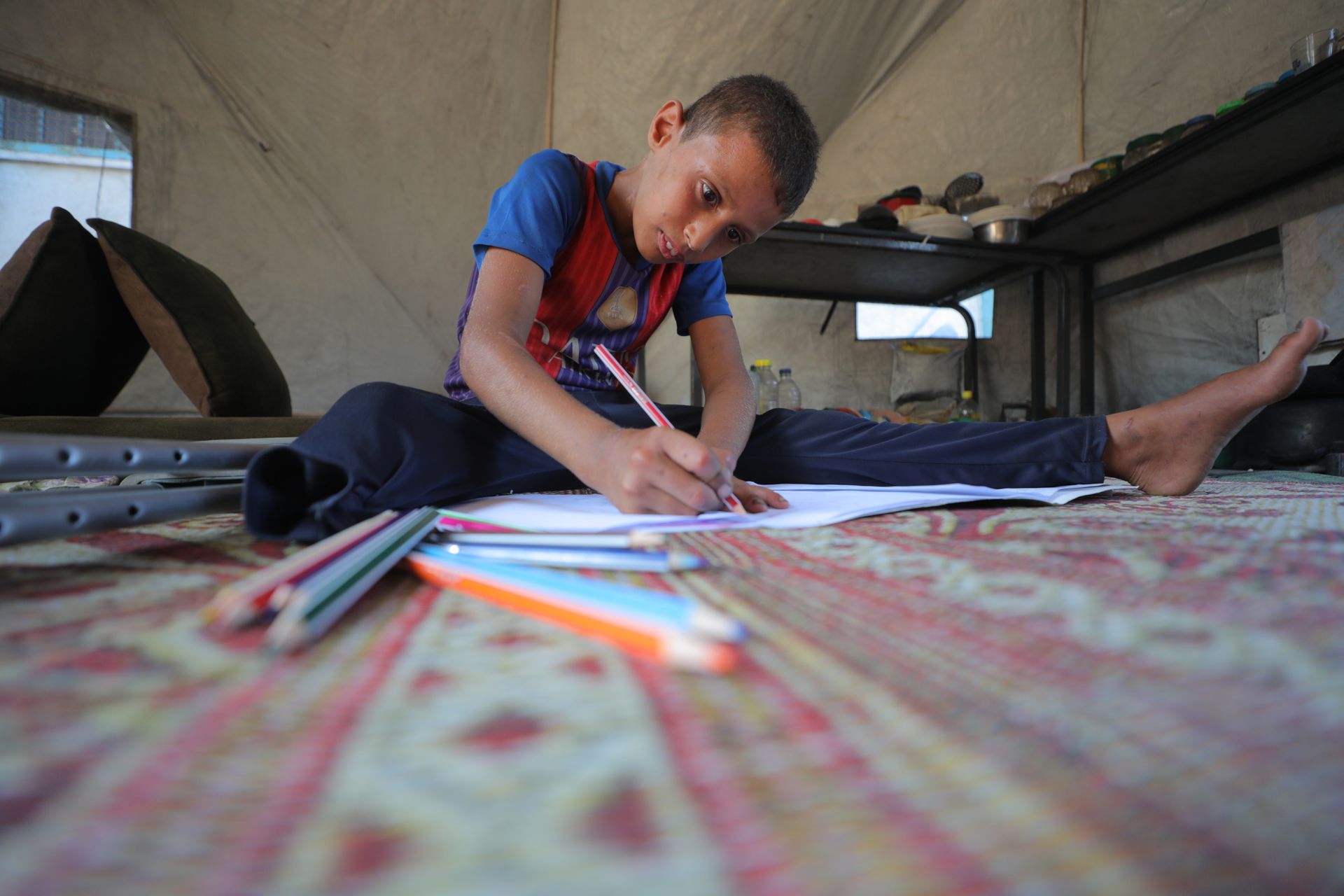
My mother called to tell me it was time to return to the tent since it was getting late. When I arrived, my sister Malak said, “I see you bought a new pair of shoes.” At that moment, I couldn’t hold back my tears: I had brought the shoes for my friend, but he couldn’t have them after his leg was amputated.
In Gaza, we don’t just need medicines and some food. We need someone to see us, to remember who we were before we vanish.
Among the most pressing struggles is access to medicine. My mother developed severe migraines during the war, worsened by the constant buzzing sound of drones. She suffers unbearable pain in her head and bones, unable to do anything. Early in the morning, she went to the nearest hospital, hoping to get treatment, but no medicine was available. I searched through several pharmacies as well, but still found nothing.
It is not only my mother who has suffered in this health crisis. Living in the displacement camps in the al-Mawasi area of Khan Younis, and working as an aid distributor since the beginning of the war, exposed me to hundreds of stories that I will never forget. Some filled me with joy — like a child’s smile or hope in a weary family’s eyes — while others left me sleepless, weighed down with sorrow. This contrast has stayed with me.
Just before the war began, I entered my second year at the Islamic University studying English translation. On Oct. 9, 2023, the university was bombed, part of a deliberate campaign to erase Gaza’s education system. Schools and universities were either flattened or transformed into overcrowded shelters. I became one of the displaced.
In late February 2024, my neighborhood was bombed. My family was forced to live in one of the United Nations Relief and Works Agency (UNRWA) schools, where I began teaching English basics to children in the shelter to bring them some structure in the chaos. I saw some volunteers teaching the Quran and Arabic letters, and soon a friend suggested that I do the same with English. I started with dozens of children, showing them the alphabet and simple words. It felt beautiful to fill my time by doing something I loved again. Many of the children learned to write their names in English for the first time, and I still remember the pride on their faces as they held up the paper to show me. In those small moments, I felt that both they and I had found a little light inside the darkness.
Later, I started volunteering with the shelter’s nutrition department, distributing meals to families like mine. That was my first direct experience working with UNRWA, and it meant everything. I didn’t just serve food — I listened, I connected and I understood.
On May 6, 2024, we were forced to evacuate Rafah. Over 1 million people had crowded into that tiny city, and suddenly it too became unsafe. I briefly returned to my long-lost home, grabbed clothes and left again. My body moved forward, but my soul stayed behind.
With no university, no home and no security, my life became one of survival.
In March 2025, things changed when my Turkish friends reached out. Together with my friend Ahmed and his camera, I began visiting displacement camps across Gaza — distributing cash aid, documenting stories and trying to bring back a piece of joy, even briefly. The project was small, run by the two of us, but made possible with support from friends in Turkey.
By the festival of Eid al-Fitr, on March 31, 2025, conditions were catastrophic. The war had dragged on, prices were soaring and people had no access to cash. Yet with help from Turkey, we collected enough money to give gifts to over 100 children who hadn’t seen a proper Eid celebration in years.
Most of these children were in hospitals, suffering from illnesses like malnutrition and hepatitis. Witnessing the scale of the health catastrophe was overwhelming, yet the children’s smiles when they saw us were even greater. For a brief moment, their laughter broke through the despair, reminding us of the meaning of Eid that war had tried to erase.
One unforgettable moment came in a camp in Khan Younis. There, we met 13-year-old Mohammed, a boy with Down syndrome. Despite the destruction, he wore his best clothes and greeted us with the brightest smile. Despite Gaza’s collapsing health care system, where children like him are left without the special care and medications they need, Mohammed’s presence lifted us more than we lifted him.
In another camp in al-Mawasi, I met Yousef, a 12-year-old boy with a bladder condition. I asked him, as I ask many children, “Are you smart in school?” — a simple question that brings back the idea of childhood. But school in Gaza is a memory. Education has been suspended for nearly two years. Yousef now faces the possibility of needing dialysis. He’s just one child. Thousands more are like him — sick, hungry and forgotten.
On May 10, 2025, I visited a camp in al-Mawasi. An elderly woman, Um Ahmad, gently grabbed my hand and led me to her “tent” — a fragile structure made from empty flour sacks, shared with three families. Her body trembled, her health was failing, yet her spirit was warm. She was dressed in a traditional Palestinian thobe, and at that moment, she was the most beautiful thing I had seen that day. With a faint smile, she said, “Seeing you is better than any help.” Her words carried more weight than any aid we could provide.
During one of our initiatives in a displacement camp, I met Fozia, a little girl with autism. She stood shyly in front of her tent, her innocent eyes full of unspoken words. When I asked her what she wanted me to bring her, she simply said, “a teddy bear.” I promised her I would. My friend Ahmed asked to take a photo of her — a picture for memory. She looked like a small ray of light amid the destruction, her presence radiating beauty and innocence. But two days later, the camp was bombed, and Fozia was gone. The teddy bear I bought for her remained in my hands, and later, when my house was bombed, I found it again under the rubble. Today, that teddy bear carries more meaning than anything else I own: It is a reminder of innocence stolen, and of the children who needed special care but were instead left to face bombs and hunger.
In mid-May 2025, we revisited a camp where we met Abu Iyad, a man supporting 10 family members. His words were simple: “Thank God.” But the state of his worn-out tent told the real story. Inside, I tried to bring some happiness to his children — 8-year-old Iyad, 6-year-old Sujoud and their older sister, Ghazal. Their mother, Um Ghazal, suggested we play a small math game to test her children, and we agreed, as she herself is living with a chronic illness, Type 1 diabetes, which means her body doesn’t produce enough insulin and she needs daily injections. When we found her, she told us she hadn’t had her insulin for over four days due to severe shortages in the hospitals. Despite her own struggle, she wanted to focus on her children’s game. We started the game, and Ghazal surprised us with her quick mind and knowledge of multiplication tables, even though schooling for kids like her has been suspended for two years. For a moment, we all laughed, and it felt like a small victory for Ghazal.
On the morning of Sept. 8, I went out to find medicine for my father. The pressure on the spinal bones in his neck, caused by carrying heavy water containers and the lack of physical therapy, left him in constant pain. I searched many pharmacies but couldn’t find any. Finally, I called a relative working in a hospital, and he promised me half a strip of pain medication. When I arrived at the hospital and saw my relative, I made my way toward my friend’s room.
I planned to visit my friend, injured in his leg and shoulder while heading to one of the sites of the so-called Gaza Humanitarian Foundation — those death traps run by American and Israeli organizations. I had bought him a pair of shoes to wear once he recovered. I walked into his room with a smile, hoping to lift his spirits. I have known him since high school; he was the best football player in school, my greatest challenge on the field. But when I entered, the shock hit me: My friend had lost his leg. It had been amputated because proper medical care was not available.
He smiled at me with calm strength. But I knew what he was really feeling inside. It reminded me of a story, published in 1956, by the late Palestinian novelist Ghassan Kanafani, about a man who brought his cousin a pair of shoes only to find her legs had been amputated. At that moment, I wished I could ask Kanafani what to do, how to comfort my friend, or at least how to hold back my tears.
That day, I left the hospital and went to the beach. Everything felt unbearably heavy, yet the sound of the waves gave me a little relief. I sat there for hours; the beach was empty. It was the night of the lunar eclipse. The moon was blood-red, just like how I felt inside.
War has taken too much from us — our homes, our health and even our dreams. Yet as long as I can write and remember, I know these stories will not be erased. Some nights, these stories don’t let me sleep. I try to find ways to help, but the helplessness is overwhelming.
“Spotlight” is a newsletter about underreported cultural trends and news from around the world, emailed to subscribers twice a week. Sign up here.