

On Wednesday morning, Galle, a popular tourist destination in Sri Lanka, woke up in shock to find itself an unwitting participant in a war that began thousands of miles away.
The IRIS Dena, carrying a crew of 180, sank 40 nautical miles off Sri Lanka’s southern coast while returning from last month’s international naval exercise near the Indian port city of Visakhapatnam, where it was torpedoed and sunk by a U.S. submarine on March 4. The United States was among the countries that participated in the drill. Sri Lankan officials said on Thursday that 32 people had been rescued and that search operations were ongoing. The vessel was sailing outside of Sri Lanka’s territorial waters when it issued a distress call at 5:08 a.m. local time. The Sri Lankan navy and its air force responded to the emergency.
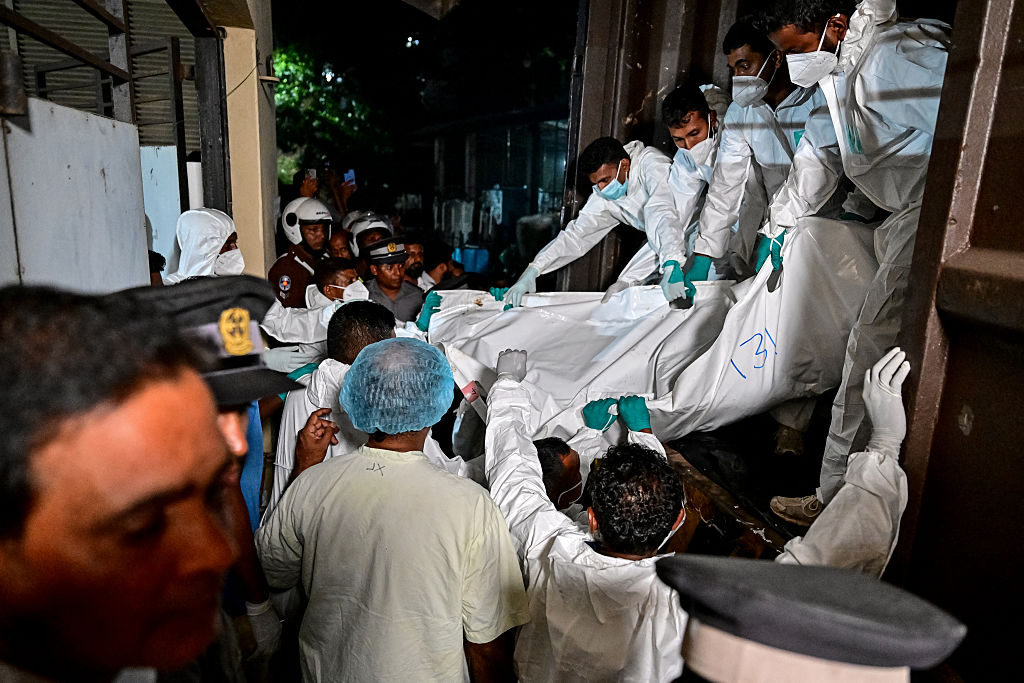
Since the rescue, Karapitiya Teaching Hospital in Galle has taken extraordinary measures to preserve the bodies of 87 Iranian sailors who were aboard the IRIS Dena, implementing a protocol to slow decomposition that was developed in the aftermath of the 2004 Indian Ocean tsunami disaster.
“Our goal was to conduct postmortem examinations and preserve the bodies to prevent further decomposition,” Janaki Warushahennadi, professor in forensic medicine at the University of Ruhuna, told New Lines. She is part of a five-person team tasked with managing the cadavers.
Under normal procedures, once bodies are identified and postmortem examinations are completed, they are stored in the mortuary’s cold storage facilities. But the sheer number of casualties and limited refrigeration capacity have forced the hospital to fall back on the emergency method used during the 2004 disaster: placing body bags alongside blocks of dry ice, ice and sawdust — a technique commonly used to preserve fish aboard commercial fishing boats.
In addition to 20 freezers, the hospital procured two refrigerated vehicles to store the bodies until they can be repatriated to Iran. The repatriation process is yet to be determined, Hansaka Wijemuni, Sri Lanka’s deputy minister of health, told New Lines.
Airspace over Iran, Israel, Iraq, Qatar, Bahrain, Kuwait and Syria has remained closed since March 1 following the U.S. and Israel strikes against Iran, triggering widespread disruptions to civilian aviation across the region. The closures have made repatriating the bodies impossible so far, despite a request from the Iranian government to its Sri Lankan counterpart.
“We are ready to store the bodies until further arrangements are made,” said Wijemuni. Commenting on the preservation process, he added: “We had to make sure there was enough space to store the bodies without disrupting the regular usage of the freezers. ”
The repatriation of a cadaver is a lengthy process that involves coordination between local authorities and the deceased person’s embassy, he said. The current conflict has further complicated matters. “We are ready to keep the bodies, even if it takes a year,” he added.
A day after the attack, on March 5, Sri Lanka allowed a second Iranian ship, IRINS Bushehr, to dock after the vessel itself requested permission to enter Sri Lankan waters due to reported engine trouble.
Authorities brought the 208 people aboard — 53 officers, 84 cadets, 48 senior sailors and 23 sailors — to Colombo, while taking the ship into custody at a port off the eastern city of Trincomalee rather than docking it near Colombo’s commercial harbor, one of South Asia’s busiest.
“We jealously guard our nonaligned policy while ensuring that humanitarian values and the saving of lives remain our top priority,” Sri Lankan President Anura Kumara Dissanayake said in a televised address, stressing the country’s neutrality in the conflict.
Sri Lankans fear that Wednesday’s attack could pull the South Asian island nation of roughly 22 million people into a geopolitical crisis it did not create and cause an and that an economic downturn may ensue as the war drives up global oil prices.