

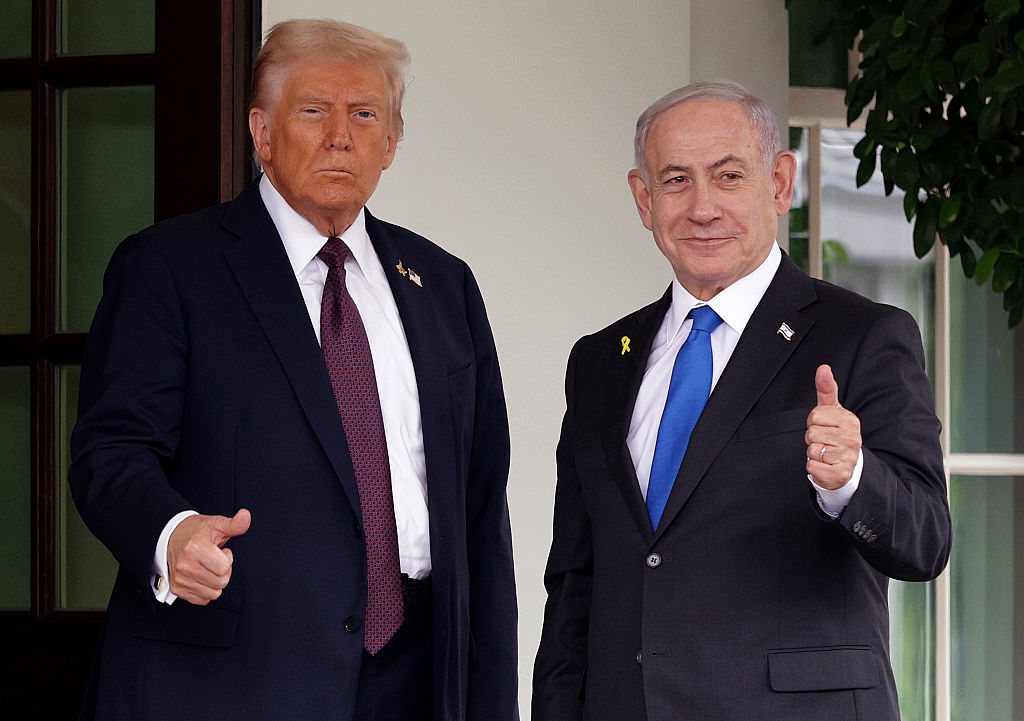
Among the mourners at today’s funeral for Sen. Lindsey Graham is Prime Minister Benjamin Netanyahu. The senator from South Carolina was an evangelical Christian whose unstintingly loyal support for Israel was predicated on his religious beliefs. A frequent visitor to Israel, he had the right-wing, pro-Trump evangelical Christian Zionists in his pocket. The senator spoke often of both the sanctity of Israel and the threat of “radical Islam” that he claimed Iran represented.
Graham, who died at 71, was among the last of the U.S. politicians to hew to a decades-old model of uncritical support for Israel. In his case, that support was motivated by Christian Zionism. In the case of former President Joe Biden, and so many of the octogenarian Democrat’s generation, support for Israel was based on a 60-year-old image of an embattled Jewish state surrounded by enemies purportedly committed to its destruction. The power of that image has now faded; it no longer resonates with the under-35 generation. The Democratic Party has turned away from Israel, with 100 of its members in Congress voting on July 15 to slash aid to the country, while 58% of Democratic voters say the U.S. is “too supportive” of it. Backing from certain pockets of the Republican Party is also declining, amid a growing split within MAGA.
Lindsey Graham was one of a shrinking number of Republican legislators still capable of winning political points, via his avowedly Christian Zionist constituents, from the traditional relationship with Israel, one based on uncritical support. Meanwhile, Netanyahu’s personal brand of diplomacy faces further challenges. The prime minister presents himself to Israelis as a Trump whisperer, whose special relationship with the president keeps Israel safe. But there is ample reason to believe that Trump, now burdened by the increasingly quagmire-like war in Iran, is sick of Netanyahu and unconcerned about Israel’s fate.
Ahead of his meeting with Netanyahu, Trump did not refer to cooperation with Israel or to Israeli interests. He also said nothing about Netanyahu’s personal political fortunes, although the Israeli prime minister’s governing coalition is doing badly in the polls as he heads into a critical national election on Oct. 27.
For Netanyahu, Graham’s death leaves a vacuum in Washington where there used to be pro-Israel stalwarts whose support was a given. Now he’s in a perilous position. Which is why today’s meeting with President Trump in the White House is a critical one.
Even without the funeral as an excuse, Netanyahu’s trip to Washington is not a typical one. He flew on his highly controversial official airplane, “Wing of Zion,” which is not a frequent sight on trans-Atlantic runways. The press was banned from the plane and his staff did not release an itinerary. Rather than his usual florid address before he flies off on official visits abroad, the prime minister offered only a couple of tersely worded phrases to the press assembled on the tarmac, just as the door to his plane was closing. “Difficult times,” he said. Adding: “We will be discussing Iran.”
The truth is that Trump never liked Netanyahu. And the feeling is mutual. Israel dominated the Biden agenda because the former president was a dyed-in-the-wool Zionist, and also because AIPAC, the most powerful lobbying organization in Washington, was responsible for funding a great many election campaigns for Democrats and Republicans. Trump was certainly aware during his first term of the perception that Netanyahu had him on a leash, but in his second term he has become not only angry at the popular image of Netanyahu controlling their relationship; he is also quite indifferent to the political fate of the prime minister specifically, and to Israel in general. Until now he followed the traditional U.S. foreign policy of allowing Israel to do what it wants, but mostly through inertia. Now this is changing; Israel is becoming a liability to Trump.
MAGA is now about a set of political promises that has very little to do with evangelical Christians, or with ensuring Israel’s supremacy in the Middle East. Trump is much more interested in what he can get from the Gulf monarchies, and from the Iranians themselves, as he prepares to turn toward China. He wants to reap as much as he personally can from what remains of his presidency. Netanyahu, fully consumed with his own problems, is failing, as he has consistently been failing, to read the room. He has completely alienated the Democratic Party, as well as large pockets of younger, MAGA-aligned Republican voters. Netanyahu had no choice but to bet everything he has on what he tries to present as Trump’s gullibility. But he has failed.