

The Real Questions for the Gulf May Start the Day After the War Ends
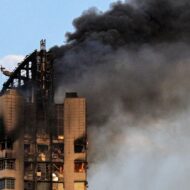
Ten days into this war, and the Gulf Arab states are already asking what their neighborhood will look like after it ends. No answer is good.
For the Gulf Cooperation Council (GCC), the biggest question is not merely who will win, or even what victory will look like, it’s what kind of regional order will emerge when the fighting stops. Every plausible outcome to the conflict — whether Iran emerges weakened but intact, or faces internal disorder for a long time to come, or undergoes a more dramatic metamorphosis — will leave the monarchies confronting a new set of strategic dilemmas.
Sultan Alamer, a postdoctoral fellow at the Center for Middle Eastern Studies at Harvard University, offers an insight into the Gulf’s predicament. “I think there will be three questions that each policymaker in the Gulf would really try to think about,” Alamer says in today’s podcast.
“The first one is how to deal with Iran, specifically if one of these three scenarios that we just discussed happened.” The three scenarios he outlines can be summed up as “Khamenei 2,” a “refined version of the same regime”; “Iraq 2,” a chaotic civil war; or “Pahlavi 2,” a new regime that is more favorable to the United States.
Even a weakened Iran would remain a significant threat, able to — and now having demonstrated a willingness to — threaten Gulf infrastructure, energy facilities and shipping lanes, and even civilians. Yet a more dramatic transformation inside Iran could create its own instability. The collapse or fragmentation of the Islamic Republic would remove a long-standing frenemy, but could also produce years of uncertainty. The third option, of a significantly changed Iran, opens the door to the remnants of the regime becoming an underground opposition.
The second question concerns the Gulf’s relationship with the U.S., which has long served as the region’s primary security guarantor. “It seems now that the United States has its own regional policy that is divergent from the Gulf countries,” Alamer says, arguing that this divergence is already affecting how Gulf leaders think about the American military presence in the region. “These military bases are now increasingly seen as more of a burden than an asset.”
For decades, American bases across the Gulf have been viewed as the cornerstone of the region’s security architecture. But the current conflict has exposed a paradox. Even if the U.S. does not necessarily use those bases to launch attacks on Iran, their presence can still make the countries that host them targets. “The United States doesn’t use these spaces to attack Iran,” Alamer says, “but they are used as an excuse to attack the Gulf.”
The third question is about the broader balance of power. “What does that mean for the region when one of the four middle powers collapses, and the Israelis take more control?” Alamer asks. For Alamer, the Middle East is a region “that has no regional hegemon” but — before this war, at least — four middle powers: Saudi Arabia, Turkey, Israel and Iran. If one of those pillars weakens significantly, especially at the expense of another, the balance that has shaped the region’s politics could begin to shift.
That possibility is one of the most unsettling implications of the day after the war ends. Even if Iran’s power is reduced, it’s not guaranteed that one of the other three middle powers will fill the vacuum. On the contrary, other alliances may appear, and even neighboring countries could find themselves on opposite sides of political divides, as Alamer wrote in an essay for New Lines on the divisions between Saudi Arabia and the United Arab Emirates in Yemen.
Much depends on whether, in that new neighborhood, the Gulf states perceive Iran as their greatest future threat.
Dina Esfandiary, the Middle East geoeconomics lead for Bloomberg Economics, based in Geneva, says on the podcast that Iran’s decision to strike the Gulf countries so hard has upended years of diplomacy. “I think, unfortunately, what this attack does is it rolls back some of the progress Iran had made in the eyes of the Gulf Arab states,” she says. “Since the outbreak of the Gaza war, many countries in the region … really saw Israel increasingly as the bigger threat.”
But that idea has been overturned. “With this war and with this Iranian retaliation directly on the Gulf Arab states, this idea that Iran would never do that was basically pierced.” That change will result in a new posture toward Iran.
For now, the Gulf is primarily concerned with ending the war in Iran. But preparing for the uncertain order of the day after is a looming dilemma.
Sultan Alamer and Dina Esfandiary discussed these ideas in more detail on today’s episode of The Lede.