

The Iran War Comes to Egypt
Standing before a hall of global energy executives at Egypt’s annual energy conference on Tuesday, President Abdel Fattah el-Sisi called on Donald Trump to stop the war on Iran.
“I appeal to you, in the name of humanity and all peace lovers, to help us stop this war,” he said.
Hours later, his government announced Egypt would begin importing oil from Libya to compensate for Kuwaiti crude it can no longer access. The Strait of Hormuz has been closed for nearly a month. This is what it looks like when a country absorbs a war it did not start and cannot afford.
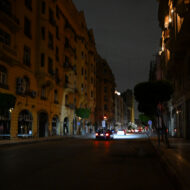
Prime Minister Mostafa Madbouly announced the first round of measures on March 18: shops, restaurants and malls closed by 9 p.m. on weekdays (10 p.m. on weekends), street lamps cut to half power, storefronts dark. Natural gas import costs have tripled since January, from $560 million a month to $1.65 billion. The petroleum bill has more than doubled, from $1.2 billion a month to $2.5 billion.
Starting Sunday, most public- and private-sector employees will work from home one day a week. The measures will be reviewed after a month, Madbouly said, and reversed if the crisis ends, but nobody is betting on that.
The 9 p.m. rule is where that arithmetic becomes visible on the street.
Cairo does not have street lighting in any meaningful sense. It runs on shops. The pharmacy is open till 3 a.m., the kiosk with its generator treating time as a suggestion. These are the light sources. Its storefronts are the grid.
Take them away in a city that has always run day and night as two parallel economies, each feeding the other without interruption, and you have introduced a cut in a rhythm that has not had one in recent memory.
The adjustment is not falling equally. Street vendors and small shop owners are bearing the weight of it in ways that salaried workers who can shift online simply are not. The 9 p.m. line lands differently depending on which side of the informal economy you are on.
“I am getting squeezed from both hands,” said Tarek Hilal, 52, a ful (fava bean) cart owner in Maadi. “The hours cut from one side, the cost of cooking oil and flour from the other. The war shows up in the sandwich before it shows up anywhere else.” He expects to raise prices within days.
Mostafa Ramadan, 28, from Shubra used to work two jobs, driving for Uber during the day, staffing a clothing shop at night. The shop’s hours are gone now. He drives full-time.
“Of course the situation has affected me. It’s affecting everyone. Why would I be working two jobs, if I could do one?” He paused, then: “Nothing else I can do except leave it to God.”
Egypt has already raised fuel prices by 30%. The Egyptian pound has weakened from 47 to around 54 to the dollar in a matter of weeks. Remittances, which brought in over $41.5 billion last year from Egyptians working in the Gulf, are now tied to economies now under direct attack.
Economists warn the cost of the early business closures will exceed the energy savings they produce, and the government has not said what happens if the war runs past April.
The political position underlying all of this is careful to the point of strain. Since October 2023, Egypt has positioned itself as a key mediator in the war on Gaza, while simultaneously, according to Amnesty International, arresting at least 123 people for expressing solidarity with Palestine.
The war on Iran has extended that posture into sharper economic territory. The longer it lasts, the greater the pressure on foreign currency reserves. Cairo cannot afford to take sides and cannot afford the war either, and the gap between those two positions is where the darkness comes from.
Egypt has practice absorbing conflicts that never officially arrived. During World War II, Cairo remained formally outside the fighting while fully inside its consequences. The British set up their regional military headquarters in the city, occupying residential districts like Heliopolis and Garden City as German forces advanced across North Africa. The cabarets of Emad El Din stayed open. Daily life reorganized itself around a war Egypt was not in.
Sisi’s appeal to Trump on Tuesday had that same quality: a country present at the table, absent from the fight, and paying for both.
Cairo lifestyle platforms have been publishing guides to life after the shutdown, pointing readers toward the Nile banks in Zamalek and Maadi and the Corniche in Giza. The river takes on more weight as everything else contracts. Some cafes have been shutting their lights off, but the shisha stays lit and the dominoes are still on the table.
One by one, the pieces keep falling. Sisi standing before a room full of the world’s energy executives and calling publicly for a war to stop is not a gesture Egypt makes lightly. The lights are dimmed, and the government’s word that this is temporary is only as good as a war it cannot control.