

The Gulf Fears Whoever Wins This War
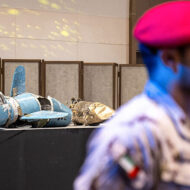
The Arab governments of the Gulf are facing myriad calculations as they now find themselves a front line for a war that was forced upon them. Even as they hope for an end to the conflict in Iran, with its risk of further targeting of energy infrastructure and diplomatic missions on their territory — like yesterday’s attack against the U.S. Consulate in Dubai — they are in a no-win situation, no matter who claims victory in this latest war.
The U.S. clearly does not have the appetite for a full-scale war that forces regime change, and if Iran succeeds in preserving its ruling system, the Gulf will have to contend with a glowering Tehran, which will have learned to strike at its neighbors as a way to pressure or deter U.S. policy. That strategy has only been a threat before, but it is now a precedent that sees not just American bases as legitimate targets, but the Gulf’s infrastructure, diplomatic and economic assets.
That is why the Gulf states are sounding increasingly frustrated and angry at their neighbor, declaring their right to self-defense and even shooting down Iranian jets and arresting Islamic Revolutionary Guard Corps agents, as Qatar did this week, while insisting that they are not part of the campaign against Iran and would not allow their airspace to be used in service of it (Qatar and Oman have long been Iran’s friendliest neighbors in the region). Qatari authorities flatly rejected Iran’s claim, made during a call with the Iranian Foreign Minister Abbas Araghchi, that recent missile strikes were not targeting Qatar, citing attacks on civilian areas, Hamad International Airport and gas infrastructure. Qatar condemned the strikes as a “flagrant violation” of its sovereignty and warned Tehran its actions reflected an “escalatory approach.”
“The irony in the justifications of Iranian officials in saying they are responding to the U.S. and Israel is that their missiles and drones are landing on Gulf cities and their critical infrastructure, so why are they targeting states that declared their neutrality and tried to avoid war?” said Ebtisam AlKetbi, the head of the Emirates Policy Center, in a post. “Targeting the Gulf states isn’t a side effect, it’s part of an attempt to broaden the conflict to the entire region. Doing this … does not create a new balance, it threatens the security and stability of the entire area and opens the door to secondary effects that can’t be controlled.”
Emirati and Qatari officials have denied to New Lines that their countries have lobbied the U.S. to stop the war, as reported by Bloomberg. While they hope for the war to end, they are frustrated with Iran attacking them even though they didn’t allow their airspace to be used for attacks on their neighbor. Iran claims that it is attacking U.S. sovereign territory in the form of military and intelligence bases in the Gulf. Riyadh has also previously denied reports in The Washington Post that Crown Prince Mohammed bin Salman had lobbied U.S. President Donald Trump to attack Iran.
Official Saudi media have run reports against what they described as misinformation campaigns to implicate and drag the Gulf countries into war.
“The Gulf states must not be drawn into a direct confrontation with Iran even though Iran violated their sovereignty and initiated the attacks on our countries,” said Hamad bin Jassim, the former prime minister of Qatar. “There are powers that want a direct conflict between the Gulf and Iran, knowing that the war between the U.S. and Israel and Iran will end, whereas direct conflict between the Gulf and Iran will sap the resources of both sides and allow other powers to control us.”
In the unlikely event that Washington and Tel Aviv force a transformative shift in Tehran, the Gulf states will have exchanged one hegemon for another. Rather than an Iran content with destabilizing the region through its networks of largely neutered proxies, it will be an ascendant Israel, which has no qualms about conducting assassinations or using airstrikes to resolve its various disputes with regional players, with the U.S. cheerleading in the background.
This has created uncomfortable dynamics for the region’s powers, with their sometimes competing agendas. For example, Al Jazeera, which is based in Qatar, Iran’s closest friend in the region before the war, right now has almost no reporting on its homepage about Qatar and its tensions with Tehran. One prominent writer in Qatar, with hundreds of thousands of followers on social media, posted footage of missiles landing in Tel Aviv and hinted that it would be much better for the region if Iran directed its ire only at its actual enemies.
By contrast, Emirati officials and academics have highlighted the fact that their country, which has a peace deal with Israel, was subjected to a disproportionate number of missile attacks by Iran. The country’s Defense Ministry said that, as of Wednesday, 189 ballistic missiles had been detected heading toward the United Arab Emirates. Of those, 175 were destroyed, 13 fell into the sea and one landed on the country’s territory. Out of 941 Iranian drones, 876 were intercepted, and 65 fell within the UAE. Eight cruise missiles were also detected and destroyed, the ministry said.
Emirati academic Abdulkhaleq Abdulla noted that the UAE was second only to Israel in being targeted. “Iran targeted our states before it targeted Israel,” he said in a television interview. “We have moved from a moment of awareness of Iran as a danger to the region’s stability, to recognizing that Iran is the primary enemy.”
While it is true the UAE has borne the brunt of Iran’s attacks in the Gulf, in last year’s 12-day war, Iran instead fired missiles at Qatar despite its attempts at mediating a peace deal at the time. Indeed, Iran’s attacks on Qatar in particular will have important consequences.
The attacks have even led other close allies of Iran to criticize its actions. Hakan Fidan, the foreign minister and former head of intelligence in Turkey, another country that worries it may come into conflict with Israel, said Iran’s targeting of the Gulf countries without distinction is the “wrong strategy.”
“They were actually acting in a way that would have benefited Iran. Despite this, Iran’s bombing of Oman as a mediator, Qatar, Kuwait, Bahrain, Saudi Arabia, the United Arab Emirates, Jordan — all of these places without making any distinction — is, in my view, an incredibly wrong strategy,” he said in an interview with the state broadcaster TRT Haber.