

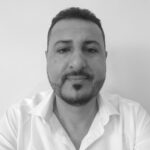
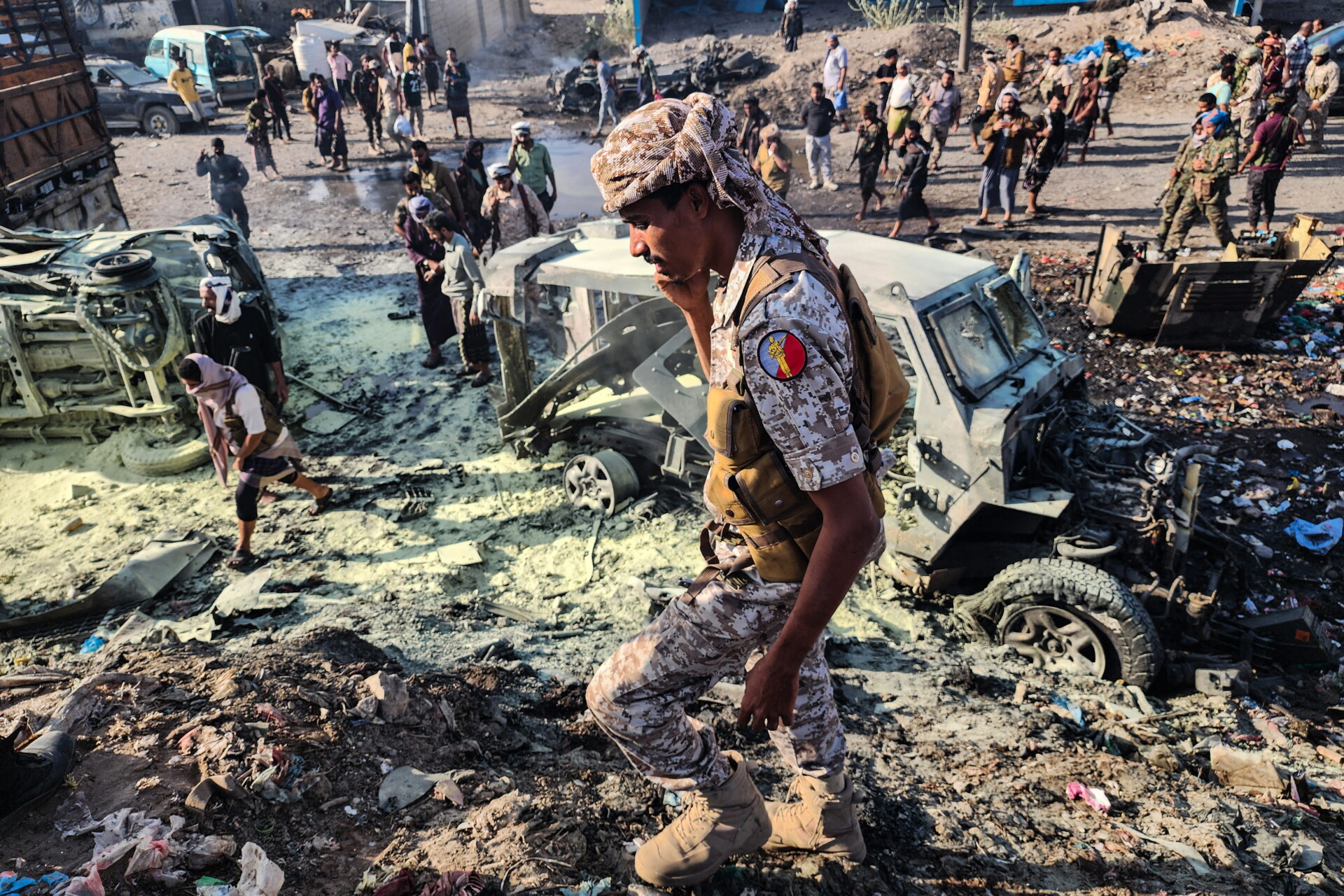
Gen. Abdulrahman al-Mahrami, known as Abu Zaraa, is one of the most visible figures in Yemen’s military and media landscape today. Alongside others, he is leading Operation Dawn of Yemen, a campaign aimed at retaking the west coast region on the Red Sea, which the Houthis seized in September, in their biggest military and geopolitical victory in years.
Al-Mahrami’s involvement is not simply a matter of his role as commander of the Southern Giants Brigades, or his seat on the Presidential Leadership Council (PLC), Yemen’s internationally recognized government. It is also the region where he made his name nine years ago in a previous fight to drive the Houthis out.
Born in 1980 in the Rasad-Yafaa district in southern Yemen, al-Mahrami is fighting to protect his most significant military achievement, one that underpinned his subsequent rise as both a military and political figure.
Two other commanders — Brig. Gen. Hamdi Shukri al-Subaihi and Maj. Gen. Abdulrahman al-Lahji — share both his record on the west coast and his religious background as a Salafist, the conservative brand of Sunni Islam that models itself on the behavior of the Prophet Muhammad’s earliest companions.
In the first operation to wrest the region from the Houthis, between January 2017 and November 2018, the United Arab Emirates oversaw the campaign. Saudi Arabia is overseeing the current one, with all three men once again involved.
Together, they have come to encapsulate the battle for Yemen as it currently stands, with its shifting battlefronts and the carnage it is now wreaking in both Yemen itself and Saudi Arabia. Understanding these men prosecuting the conflict on the ground provides a unique and vital perspective on its dynamics and evolution.
For Brig. Gen. Hamdi Shukri al-Subaihi, the first campaign back in 2018 was a watershed, completing his transformation from preacher into military commander, along with a range of security and social roles.
Before the Houthis reached Yemen’s southern governorates in 2015, Shukri was a little-known teacher of Islamic sciences in the Subaiha areas of Lahj governorate.
The Houthi offensive against the Salafist movement changed that. The siege of the Dar al-Hadith center in Dammaj in Saada governorate — a battle that lasted over two years and ended in January 2014 with over 200 deaths, the expulsion of its students and then the push into the southern governorates — drove many in that milieu from preaching into fighting. Shukri was among them.
His reputation grew because of his role in the battle for Aden in the summer of 2015, when the attempted Houthi takeover of the southern city was rebuffed. He then moved to Lahj, where he helped recapture al-Anad Air Base, one of the country’s largest, before leading operations on the Kirsh front and at the Labouza camp on the Lahj-Taiz boundary.
In 2017, he formed the Hamdi Brigades, composed of fighters from his home governorate, to join the west coast campaign. He became associated with the capture of the strategic Khalid bin al-Walid camp in Mokha.
He helped found the Giants Brigades, and commanded its 2nd Axis, which later became the 2nd Division, and served as the brigades’ deputy commander in chief. His military record extended beyond the coast to oil-rich Shabwa in eastern Yemen, where he played a leading role in driving the Houthis from three districts.
Alongside his military work, Shukri took on significant security responsibilities: leading an anti-smuggling operation and securing the coastal road between al-Madaribah and Ras al-Arah in 2020, then running a security campaign along more than 110 miles of coastline from Imran Cape to Bab al-Mandab, curtailing arms smuggling, illicit trade and irregular migration from the Horn of Africa.
Despite all this, he never stepped back from his social role: settling disputes, resolving blood feuds and mediating community conflicts, which had been central to his life as a preacher. This kept him close to ordinary people and earned him goodwill rare among commanders of his rank.
His mediation efforts extended to the political clashes between the Yemeni government and the separatist Southern Transitional Council (STC) in 2018 and 2019, when he led military mediation efforts to reduce tensions through security arrangements involving his own forces.
Observers credit his success in part to his refusal to align himself politically or to publicly back southern secession, in contrast to other Salafist commanders who took up arms and then adopted separatist positions at odds with their Salafist frame of reference, which traditionally rejects fragmentation and parochialism.
This approach defines how Shukri has navigated public life, along two lines: staying clear of political alignments while focusing on the common good, and preserving his Salafist identity against the pressures that political life tends to impose.
People close to him describe him as straightforward, unpretentious and accessible, qualities he has maintained even after his appointment last April as commander of the Fourth Military Region, covering Aden, Lahj, Dhale, Abyan and Taiz.
He avoids official motorcades and media appearances, communicating with the public through audio recordings and almost exclusively about the Houthis. When he does so, his rhetoric combines patriotic language, invoking the state and the people, with doctrinal framing.
He has survived two assassination attempts: a Houthi heat-seeking missile in 2018, and a bomb targeting his convoy north of Aden in January 2026.
If Shukri has maintained a balance between his military, security and social roles while steering clear of political alignments, Abdulrahman al-Lahji presents another variant of the same Salafist milieu, and another example of how the conflict drew many men from religious study and preaching into military and then political life.
All three commanders are close in age. Al-Lahji was born in 1979 in Tuban district, Lahj governorate, moved to Aden in 1997, and completed his basic education and a vocational diploma there. Early in life, he went to study religious sciences at Dar al-Hadith in Dammaj, Saada governorate, then returned to Aden, where he served as imam and preacher at the al-Sahaba Mosque in the Mansoura district from 2005.
When fighting broke out between the Houthis and the Salafists following the siege of Dammaj and the shock experienced by the center’s students, al-Lahji joined the Kitaf front in 2014. That was the beginning of his military career. The following year he was in Aden, commanding the Solaban front in Khor Maksar, and also fighting in Abyan and Lahj.
His military career took a turn in 2017, when the Saudi-led coalition appointed him commander of the 3rd Battalion for the west coast operations. He helped found the Giants Brigades and led its 3rd Brigade in battles that extended into some Hodeidah governorate districts.
In 2018, a presidential decree appointed him commander of the 4th Infantry Brigade as a brigadier general, but he resigned in 2019, went to Medina to resume his religious studies, and remained there until March 2026, when he was appointed chief of staff of the National Shield Forces, rising to become its acting commander. The National Shield was formed by a Presidential Leadership Council (PLC) decree in January 2023 and receives Saudi military and financial backing, a part of what some see as Riyadh’s effort to build influence through Salafist-oriented formations alongside comparable UAE-backed ones.
Despite his move from preaching to military command, al-Lahji has kept his Salafist character, staying out of the public eye and rarely appearing in the media. Like Shukri, he relies on audio recordings when addressing the public, and his language draws heavily on Salafist vocabulary.
He has not been known to take part in political activity. His public statements focus on the military mission of recovering territory from the Houthis, with consistent emphasis on adherence to state directives, the law and Islamic ethics in dealing with prisoners.
The careers of Shukri and al-Lahji shed light on the world that produced al-Mahrami: All three came from the same Salafist background and fought together against the Houthis, even as they later diverged in their military and political positions. It is against this backdrop that some Yemenis have taken to calling al-Mahrami “Yemen’s Ahmad al-Sharaa,” a comparison that first appeared after al-Sharaa led the operation that toppled Bashar al-Assad’s regime in Syria.
For those who make the comparison, it rests on traits they see the two men sharing: a Salafist background, even if each followed a different path within the movement; a rise as military commanders from outside the traditional military and political establishment; and a connection to formations that proved effective in battle.
For a segment of Yemenis opposed to the Houthis, al-Mahrami represents a figure distinct from most of the political elites the country has produced in recent years. He did not emerge from state institutions or political parties, which his supporters associate with a record of failure and corruption.
His distance from the media, the limited personal information available about him, and his measured public voice all contributed to setting him apart. This was also reinforced by the air of mystery surrounding his personal life, in contrast to other PLC members, most of whom have extensive online profiles.
Published accounts describe al-Mahrami, the PLC’s youngest member, as having grown up in Aden after his family moved there when he was a child, completing secondary school there, with no record of further study.
Unlike his father, Saleh Zain, who belonged to the Yemeni Socialist Party, al-Mahrami went to study at Dar al-Hadith in Saada, the Salafist movement’s largest center, then run by Sheikh Muqbil al-Wadi’i, where he received his religious education alongside the men who would later fight with him.
After returning to Aden, he kept out of the public eye until 2015, when the Houthi takeover of the coastal city pushed him into the conflict, driven in part by the shock of the expulsion of Dammaj’s students in 2013.
His first military role came as a member of the Arab coalition’s operations room, which had intervened in March of that year at the request of former President Abd Rabbuh Mansour Hadi. That was also the beginning of his relationship with the UAE, which had been tasked with overseeing operations in the south as part of a division of roles with Saudi Arabia. Abu Dhabi recruited Salafist figures and backed them militarily and financially to form battalions and brigades that fought the Houthis in the governorates around Aden, and al-Mahrami was among those drawn in.
The second turning point came in January 2017, when he took command of the force then known as the West Coast Giants Forces, formed from four Southern Resistance brigades and later expanded with coalition support. As he told the Saudi newspaper Okaz in an interview in August 2023, that expansion came through Arab coalition backing.
Among the most prominent commanders alongside him were Shukri and al-Lahji, all under the oversight of former Defense Minister Maj. Gen. Haitham Qasim Taher, appointed by the UAE when it was running the west coast campaign.
In that phase, al-Mahrami came to prominence alongside his maternal uncle, Maj. Gen. Ahmed Saif al-Yafei, deputy chief of staff of the Yemeni army, while leading the UAE-backed Operation Golden Spear to liberate Mokha and Dhubab overlooking the Bab al-Mandab Strait.
After his uncle was killed in Houthi shelling during the battles in February 2017, al-Mahrami’s role expanded as he led the operation to its main objectives: the liberation of Mokha, Dhubab, Bab al-Mandab and Mayyun Island.
His reputation grew further as the fighting approached Hodeidah city in November 2018, after the capture of al-Khawkhah and Hais districts, until the operation was halted under U.S. and Western pressure and the Stockholm Agreement, which established a ceasefire in Hodeidah, was signed in December that year.
From then on, al-Mahrami and the Giants became synonymous. His reputation spread beyond the south to Yemen as a whole. He came to be seen as a commander who delivered swift results and one of the most prominent figures in Abu Dhabi’s orbit.
But the relationship with the UAE hit a setback in 2019, when Abu Dhabi removed him from command for reasons that were never made clear, appointing the Salafist commander Ali Salem al-Hassani in his place. This was one part of wider arrangements that also saw Haitham Qasim appointed overall commander of the West Coast Joint Forces, as the UAE announced a gradual withdrawal from Yemen. Al-Mahrami was reinstated the following year.
On Jan. 3, 2022, he renamed his forces from the Southern Giants Brigades — West Coast Liberation Forces to the Southern Giants Brigades and changed their emblem. Al-Mahrami said the change reflected the fact that all its members came from the southern governorates; others read it as carrying a political signal.
Days later, those forces drove the Houthis from three Shabwa districts in under two weeks, in an operation called Southern Hurricane, reinforcing the Giants’ image as a force capable of breaking the Houthis’ battlefield edge.
As his military ascent continued, al-Mahrami moved to a new level of political prominence when he was appointed as a vice president of the PLC, the internationally recognized national authority formed on April 7, 2022, placing him one step from the presidency.
In May of that year, he joined the STC and was appointed its vice president, a step that critics argue clashes both with his Salafist principles and with his standing at the top of the state.
Throughout his years of military ascent, al-Mahrami largely avoided the media, to the point where he came to be known as “the enigmatic figure.” The first widely circulated photograph of him appeared only after his April 2022 appointment. Asked about this in the Okaz interview, which the paper described as his first, he said: “I did not care about my picture appearing in the previous phase. My concern was the success of our mission in leading and organizing the forces and winning the battle. I have no wish to be seen.”
Even after moving to a senior post that brought him into contact with foreign officials and diplomats, he remained defined, in the public eye, by what he had achieved in the field.
Asked what accounted for the Giants’ success against the Houthis, al-Mahrami cited several factors: “First of all God’s assistance, then the sincerity and courage of his fighters, effective use of [foreign] support, placing the right person in the right role, and an organizational structure we carefully built,” along with “varied armament capabilities and personnel qualified and trained in specialist camps under qualified instructors. Within the Giants, he added, there is a dedicated training brigade whose task is to prepare, train and qualify officers and soldiers.”
Yaqoub al-Sufyani, regional director of the South24 Center, a research center, pointed to the ideological dimension as particularly important. “A large number of first- and second-tier commanders, and brigade and battalion commanders, come from a Salafist background,” he said. “So many of them do not see the fight against the Houthis as merely a military or national confrontation, but also as one with a religious and ideological dimension. This provides a high level of motivation and readiness to fight.”
While the Giants share some features of conventional armies, including a hierarchical structure, they retain their Salafist character in recruitment, which relies on “tazkiya,” a system of personal vouching designed to prevent infiltration. Members are known for their discipline and absolute loyalty to the leadership, which makes desertion in battle rare. Some observers also note the relative lack of the financial corruption found in other formations.
Al-Sufyani also noted the nature of relationships within the force. “The relationship between leadership and fighters in many Giants units is less formal than in traditional armies. Field commanders live and move with their men, and the bond between them rests far more on personal acquaintance, trust and shared experience in combat than on formal military hierarchy alone.”
The accumulated combat experience of some members is another factor. Al-Sufyani observed that “some Giants commanders and fighters had combat experience before the force was founded, and then gained extensive experience through the 2015 war and the battles of the west coast, Shabwa and elsewhere. There are field commanders inside these forces who were not produced by traditional military academies but by years of fighting.”
Important as these factors are, they cannot be separated from the UAE’s backing, which al-Sufyani described as covering “the building, organizing and arming of the Giants across successive phases, with a clear impact on its development into one of the most effective formations in the anti-Houthi camp.”
That backing ceased following the Saudi-Emirati rift last January, which came after the STC took control of Hadramawt and Mahra governorates, areas Riyadh regards as within its traditional zone of influence. Saudi Arabia backed a military operation to remove the council from both governorates.
According to sources I spoke with, the operation would not have succeeded without al-Mahrami responding to Riyadh’s request to withdraw his forces, which contributed to the collapse of the STC’s hold. Since then, al-Mahrami has moved closer to Riyadh, while UAE forces have left Yemen following a Yemeni government decision related to the rift.
Some, however, believe Abu Dhabi’s influence over the Giants, and over other formations now under Saudi oversight, has not entirely ended.
Saudi support for al-Mahrami raises the question of what role he might play in the coming period, particularly since Saudi media outlets have given him growing attention in recent months and portrayed him as the man of the moment.
To understand the broader context, I spoke to Adel Dashela, a Yemeni academic and researcher, who sees a clear trend of supporting military formations associated with the Salafist movement, such as the National Shield Forces and the Giants. But Dashela framed a more important question around al-Mahrami specifically: Has Saudi Arabia laid the political, social and tribal groundwork to promote him in the northern and eastern regions as a figure capable of holding together national unity?
The coming phase, Dashela argued, will require a leadership broadly accepted by all parties — the political parties, the STC, and tribal and civic forces — particularly if military balances shift in eastern Yemen or if there is a push toward Houthi-controlled Sanaa. Stability, he said, requires a balance that preserves the country’s social, geographic and political equilibrium.
Yemen needs a single military and political leadership with one head, capable of fighting its battles and reaching a settlement with the Houthis whether through peace or war. The current arrangement serves neither Yemen nor Saudi Arabia.
These arguments take on added weight with al-Mahrami’s return to the west coast in Operation Dawn of Yemen, fighting in the very region that built his reputation. Success there could reintroduce him to Yemenis primarily as a military commander capable of winning, leaving aside his political position within the STC.
The role he plays has drawn the attention of major international actors. Meeting al-Mahrami on Aug. 17, U.S. Charge d’Affaires Neil Hope described him on X as the commander of “one of the most effective forces in the fight for freedom against Iranian proxy control of Yemen,” — an unusual characterization of a Yemeni force. Hope also praised al-Mahrami’s political role as standing “for unity to allow all of Yemen’s people to build a better future.”
For segments of anti-Houthi Yemenis, al-Mahrami’s image is divided between the military and the political. His appeal lies in his origins outside the political class and his command of a force that has proved its worth in the field. But his alignment with the separatist project limits that appeal for those who see him as a potential leader for all of Yemen.
The dynamic is straightforward: The more al-Mahrami distances himself from political and parochial alignments and presents himself as a commander fighting for the Yemeni state, the broader his appeal beyond the south. The closer he draws to the separatist project, the more it narrows.
Former Information Minister Ali al-Amrani called on al-Mahrami to commit to Yemeni unity and fly the flag of the Republic of Yemen, arguing that competing banners and agendas will not liberate or revive the country.
Writing on X, al-Amrani said that Yafaa, al-Mahrami’s hometown and once a stronghold of the pre-Islamic Himyarite kingdom that ruled all of Yemen, should be among the foremost advocates for Yemeni unity. He quoted a friend who had met al-Mahrami and said to him: “Why do we see you as though you are beholden to separatist hotheads, when you have the potential to be another Ahmad al-Sharaa in Yemen?”
This debate cannot be separated from the broader question of al-Mahrami’s future, particularly if the west coast operation succeeds, giving him a fresh opportunity to restore his image as a commander who transcends divisions. But converting a military record into wider national political appeal will depend on how he presents himself, and on where he ultimately stands on the question of unity versus secession.
In the end, the return of al-Mahrami, Shukri and al-Lahji to the west coast is not simply an attempt to recover a military achievement they once secured together. It also reflects the profound changes that missionary Salafism in Yemen has undergone after a decade of local and external pressures.
While the current operation offers all three an opportunity to consolidate their military standing, the greater challenge for al-Mahrami personally remains how to translate his battlefield record into a genuine national political role.