


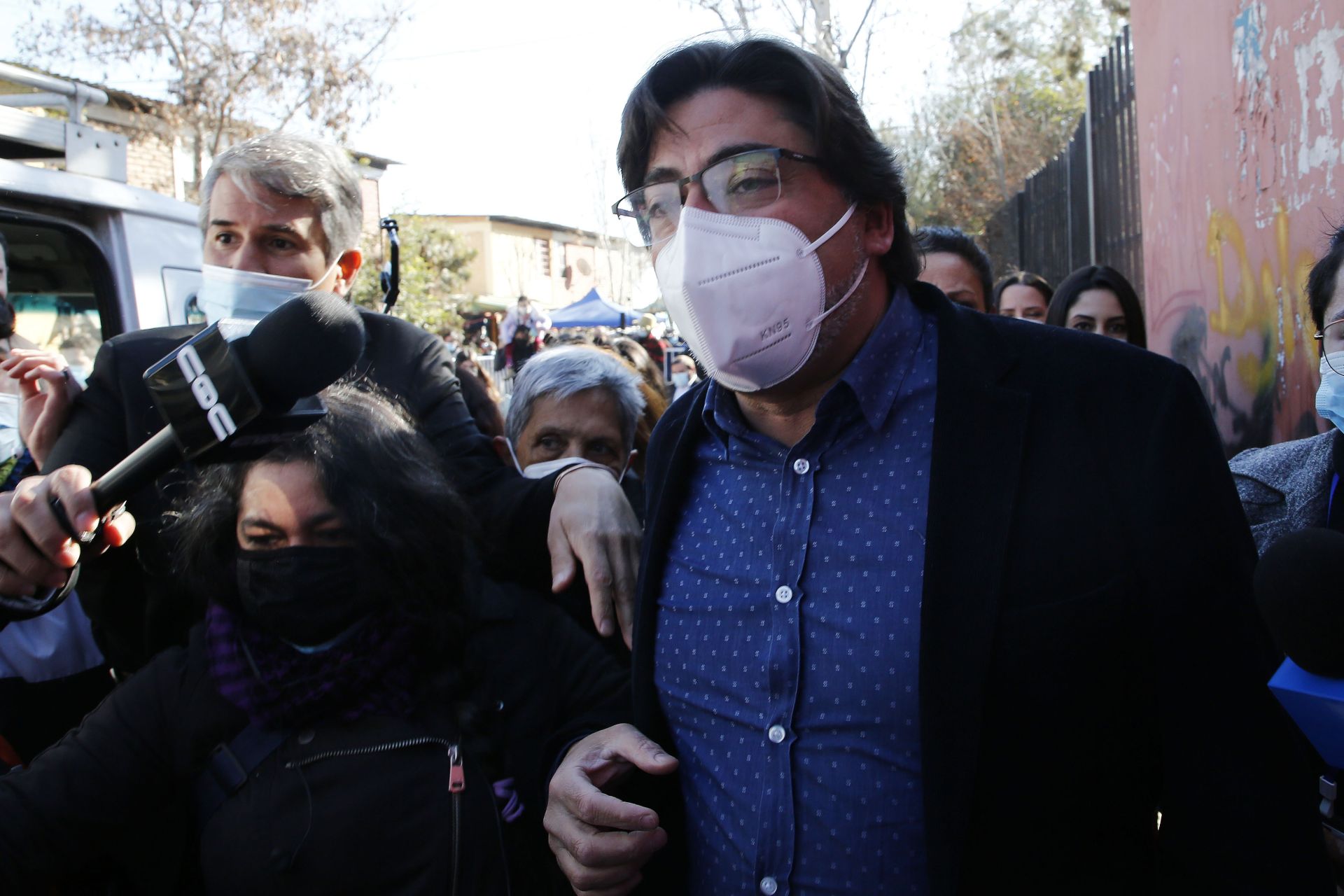
When I arrived at Daniel Jadue’s doorstep in a residential Santiago neighborhood, the Chilean communist greeted me at the front door in his sandals. I thanked him for welcoming me to his home. “It’s not like I have much of a choice,” he said with a hearty laugh. Jadue, after all, can’t leave this location. The one-story home has been Jadue’s prison since Sept. 2, 2024, when a judge ordered his house arrest.
The former mayor of Recoleta, a working-class municipality of roughly 160,000 people in the north of Santiago, Jadue stands accused of corruption charges for fraud and misuse of public funds. He contends that the charges, which date back to as early as 2017, are politically motivated. “Preso injustamente” — unjustly imprisoned — his bio on X announces. Chilean prosecutors see things differently: In August 2025, when charges were filed against him, they asked for 18 years in prison plus a 10-year disqualification from public office.
Jadue is a large man, with broad shoulders, dark-rimmed glasses and cropped black hair that frames his oval face. He’s a Chilean of Palestinian descent and a communist. His home has been decorated throughout with Palestinian flags and hammer-and-sickle propaganda. But is he a political prisoner and a victim of a witch hunt against progressives, or a corrupt mayor who pocketed funds earmarked for the same low-income populations he purported to serve?
When I visited Jadue’s house one week before the first round of Chile’s 2025 presidential elections — won by far-right candidate José Antonio Kast, who will take over as president in March — it was not just to answer this question. Nor was I there to have him respond to the charges against him, though I was itching to do that. Rather, I wanted to try to put my finger on the answer to one of Chile’s biggest what-ifs: What if, instead of becoming a prisoner — political or otherwise — Jadue had become president of Chile? And what does his rise and fall say about the challenges of the country’s progressive politics?
There are many what-ifs in Jadue’s story. In the left’s 2021 primaries, which brought together five parties from across the progressive spectrum, Jadue lost to student leader Gabriel Boric, who ended up winning the general election a few months later. As Boric’s mandate drew to a close, Jadue was again pictured as a presidential hopeful, but in the end, it was another communist — Jeannette Jara, who is more of a reformer than a revolutionary and had played a key role in Boric’s government — who snatched the nomination.
Jadue is a staunch defender of Venezuelan sovereignty and Palestinian liberation. He sees himself just as much as a foot soldier against imperialism as he does an innovator of grassroots, local policy. The latter, he says, is what put him in the line of fire. Jadue contends that he has been targeted for presenting an alternative to the capitalist model, thereby making him more dangerous than the coalition-building, reformist left that has managed to win election in Chile in the past and that ran in 2025. He is highly critical of the right for attacking him, but also of the left for betraying its values. In the wake of the Chilean left’s crushing electoral defeat last year, Jadue’s case brings this question roaring back: What should the left do against the rise of right-wing governments across the globe: adopt a radical, populist agenda or compromise?
Sitting in his armchair, drinking strong Turkish coffee, Jadue spoke with the confidence of a man who believes that history will absolve him. As our conversation went along, I started to think that the former presidential candidate, far from being out of the game, was actually sitting right where he needed to be — ready and waiting for his moment. With Kast’s resounding victory, and corruption allegations mounting against the prosecutors who investigated Jadue, the communist might get another chance to make his case: that the only way to obtain true progress toward equality is not through reform but through revolution, and that the only way to fix Chile is first to break its current form, and breaking things is necessarily messy. From Jadue’s perspective, the same cause he thinks landed him in the hot seat — trying to impose an alternative model to capitalism — might just be his absolution once the smoke clears.
Recoleta is like any other sprawling, working-class commuter suburb in Santiago: low to the ground, dingy, filled with graffiti and buses that fly through stoplights at a concerning clip. Except for one difference — the word “popular” is omnipresent. There are popular pharmacies, popular housing projects and popular bookshops. In this context, the best English translation of “popular” might be “people’s.” It’s important to define it because this term is the key to Jadue’s political and economic project. Jadue’s idea was simple: create a nonprofit to buy goods — such as medicines — directly from the supplier, register citizens as members of the cooperative structure, and sell them these goods at drastically reduced prices. Sort of like Costco, but run by the municipality.
The project didn’t come out of nowhere. In 2010, a young Communist Party activist named Fares Jadue received a late-night call from Daniel. Fares, who is not related to Daniel despite the shared surname (more than a century of Palestinian migration to Chile means that the country has one of the largest diaspora communities in the world, all descendants of a handful of families), had crossed paths with Daniel before in activist circles. He picked up the call. “We’re going to start campaigning for mayor,” Fares remembered Daniel telling him. “Isn’t it too early?” he responded. (Elections were scheduled for 2012.) That night, Fares became Daniel’s ground campaign manager, tasked with combing the municipality — one of Santiago’s largest and poorest — from north to south and east to west, and talking to members of the community to better understand their problems.
The approach made sense for Daniel. Before entering politics, Jadue had studied architecture and sociology at the University of Chile and worked as a commercial urban planner. His understanding of the world is as much spatial as it is ideological. So, two years before the election, Fares and a small group of colleagues started the long process of mapping out Recoleta. In all, they set up around 500 community meetings, many of them with elderly residents. Across these formal and informal chats, one topic kept coming up: access to affordable health care services and medical products. “The most common problem at that time was access to medicines that we define as fairly priced,” Fares told New Lines.
Daniel, whom Fares described as “very studious,” and his team began to investigate the market. What they found was galling. Cancer treatment in developing countries like India or Indonesia (Fares’ examples) costs 10 times less relative to average salaries. Other medicines, they claimed, were routinely 300, 500 or even 1,000 times more expensive in Chile than in other parts of the world. Their analysis was simple: the market was protecting itself rather than serving consumers. “We realized that the big retail pharmacy chains — the ones that dominated the market and even owned many of the pharmaceutical companies — were effectively fixing prices and only opening stores in areas where profits were guaranteed, leaving entire communities without access to affordable medicines,” Fares explained.
In Recoleta, Daniel and his team felt like they were on the front lines of righting this wrong. Their groundwork and simple messaging paid off. Despite polling that gave Jadue’s campaign only the slightest of chances of victory, the communist (who had already lost twice, in 2004 and 2008) won over 40% of the vote in 2012 — not an absolute majority, but enough to win the race against the incumbent, a representative of the hard right. Once in office, Jadue continued to work in secret for several months on what would become the people’s pharmacies.
The announcement initially ruffled some feathers, Fares admitted. In the first few years of the people’s pharmacies, questions about the constitutionality of the project were debated, notably regarding whether municipalities could offer health services without involving an independent legal entity such as a health corporation — possibly violating constitutional rules governing state involvement in commercial activities. “The usual dominant, hegemonic suspects tried to shut us down,” Fares added. “But at the time we had the support of the undersecretary of health, the minister of health, and President [Michelle] Bachelet herself, who came to see the project, endorsed it and ultimately adopted it as a public policy.”
Over time, Daniel and Fares continued to work out the kinks in their grassroots initiative. In 2016, they created a nonprofit body to better coordinate the individual member pharmacies, called the Chilean Association of People’s Pharmacies (ACHIFARP). They also sought to expand the project to other municipalities, which were intrigued by its early results and Jadue’s electoral success (in 2016, he was elected with over 50% of the vote; in 2021, he garnered nearly two-thirds of the vote in elections postponed by one year due to the COVID-19 pandemic). Soon, as many as 170 municipalities across Chile had at least one people’s pharmacy.
To Gonzalo Contreras, a Chilean researcher at Tulane University who grew up in Recoleta and has studied the people’s pharmacies, the municipality under the Jadues became a sort of “template” for grassroots progressive policymakers across the country and around the world. “Jadue’s position and progressive portfolio was imitated and was looked at with a lot of attention, not only in Chile but also in other places, about how to provide or complement the goods and services that are perceived to be exclusively allocated by markets,” Contreras explained by phone. Jadue used Recoleta as a sort of “laboratory,” he added, not only locally, but also nationally. “I think he wanted to signal to the electorate that politics could be done differently, and to some extent he did it,” he said.
The Jadues decided to expand to other sectors. In 2016, the municipality of Recoleta launched the People’s Optician; in 2018, they developed the People’s Real Estate Company of Recoleta and the free-tuition Open University of Recoleta. In January 2019, a people’s bookshop — Recoletras — was inaugurated in an alcove beneath the blockish municipal building that houses the mayor. It felt like the world was being reimagined from the bottom up.
On a warm, early spring day (autumn in the northern hemisphere), Fares ushered me into the office that used to be Daniel’s. Like Daniel’s home, Fares’ office is decorated with Palestinian flags and other paraphernalia. A large Palestinian flag was folded on a table. The municipality was planning to drape the flag, which is several yards long, on the side of the building for the upcoming International Day of Solidarity With the Palestinian People.
Fares has occupied this space since July 2024, when he took over from Daniel, who was forced to resign in the wake of the corruption allegations.
A month before Fares took office (he was elected with a far less resounding 35% of votes), Chilean prosecutors requested a formal indictment against Daniel — who, as mayor of the municipality, served as the head of ACHIFARP — for alleged irregular contracts and misuse of public resources during the COVID-19 pandemic. The criminal complaint was lodged in 2022 by Best Quality SpA, a Chilean medical resources provider, which claimed that ACHIFARP had failed to pay for about $1 million worth of goods — including masks, gloves and other supplies. The claim had ignited a broader inquiry into ACHIFARP’s financial management. The prosecution seemed to suggest that Daniel Jadue and others in the mayor’s office had been using the people’s pharmacies as a vehicle for personal enrichment since at least 2017.
Jadue had dealt with legal cases before, including one that was dismissed in September 2021. But the allegations against ACHIFARP were more serious and wide-ranging.
Fares told me that he was unable to comment on ongoing investigations. He could say, however, that in general the attacks against Daniel served a clear political purpose. “In this country, there’s a deeply entrenched narrative from the right that communists don’t know how to govern,” Fares told me from the glass office with a view of the distant mountains that surround the city. “So the attack is ideological, but it’s also about the state wielding its judicial machinery to halt the changes [Daniel] could implement within government in order to shape the narrative about the progressive left.”
The authorities closed in on Daniel. On June 3, 2024, a Chilean court ordered the politician’s pretrial detention, citing a risk to public safety and the seriousness of the financial allegations. Three months later, the pretrial detention was converted to a full house arrest as the prosecution built its case. It took nearly a year for prosecutors to file their final accusation, which accused Jadue of tax fraud, embezzlement, bribery and a bankruptcy offense under Article 463 of the Criminal Procedure Code. Prosecutors requested an 18-year prison sentence and a 10-year ban on public office.
The aggressive prosecution has been framed by Jadue’s legal defense as a “judicial setup” aimed at destroying his credibility. To that end, in March 2025, he filed a criminal complaint alleging collusion between the prosecutor, certain private attorneys and commercial pharmaceutical interests — claiming they conspired to frame him. Since Jadue’s arrest, a number of international leaders and human rights activists have decried the case as “lawfare” — the use of legal institutions to punish political leaders for their (in many cases progressive) policy stances.
In many ways, cases like Daniel Jadue’s are familiar across Latin America, where a number of high-profile politicians have been forced out of office and even imprisoned in corruption cases, explained Ezequiel González-Ocantos, a professor of comparative and judicial politics at the University of Oxford. According to González-Ocantos, allegations of lawfare have been made by politicians across the political spectrum, from Brazil’s Jair Bolsonaro to Ecuador’s Rafael Correa. “There is absolutely no politician who is convicted, charged or indicted for corruption who doesn’t make this claim,” he said.
Though the narrative goes that aggressive legal tactics have primarily targeted the left, the professor and author of several books on the topic cautioned that the numbers don’t necessarily confirm the bias. “Lawfare lies in the eye of the beholder,” González-Ocantos told New Lines. “It’s very difficult to establish intent in corruption cases, or it’s very difficult to obtain the evidence, so prosecutors have to be really shrewd and creative in the ways in which they approach these investigations.” The sometimes borderline tactics used to obtain evidence and sideline politicians accused of corruption “legitimize” the lawfare claims, he explained.
To Contreras, the researcher at Tulane, the truth in Jadue’s case probably lies between the two narratives — as it often does. “It’s very easy to think that there are a lot of people that didn’t want [the people’s pharmacies] to happen at all,” Contreras told New Lines. “If you can show a different vision of what politics might look like in a local territory, you’re demonstrating that another form of politics is possible on a national scale,” he said. “At the same time, there were a lot of things that probably in the end failed, in terms of provision, in terms of how you sustain this market with very [low] prices for people,” he added. In the end, “Someone has to pay for it.”
On Aug. 12, 2025 — the day after the formal charges were filed against Jadue — the Chilean Communist Party weighed in on his future. “We’re not losing any sleep over it,” Lautaro Carmona, the party president, said. “He will be part of our slate of candidates as long as he is legally able to run. And if he can’t, well, the situation will explain itself.” Then, in October 2025, even as the trial was still ongoing, Chile’s election commission banned Jadue from running for Chile’s ninth district, which includes Recoleta — a decision the party qualified as a “clear disparity in treatment toward our comrade Daniel Jadue compared to other high-profile cases, where candidates were able to exercise their political rights and run freely, even amid ongoing trials.”
Unable to run for president and removed from the mayor’s office, this third blow against Jadue looked like the knockout. It came at an interesting time.
The Chilean Communist Party is no stranger to being the pariah. It was twice banned — first from 1948 to 1958 under the Permanent Defense of Democracy Law, or so-called “Ley Maldita” (“Damned Law”), then again during the 17-year dictatorship of Augusto Pinochet, and was later excluded from the broad left-wing coalition known as the Concertacion that followed the return to democracy. But the blowback from Jadue’s case has revealed subtle fault lines within the movement, which was thrust suddenly into the national spotlight with the precipitant rise of Jara, the 2025 presidential candidate. Could the Communist Party go from outsider to mainstream without losing its ideological bent and transformative projects like the people’s pharmacies? If so, Jara’s candidacy posed a second question: Is Jara-the-reformer the future of the party, and Jadue its past?
In June, Jara won the left-wing primary (in Chile, candidates cannot serve multiple terms, so incumbent Boric was unable to run for immediate reelection), and the Communist Party found itself at the helm of a left-wing coalition extending from the far-left to the centrist Christian Democrats. Jara is about the same age as Jadue and also a longtime party activist who participated in its popular youth movement known as La Jota. Whereas Jadue is viewed as more ideological and closer to the Marxist old guard, Jara gained a reputation as a reformer. As labor minister under Boric, she was able to make significant, if incremental, policy advancements: a reduction of the work week from 45 to 40 hours, a minimum wage hike and partial pension reform. In the lead-up to Chile’s two-round ballotage elections on Nov. 16 and Dec. 14, Jara moved further and further to the center to appeal to a wider coalition, mixing bread-and-butter economic proposals with a working-class, almost folksy, delivery and a tough-on-crime bent. Jara implied that, if elected president, she would hand in or temporarily suspend her party membership.
That she lost so tremendously might not have surprised Jadue. When we spoke in November, he paused to ask me when this article would appear, as if measuring what he felt comfortable saying. “Jeannette’s result depends on — and will be strongly influenced by — the image Chile has of [the Boric] government,” he predicted. “And this is a government that started losing its bearings from the very moment it won. From the moment it won, it gave up all the transformative power it represented.”
Jadue, I would quickly understand during our hour-long meeting, is someone who sees the world in black and white, good and evil, right and wrong. It’s part of his origin story. “I was born on June 28, 1967, the day the Zionists annexed Jerusalem after the war,” Jadue told me. “So I was born in a context of great turmoil, and I immediately knew which side of the world I was on: the one that is not on the side of domination.”
When Jadue was 6 years old, a military coup toppled Chile’s democratically elected leader, Salvador Allende. Pinochet was installed as dictator, an iron reign that would last 17 years and during which thousands of opposition members, leftists and student leaders were rounded up, detained, often tortured and in many cases killed. Jadue’s first political education was in resistance. First, as a young activist for the Palestinian cause; then as a member of Chile’s communist youth movement, La Jota; and finally, as a full-fledged member of the Communist Party. The communists, to the young Jadue, were “the closest to my positions and beliefs.” As some of his colleagues — often younger and less Manichaean in their views — adopted a more social democratic approach, Jadue relished his role as both a party upstart with grand ambitions and one of its ideological anchors, close to the central committee.
Jadue represents the old guard, as Rolando Álvarez, a historian at the University of Santiago de Chile whose work focuses on the history of the Chilean Communist Party, explained to me over beers at a loud rock pub near the university. “Right now, there are basically two parties in one,” Alvarez said. “Jara’s campaign couldn’t be further from the one Jadue ran [in 2022]. During his campaign, Daniel said: ‘I’m a communist, not an identitarian.’ Because of this, he is very respected in the more militant circles. He’s the banner of Marxist-Leninist thought.”
Álvarez explained that the debate between revolution and reform, ideology and pragmatism, goes back to 1990. That year, Pinochet was voted out of power and replaced by a center-left coalition led by Patricio Aylwin that did not include the Communist Party. Facing a “triple crisis” — the communist-free Aylwin government, the dissolution of the Soviet Union and internal debates over ideology — the party needed to decide on a new way forward. Facing what they saw as two right-wing movements in Chile (Pinochet’s right-wing Independent Democratic Union (UDI) and the centrist Concertacion), the communists would stand for something else: a true opposition to the neoliberal economics that, in their view, both of the other movements espoused.
Ditching terms like the “dictatorship of the proletariat,” they would nonetheless work toward a “democratic revolution” that would fundamentally transform the country. The thinking went, “We want to fight for the country, reclaim it once again and achieve a real democracy, and that will require overcoming the neoliberal model and the legacy of the dictatorship,” Álvarez said. “That was the common ceiling under which many people gathered, but the devil lay in the details. That is to say, where and how are we going to build that democratic revolution?”
Within that common framework, some members of the party moved toward the center, toward the word “democratic” — embracing and endorsing left-wing governments such as that of Michelle Bachelet (2006-2010; 2014-2018). Others, like Jadue, focused on “revolution.” To Claudia Heiss, a professor of political science at the University of Chile, Jara’s 2025 campaign had all the trappings of the center-left and very little of the Communist Party hard-liners. “She is the candidate of the center-left coalition,” Heiss told New Lines before the elections. “And I think that, in that sense, what she represents today is not the agenda of the Communist Party; it is the agenda of the mainstream — the left wing of the Concertacion, the so-called ‘self-flagellators,’ as they were called in the 1990s.”
Jara was also seen as a continuation of the Boric presidency. In 2021, Boric, a student leader involved in the nationwide 2019 social movement that came to be known as the “estallido social” or “social uprising,” was elected president, beating Kast in the runoff. At 35 years old, he became the country’s youngest president. Boric has tattoos and a mutt known as Brownie; he came into office with plans to rewrite the constitution and end the private health care and pension systems. Chileans had clamored for radical change; many had lost eyes or limbs in the protests, which had been sparked by quality of life concerns in one of Latin America’s most expensive and unequal countries. Yet attempts to change the system from within hit barriers. The constitutional rewrite would have enshrined protections for Indigenous nations, done away with the private pension system and recognized rivers as protected entities. Nearly two-thirds of voters rejected it. Weakened by the vote, Boric instead pushed incremental changes: a gradual rise in the minimum wage, a tapering of private pensions and regulation of extractive industries.
Attempts at reform haven’t worked, Jadue insisted in our conversation, choosing to paraphrase the Marxist intellectual Rosa Luxemburg. Once in power, Jadue’s reading goes, Boric was nothing more than “a disciplined alumnus of North American imperialism.” “Beyond the nice, positive stories they told, the government failed. This is a government that came to La Moneda [the historic seat of the Chilean presidency] with a series of promises born out of the uprising and did not miss an opportunity to disappoint those who trusted them,” he said. To move forward, Jadue saw only one path: going back to the basics of revolution. “The failure of the left — of this so-called ‘progressive’ left — is that it learned to speak the language of economics perfectly, to speak the language of neoliberalism. It learned not only to speak it, but also to accept the categories and hierarchies imposed by the language of neoliberalism: fiscal rule, inflation, credit control, stability and governance.
“The problem of the left is not the success of the right; it is a left that no longer looks like the left,” he continued. “It forgot its own language, and if you forget your own language, you forget your reason for existing.”
Before leaving his house, I asked Jadue what he planned on doing if he was unable to return to politics. He quickly cut me off: “I’m going to return to politics,” he said. “Many people mistakenly think that politics only happens in the superstructure [in Marxist thought, the superstructure is the set of political, legal and cultural institutions that uphold power in society]. But the most important part of politics happens at the grassroots level, not in Congress or in government.”
In October 2025, Chile’s electoral commission banned Jadue from running for the assembly seat in Recoleta. The Chilean Communist Party tapped another member of the old guard, Boris Barrera — a subtle nod to Jadue. Jadue then appeared in a social media post with Barrera, a musician turned political operative, who promised to continue Jadue’s work.
“They had to cancel him because he was being seen as a primary candidate,” Barrera told New Lines over the phone several days before he was elected to the Chamber of Deputies during the Nov. 16 parliamentary elections. “There’s nothing casual about it. It was a set-up.”
Jadue’s camp has continued to cry foul — claims that seem to be gaining credence. In November, just two days before the first round of the elections, two of the prosecutors who investigated Jadue were themselves swept up in a corruption scandal. In the so-called “Belarusian doll” case, a mining company is accused of taking part in influence peddling to unlock access to lucrative government contracts. Eduardo Lagos and Mario Vargas, lawyers who prosecuted Jadue, have been named in media reports alleging corruption, though no formal legal action has been taken against them.
A few weeks later, a documentary by HispanTV suggested that judges in the Jadue case ignored evidence that could have exonerated the politician. The documentary also pointed to conflicts of interest that other members of the prosecution might have had with the pharmaceutical industry. A smoking gun? Certainly not. Still, there’s a sliver of hope for Jadue.
Contreras, the researcher at Tulane, pictured Jadue returning to office in a more formal manner. “He’s a very self-convinced person, who believes that what he is pursuing is the right way for local and national politics,” Contreras said. “He is probably going to try to run for office in the same district as Recoleta. I think he will have the time to start up again from scratch.”
In the meantime, the rest of the Chilean left finds itself weakened and on the back foot after Jara’s loss in December. Caught between the waning “Pink Tide” of left-wing movements and increased U.S. interventionism and aggression, it seems hard to imagine a credible alternative. But then again, the same thing could have been said about the upstart Jadue more than a decade ago.
In the Recoleta mayor’s office, Fares was just as convinced as ever of the need for the types of innovations Daniel had pushed for — regardless of the way he did so. “If there’s one important thing, something I really learned from Daniel, it’s daring to act,” Fares said, adding with a laugh: “He used to say, ‘I’d rather ask for forgiveness than ask for permission.’ That’s gotten us into trouble, hasn’t it?”
Become a member today to receive access to all our paywalled essays and the best of New Lines delivered to your inbox through our newsletters.