


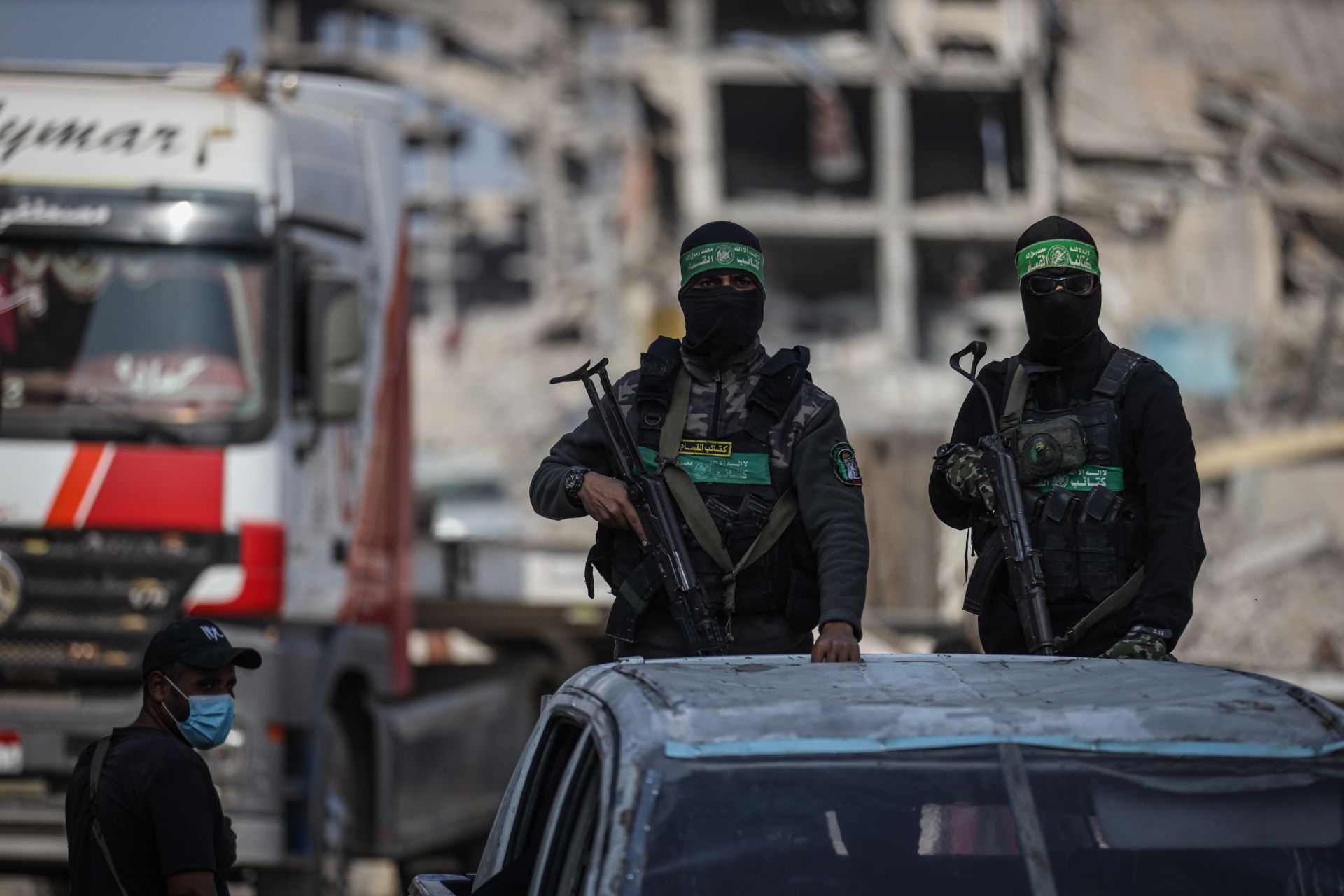
At least two parallel universes are intersecting in Gaza on a daily basis. In one, the obvious one, there is no ceasefire of which to speak. Israel continues to carry out strikes and demolitions at will, using everything from fighters to sniper rifles and drones to kill Palestinians. No one is immune.
Israel offers two justifications for the ongoing massacres. The first is “violations of the ceasefire.” If a Palestinian (regardless of age or immediate risk) has been found to be on the “Israeli” side of the Yellow Line — the line that divides the Gaza Strip roughly in half between Israel and Hamas (which Israel is hell-bent on destroying, though it can’t seem to actually do so) — then the “Palestinian” has “violated” the ceasefire and should be shot on sight. The Israeli army has killed more than 200 Palestinians since the ceasefire went into effect, including one 24-hour period following a “violation” in which more than 100 Palestinians were killed. Israel seems to believe it has a mandate to kill as many as it deems necessary. Imagine a soccer game in which one player fouls another, is carded for a violation, and then taken to the sidelines and shot by members of the opposite team.
Israel’s second justification for ignoring the massacres is its ongoing mission, as Prime Minister Benjamin Netanyahu has defined it, to “destroy” Hamas. Since Israel has declared that all Gaza is Hamas and every structure standing in the strip has been or could be used in support of terrorism, Israel considers itself formally permitted to destroy as much as it can as long as it still has relatively unimpeded access to various parts of the devastated territory. The tactical logic is simple: Hamas and the international community will undoubtedly mount obstacles and obstructions on the way to a consensual process. The more Israel destroys, the fewer resources Hamas will have to pit against Israel in a diplomatic struggle, and the more likely Hamas is to cave to Israeli demands, the most prominent of which will likely be official permission to attack inside Hamas territory at any time or to leave Israeli troops permanently in Gaza. This working premise is based on an assumption that Israel commands sufficient diplomatic might to preserve the nearly unlimited freedom of action it has enjoyed over the past two years. Any destruction is good destruction if there is no endgame.
However, as I suggested above, there is another, parallel universe in Gaza. In that universe, any operational or strategic (as opposed to tactical) power Israel may have had in shaping Gazan reality is gone. Israel has become a political liability even to its most steadfast friends, including President Donald Trump, who is taking flak right and left for supporting Israel in violation of American law and against the interests of the American taxpayer. While Israel may delude itself that it still enjoys complete impunity in Gaza, it does not. It is horrible to think, let alone write down this reality, but just about no one cares about the plight of the Palestinians. As a result, the U.S. allows Israel de facto permission to kill Palestinians, as long as they don’t kill too many, and as long as Israel can claim the army was only responding to Hamas’ violations of the ceasefire. In other words, Israel is permitted to shoot Palestinians who cross the Yellow Line, send bulldozers to demolish the few structures remaining standing in the strip, and use drones and fighters to “neutralize” (a favorite Israeli term for assassinations that often come with “collateral damage,” meaning the killing of innocent bystanders) Hamas targets with an unlimited human cost. Yet despite the horrors they cause daily, these actions play a marginal part in the shaping of Gaza’s geopolitical future.
The U.S. now holds the reins in Gaza. It does not appear that the Trump administration has an interest in sending American troops into Gaza, but the U.S. is very much interested in leading this coalition mission from behind. The U.S. Central Command (Centcom) has established a Civil Military Coordination Center (CMCC) in the Israeli city of Kiryat Gat, a short distance from the Gaza perimeter. The CMCC is a joint command center (that is, bringing together various functions and branches of the U.S. military). It is charged with coordinating stability efforts and humanitarian aid in the Gaza Strip. These official phrases, straight from the orderly briefing provided by CMCC staff for the Israeli and foreign press on Nov. 5, already indicate the sea change of strategic conditions in Gaza.
Israel has always vehemently opposed any type of internationalization of the Israeli-Palestinian conflict. This strenuous objection has solid reasons. International oversight, to say nothing of actual government- or military-level daily management of the Palestinian territories, would chip away at Israel’s facade of “normalcy.” The International Court of Justice ruled on July 19, 2024, that Israel’s occupation of East Jerusalem, the West Bank and Gaza was unlawful. The presence of non-Israelis in positions of oversight or actual influence would very quickly make the grim daily reality of the occupation, let alone the extent of the genocide in Gaza, impossible for Israel to deny. The very establishment of the CMCC should be considered a paradigmatic shift. This shift, in turn, is detrimental to the new Israeli security doctrine, as explained to Haaretz by an unnamed senior source (translation mine): “The IDF [Israeli military] will act against any threat when it is at its initial stages, regardless of the enemy’s motives.” In other words, when left to its own devices, Israel seeks a forever war ignited by the unrestrained discretion to identify “enemies” and to attack them at will. This new doctrine remains empty and hollow if a potential conflict zone is manned by international forces. Israel will not be able to fire at will if Gaza is full of Turkish, Qatari, Egyptian, Azeri and Indonesian troops and rescue personnel.
This seems to be the way forward for this so-called ceasefire. Palestinians will continue to die while Israeli authority over the strip continues to erode. Consider the question of the 200 Hamas fighters apparently “stuck” in the tunnels beneath Rafah. It is not clear if they are still alive or have already starved to death. In any case, Hamas is negotiating for their safe return to the Palestinian-held side of Gaza in return for the body of the Israeli soldier Hadar Goldin, who was killed by Hamas in Rafah during Israel’s invasion of Gaza (preceded by an intense rocket attack on Israel carried out by Hamas) in 2014. These negotiations have still not been officially approved. Nevertheless, Israeli army chief of staff Eyal Zamir said on record that these 200 fighters will be provided with safe passage “only in return for Goldin.” Someone then leaked to the media that Goldin’s body is being kept in the same tunnels in which the Hamas fighters are “stuck.” A day later, the Israeli army claimed that it had no information confirming the location of Goldin’s body. At the same time, various media outlets reported that the U.S. was pressuring Israel to allow the Hamas fighters safe passage.
These details are relevant because they provide a glimpse of the disarray on the Israeli side. Even three months ago, Israel would never have entertained the notion of allowing 200 Hamas fighters safe passage. Israel set out to destroy Hamas, not to care for the safety of its fighters. Similarly, even Israeli messaging, already notorious for its lapses in veracity, would have remained tight and focused on its main message, that Israel must destroy Hamas completely. None of this is happening at the moment. All Israel can do is obstruct and disturb the emerging International Stabilization Force currently being drafted by various countries, soon to be presented to the U.N. Security Council. To reiterate: Israel can kill any Palestinian who crosses the Yellow Line, no matter their age, motive or occupation. It can continue demolishing various cities and towns in the Gaza Strip. It can continue its use of drones and bombs in order to “hit” Hamas personnel while killing as many civilians as necessary. Still, despite the horrific impact of these actions, they are the only military options left for Israel in Gaza, alongside the prevention of aid entering the strip.
Israel has recently begun to invite foreign journalists to enter Gaza for carefully curated trips chaperoned by Israeli army personnel. This, as well as various opinion pieces in the Hebrew press calling for new approaches to Israeli messaging, along with a global hasbara effort making use of the most sophisticated tools (AI), indicate that Israel still hopes it can control the impact of the images broadcast from Gaza on a daily basis to screens all over the world. Based on commentary in Israeli social and mainstream media, it is clear that Israelis expect nothing less than a media disaster, whereas they seemed confident in previous stages of the war that they could convince the world that the destruction they generated was necessary. Once the scope of the genocide becomes unmistakably clear, Israel’s international reputation, already as low as it has ever been, will sink to new and murkier depths. Israel is trying every option and opportunity it has to draw attention away from this loss of control over Gaza, because this is a complete failure, even according to the standards Israel set for itself. These options include concentrated bombings directed at Hezbollah targets in Lebanon (Israel boasted about the complete destruction of Hezbollah, but this was, apparently, as complete as Israel’s destruction of Hamas), indicating the will to go as far as starting another war in order to distract both the Israeli public and the international audience.
Consistent reports suggest that since the announcement of the Trump administration’s 20-point ceasefire plan for Gaza, Qatar and Turkey have had Trump’s ear long before he calls Netanyahu. Trump appreciates the adulation he receives in Israel, but he also understands the risk to him, both domestically and internationally, of offering unlimited support. Trump also appears to want an actual mechanism in place. That this mechanism provides no representation for the Palestinians, that once again the Palestinian future is to be decided by others, that Israel retains a mandate for continuing to obstruct any politically binding agreement as well as for killing Palestinians — none of this concerns Trump. The U.S. president appears to have surmised that Israel is interested in going rogue or, if all else fails, in obstruction. Trump seems concerned about neither. The vacuum that has been left in Gaza by the Israeli genocide, a vacuum in all aspects of life, will not be filled by Israel.
In this universe, Israel is not interested in a land grab or in settling Gaza. Israel may be interested in the disappearance of the Palestinians, but now Israelis are interested most of all in their own domestic conflicts, such as the prime minister’s ongoing corruption trial and his government’s controversial plan to end the judiciary’s independence. Trump has no wish to participate in those struggles any further than suggesting “majestically” that he will “help Bibi out” with his trial because “he deserves it.” Trump and his senior leaders have already made it clear that they will not allow Israel to annex the West Bank. The fact that the settlers in Netanyahu’s government are actually conducting exercises in ethnic cleansing is less important in our second universe. By forbidding annexation, Trump has demonstrated that he heeds the call of his Arab and Turkish friends before he listens to Netanyahu.
Two universes. In one, Israel continues its genocide of the Palestinians relatively unimpeded. In the other, Israeli authority is disappearing quickly in Gaza, forcing Israel to resort to desperate bravado and warmongering and to abandon all hope of strategy. As far as most Israelis are concerned, the Gaza “war” will be over when the last dead hostage is returned. It is effectively over now. Most Israelis believe that the U.S. is making the major decisions in the field, but they don’t really care. With the live hostages safely back home and the dead hostages nearly all returned, Israelis are turning away from Gaza. Now they are ready to recede fully into domestic concerns.
Become a member today to receive access to all our paywalled essays and the best of New Lines delivered to your inbox through our newsletters.