


On Feb. 8, Japan will head to the polls after Prime Minister Sanae Takaichi dissolved the lower house of parliament and called for snap elections, aiming to capitalize on her high approval ratings. The first woman to hold her office in a country where significant gender gaps persist, particularly in politics — notably without coming from a family of politicians — she has earned widespread support through her direct, less rigid approach. Her gamble is to use this momentum to secure a more substantial majority than the current one-seat margin held in coalition with the right-wing populist Japan Innovation Party.
Yet despite polls placing Takaichi’s support rate at 60%, it is not guaranteed that this personal popularity will translate into equally strong backing for the Liberal Democratic Party (LDP) as a whole. Japan’s political terrain is being redefined by a brand of populism that bears a distinct American imprint — a phenomenon that is no longer an anomaly but a regional trend. One of the most compelling barometers of this election will be the performance of Sanseito, the far-right, xenophobic party that has sparked intense debate. Yet to fully grasp the “MAGAfication” of the region’s politics, one must look beyond Japan’s borders toward neighboring South Korea.
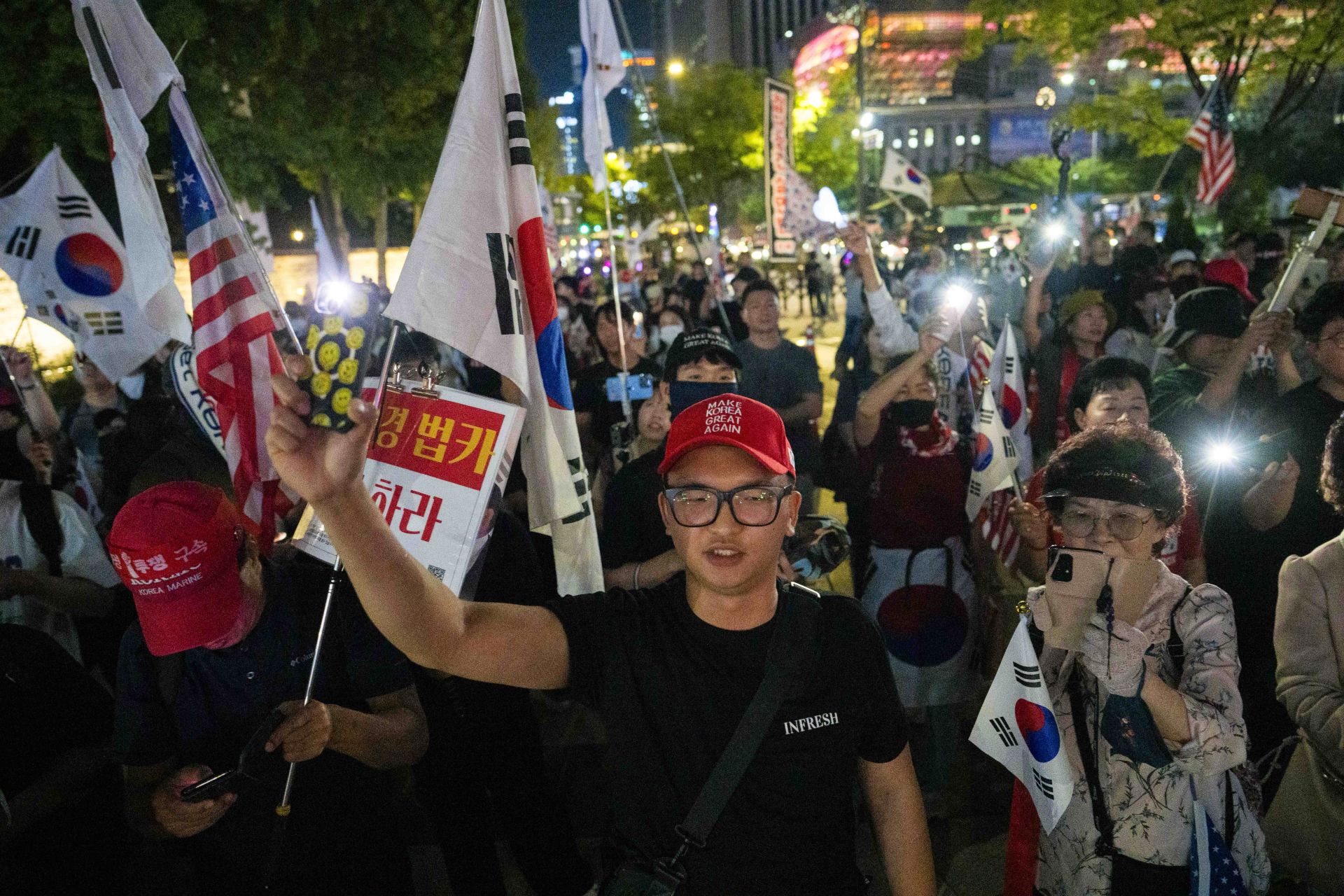
Every Saturday, a group of demonstrators gathers in Seoul, the capital of South Korea, equipped with the U.S. Stars and Stripes and the Taegeukgi — the red and blue Korean flag. They chant xenophobic slogans, using offensive slurs directed against Chinese residents in South Korea. They carry panels reading “Korea to Koreans” and wear baseball hats emblazoned with the well-known Trumpian refrain, slightly adapted: “Make Korea Great Again.” Leading the march is the far-right organization Free University, composed mostly of men in their 20s.
The organization took shape following then-President Yoon Suk-yeol’s declaration of martial law in December 2024, an event that plunged South Korea into political turmoil. After being dismissed from the presidency through impeachment, Yoon is now standing trial for insurrection and several other charges. Immediately following these events, militants from Free University rallied to Yoon’s defense, demanding his “liberation” and decrying the alleged plot against him — a plot they claim led to the election of Democratic candidate Lee Jae-myung, the current president. This campaign included the adoption of the slogan “Stop the Steal” — a direct nod to the rallying cry used by Donald Trump’s supporters to contest the 2020 U.S. presidential election — because Free University insists that last June’s election results were a product of interference from Beijing. The name reflects the group’s origins among university students who see themselves as “liberated” from the grip of leftist ideology.
Just hours after the American political activist Charlie Kirk, the founder of Turning Point USA, was killed at the Utah University campus, memorials and marches were already being staged. The connection between Kirk and the Korean far right was made evident when, just days before his killing, he embarked on an Asian tour that brought him first to South Korea and then to Tokyo. It is precisely in these two nations that a new political wave, directly inspired by MAGA, is emerging and employing the same playbook. Its supporters share identical code words and political agendas: They are fiercely anti-leftist, rail against the communist “menace” from China and North Korea, demand zero immigration, and maintain staunch opposition to any civil rights for the LGBTQ+ community.
For the demonstrators, the key evidence of the Korean government’s collusion with the Chinese Communist Party arrived when, at the end of September, the Lee administration permitted visa-free entry for Chinese tourist groups for up to 15 days until June 30 this year. This decision immediately inflamed the anti-China rallies, which claimed that the visa-free tourism policy would lead to an invasion of South Korea by Chinese nationals who would remain in the country illegally even after their visa-free entry expired. Conspiracy theories and alarmist claims that criminals and infectious diseases would enter the country circulated online and offline, and were promptly dismissed by officials and experts as false.
The situation escalated to such a degree that Lee intervened in early October, just ahead of a planned visit to Korea by Chinese President Xi Jinping. Lee ordered a crackdown on anti-Chinese and anti-foreigner rallies, stating that such demonstrations were harming South Korea’s international image.
It is obvious, however, that many of the attack lines of the Korean right have been lifted almost verbatim from the MAGA playbook. As Sim Jae-hong, a representative from Free University, told me during the Charlie Kirk memorial, the “nightmare to avert in Seoul is to become a city like London, full of immigrants and criminality.” This rhetoric, which frames European capitals as dystopian warnings of failed integration, is a hallmark of MAGA-style discourse.
By importing these narratives, the movement targets not only the Chinese community but also the Muslim community, which is no stranger to Islamophobic sentiments in South Korea. In the city of Daegu, in the southeast of the peninsula, the construction of a mosque was fiercely opposed by the local community in 2023. At the site where the place of worship was to be built, Al Jazeera reported at the time, three severed pig heads were left. Muslims are not allowed to eat pork under Islamic law, and people have used pork and severed pig heads as a symbol of anti-Muslim hate in other parts of the world, including in the United States.
South Korea, too, has experienced its own version of the U.S. Capitol attack on Jan. 6, 2021. On the night of Jan. 19, 2025, hundreds of Yoon supporters stormed the Seoul Central District Court, smashing windows and breaking down entrance doors. In the ensuing chaos, at least 40 people were injured and nearly 50 were arrested. The rioters broke into the court complex immediately after the Corruption Investigation Office for High-Ranking Officials (CIO) approved the detention warrant for Yoon. Free University activists were involved in the incident — one, 22-year-old Choi Sia, was convicted in November 2025 and sentenced to one year in prison, suspended for two years, along with 200 hours of community service.
Kim Joon-hyo, a journalist for the leftist newspaper Workers’ Solidarity, who has closely followed the ties between the Korean far right and the MAGA movement in the United States, explained: “We know that Charlie Kirk had visited Korea the previous December, at the invitation of a state institution, right after Yoon’s self-coup. But there are two more cases that show the unexpectedly strong ties between Korean far-right forces and MAGA, both directly connected to Trump himself.”
The first has become known as the “purge or revolution” tweet. Just hours before his summit with Lee at the White House in August last year, Trump wrote on his social media: “What is going on in South Korea? Seems like a purge or revolution. We can’t have that and do business there.” He was referencing police actions in South Korea aimed at rooting out supporters of the indicted Yoon. The timing offered Trump a measure of leverage in his own negotiation with Seoul, regarding the 25% tariffs he announced on imports from South Korea, a powerhouse exporter of computer chips, cars and steel.
The second case came during Kirk’s funeral event, when Trump publicly praised the Korean far right, saying, “In Seoul, South Korea, crowds gathered waving American flags and shouting ‘We are for Charlie Kirk.’” According to Kim, the journalist, this message is the second key element to consider regarding the ties with the United States, because this happened at the very moment when the People’s Power Party (PPP), now in opposition, stepped forward to lead the entire Korean far right and began mobilizing street protests.
The central figure acting as a bridge between the two sides of the Pacific is Mina Kim, the 36-year-old founder of Build Up Korea. Roughly three years ago, she began systematically bringing major personalities from the MAGA movement to South Korea. In September 2025, in addition to Charlie Kirk, the lineup of guests included U.S. political strategist and MAGA social media guru Alex Bruesewitz, and Maureen Bannon, the daughter of Steven Bannon and CEO of WarRoom. Far-right personality Jack Posobiec, who is best known for promoting the “Pizzagate” conspiracy theory, delivered a prerecorded message. The previous year, Donald Trump Jr. was the main attraction.
The reference model for Build Up Korea is precisely Turning Point USA, which established chapters in high schools and universities across the United States. Kim defines herself as a “Korean MAGA” and has twice been a guest on Steve Bannon’s podcast, War Room. During one episode, she claimed that the Chinese Communist Party and other foreign interests had influenced the push to remove Yoon from office. There is, however, no evidence for this claim. She also pointed to what she described as a wave of “CCP espionage,” including drones flying over military bases and hacking into government systems. She suggested that the declaration of martial law and the subsequent impeachment “opened the eyes of people” to deep-seated government corruption, sparking the Korean version of the MAGA movement.
With the return of Trump to the White House, many of Korea’s election deniers have been welcomed in the United States, where they organized meetings to spread their narrative. They clearly aim to secure backup in Washington to pressure the government to free the “unjustly” impeached former president Yoon.
A year after Yoon’s failed coup, South Korea’s celebration of its democracy’s resilience is rooted in more than just symbolism. The institutions have actively countered the antidemocratic threat through a rigorous judicial reckoning. Recently, former Prime Minister Han Duck-soo was sentenced to 23 years in prison, becoming the first Yoon administration official convicted on rebellion charges. The Seoul Central District Court is expected to deliver its verdict on Yoon’s rebellion charges on Feb.19.
The political polarization has, however, metastasized. The driving force behind this transformation has been the People’s Power Party (PPP) led by Yoon. The PPP was the first to successfully capitalize on the 2022 election results by identifying well-defined enemies — such as feminist movements and communists linked to China and North Korea — and is now openly endorsing the far-right demonstrations that have adopted Trumpian language.
“All this indicates that we must not consider Korean far-right forces as merely fringe groups,” explained Kim Joon-hyo from Workers’ Solidarity. “The PPP is a direct descendant of the ruling party from the pro-U.S. military dictatorship era in the 1970s. It has built deep networks within state institutions, the military and other political forces.
“We must not think of the PPP as ‘becoming’ a far-right party, but rather as ‘revealing’ its true nature. The coup attempt demonstrated that authoritarianism is an option. That is why Yoon remains the symbol and leader of this entire far-right wave.”
Although its politics and society are not polarized in the same volatile way as South Korea’s, Japan is also seeing the emergence of a political force that is gaining traction via the same far-right playbook. In a country where the LDP has ruled almost uninterruptedly for 70 years, Sanseito (literally, the “Party of Do It Yourself”) can now boast 15 seats in the Diet, the Japanese parliament. While this figure is far from undoing the LDP’s dominance, it is significant enough to shift the parliamentary balance and give Sanseito leverage in legislative debates.
Born on YouTube during the COVID-19 pandemic in 2020, the party, led by Sohei Kamiya, has adopted the QAnon playbook. For the first time in the Japanese political landscape, Sanseito has managed to bundle together diverse conspiracy theories — concerning vaccines, “globalist elites” plotting to destroy nation-states (including Japan), and xenophobic propaganda aimed primarily at Chinese and Kurdish people — all under the slogan “Japanese First.” Recently, Kamiya unveiled a new slogan for this electoral race: “I am Japan.” Its Japanese equivalent, “hitori hitoriga nihon,” literally translates to “every single person is Japan.”
While anti-Chinese sentiment is rooted in Japan’s colonial past and historical revisionism over many of the events of World War II, the hatred toward Kurds and Islamophobia in general are more recent phenomena. A community of Kurds settled mostly in the cities of Warabi and Kawaguchi, in Saitama prefecture. While they number only around 3,000 people out of a local population of 670,000, the area has been given the derogatory name “Warabistan.” The primary cause of the heightened tension was an incident in 2023, when a private dispute led to one stabbing and the Kurdish community members connected to the dispute crowded the hospital, temporarily disrupting emergency services.
Although refugee intake, Chinese investment and overtourism would normally require distinct policy approaches, Sanseito has grouped them under a broader umbrella. “Sanseito has been very successful at spreading their message and putting together all of these very separate ideas: refugees, immigrant labor, Chinese people buying up land, foreign capital, overtourism,” explained Romeo Marcantuoni, adjunct instructor at Temple University Japan. “All of the problems within that bucket existed beforehand, and have always been here. But they never really were pushed into this kind of political message in this way. So there’s definitely a political innovation, and Sanseito has managed to capitalize on that.”
The party has been attractive to voters primarily due to its increasingly popular YouTube channels, which have soaring subscriber numbers. Following their entrance into the Diet, mainstream media also opened their studio doors. Generally, the mainstream media are very careful to give space and time to political forces in proportion to their political weight. To that end, outlets started interviewing Sanseito members, in the process airing their statements without providing critical context or nuance.
The so-called “cordon sanitaire” — a mechanism that has historically kept far-right parties out of power and off the news and political agenda in many European countries like Germany, France and Belgium, and which is increasingly fragile — does not exist in Japan. Instead of an external barrier, Japan’s political system has historically relied on a form of internal containment. For decades, radical nationalist views were not represented by independent parties, but were instead absorbed within the broad tent of the ruling Liberal Democratic Party.
As Marcantuoni said: “Japan has no such history because they never really needed that for most small far-right parties, which never won elections. The LDP has far-right people within it, but they don’t necessarily discuss those issues publicly unless they’re with their closest supporters, and those views don’t often become official party policy.”
It is therefore no coincidence that Charlie Kirk made Japan the second stop of his Asian tour, attending an event organized by Sanseito. Kamiya, its leader, is actively moving to forge relations with overseas right-wing forces: in recent months, he held meetings with European far-right party members, including Virginie Joron from the French National Rally in November, and Tino Chrupalla, co-leader of the Alternative for Germany (AfD) party in August.
The individual acting as the key liaison with the United States is 66-year-old Sen Yamanaka, who is in charge of International Affairs for Sanseito and was elected to the upper parliamentary house via the proportional representation system in July 2025. Yamanaka previously worked in New York for the Japanese financial services company Nomura Securities before starting his own business between the U.S. and Japan. Kamiya has much to gain from these meetings: He can present himself to his own electorate as the preferred interlocutor of far-right forces in the U.S. and Europe. As one party executive told the Japanese newspaper The Asahi Shimbun, “Reviving the middle class through a country-first principle is a global trend, we will be the ones to lead it in Japan.”
To win over the middle class, they are using exactly the same rhetoric that worked in the West, repeating the antisemitic conspiracy theory that George Soros interferes in national politics for immense profit. They also rail against the Muslim community in Japan, arguing that they hold “values and customs that clash with those of Japan.” This sentiment was demonstrated by Diet member Umemura Mizuho, who went viral for speaking out against the burial of Muslim residents in the country, arguing that cremation is part of Japanese culture. It is worth noting, as Jeffrey J. Hall, a lecturer at Kanda University of International Studies, pointed out on X, that burial was normal for most Japanese people before the 20th century.
Kamiya has also used conspiracy theories that are less well known in Japan, such as “cultural Marxism,” which posits a plan by universities and cultural elites to suppress the Christian values of Western society. Although this reference is less immediate to the Japanese public, the phrase is now being repeated by Sanseito representatives directly from the Diet benches.
Takaichi, the current prime minister, represents the most conservative and nationalist wing of the LDP and is considered the political heir to former Prime Minister Shinzo Abe. Her approval ratings remain high despite the controversy she sparked during her inauguration speech, when she explicitly vowed to “throw away the phrase ‘work-life balance.’” This caused an immediate stir in a country where “karoshi” (death from overwork) remains a traumatic social issue, recently reignited by public appeals from families of victims warning against any policy that might justify longer working hours. Her popularity also persists despite her declarations regarding a possible military intervention in Taiwan in the event of an invasion, which triggered a crisis and a series of political and economic retaliations from Beijing. Several scholars — as well as former Prime Minister Shigeru Ishiba — have highlighted that none of her predecessors had ever publicly expressed themselves on Taiwan as Takaichi did on Nov. 7 in a parliamentary session.
For decades, Tokyo has maintained a policy of “strategic ambiguity” regarding Taiwan, mirroring the cautious approach of the United States. While previous leaders typically relied on carefully worded, standard responses to avoid challenging the “One China” principle, Takaichi’s explicit stance marks a significant departure from this tradition.
The Liberal Democratic Party has long faced an approval crisis, which intensified first with a scandal over illegal campaign funding that became public in 2023, and later due to revelations about its ties with the Unification Church, which came to light after Abe’s assassination in July 2022, motivated by a grudge against the church. Yet for the Feb. 8 elections, Takaichi has called upon candidates who have been forced to resign in recent years due to their ties with the Unification Church or their involvement in the illegal funding scandal. This lineup includes former Economy Minister Daishiro Yamagiwa, forced out in 2022 over Unification Church ties, and Tamayo Marukawa, who recently fueled xenophobic anxieties by claiming immigrants are “invading” residential areas. Most polarizing is the endorsement of Mio Sugita, a lawmaker notorious for her derogatory remarks against the LGBTQ+ community and ethnic minorities, including the Ainu and the Korean diaspora.
Takaichi was scheduled to participate in a televised debate on NHK ahead of next Sunday’s elections. However, the prime minister cancelled at the last minute, citing a health issue. Takaichi, who suffers from rheumatoid arthritis, reportedly experienced significant swelling in her hand due to the countless handshakes during recent rallies. Yet some in the press suggest that her absence was a strategic move to avoid uncomfortable questions regarding ties to the Unification Church.
Last week, a Sanseito-backed candidate won in a gubernatorial election for the first time. As The Asahi Shimbun noted, the party hopes that the victory of Takato Ishida, 35, in Fukui prefecture will become a tailwind for the elections to the House of Representatives on Feb. 8. This win signals, once again, that what was once considered fringe discourse is rapidly becoming the new mainstream. This momentum is being fueled by tactical digital campaigns: On X and TikTok, viral clips of Kamiya show him strategically targeting younger voters. He argues that those who truly wish to support Takaichi should not further empower the LDP, but instead vote for Sanseito — a calculated attempt to siphon support from the prime minister’s base through political misdirection.
The rise of Sanseito, alongside the MAGA-inspired movements in South Korea, suggests that a new, U.S.-influenced political model is firmly taking root among Washington’s key allies in the Asia-Pacific region. In this context, leaders like Takaichi or Yoon act as institutional bridges: By adopting and normalizing parts of this discourse, they shift the boundaries of what is considered acceptable in political debate.
As European politics often shows, when the center-right chases the far right on immigration issues, they end up paving the way for their own displacement. The “MAGAfication” of Japan and South Korea is far more than a passing trend; it marks an epochal upheaval that is rewriting the rules of democracy in East Asia.
Become a member today to receive access to all our paywalled essays and the best of New Lines delivered to your inbox through our newsletters.