





In the weeks running up to Christmas in 1984, amid the familiar din and bustle of high streets and shopping malls across the U.S. and U.K., a new holiday song began wriggling its way in among the classic carols and cheery pop tunes piped into every store. “There won’t be snow in Africa this Christmas time,” a blockbuster lineup of pop and rock stars — including U2’s Bono, Boy George, Sting, members of Duran Duran and George Michael — sang plaintively, over a track of clanging bells and Phil Collins’ enthusiastic runs on the drums. “The greatest gift they’ll get this year is life / Where nothing ever grows / No rain nor rivers flow / Do they know it’s Christmas time at all?”
Band Aid, as the supergroup was known, was about to top the U.K. charts and raise millions for what the BBC, earlier that fall, had called “the closest thing to hell on earth” — the famine ravaging Ethiopia. A series of catastrophic droughts and internal conflicts had disrupted agricultural cycles for several years in a row, leaving nearly a fifth of the population hungry. As shoppers in some of the world’s wealthiest nations went about filling their grocery carts while contemplating Bono’s exhortation to “tonight thank God it’s them instead of you,” millions of men, women and children were suffering catastrophic hunger. As many as 1.2 million Ethiopians were estimated to have died between 1983 and 1985.
Band Aid’s promotional campaign relied on a striking poster: a globe laid out like a dinner plate, flanked by a fork and knife, bearing the slogan: “Feed the World. Buy this record.” The imagery of richly laden Christmas tables stood in stark contrast to Ethiopia’s reality.
The song’s portrayal of Africa as a land of perpetual scarcity — “where nothing ever grows,” as Boy George sang — was far from reality, however. Ethiopia itself had long enjoyed a reputation beyond Africa for its rich, fecund soil and its lush green highlands. In 1816, Henry Salt, a British diplomat and consul in Ethiopia, described the land as “so rich in water and pasturage that Europeans could scarcely imagine its beauty.”

The reductive and contradictory images long associated with Ethiopia are finally coming under scrutiny. In 2024, 40 years after “Do They Know It’s Christmas?” first aired, several artists — among them Ed Sheeran, who had earlier expressed regret for joining the 2014 remake — denounced the song for perpetuating outdated stereotypes about Africa. From Addis Ababa, Ethiopian Prime Minister Abiy Ahmed added his voice to the chorus of criticism. “Famine does not define who we are as a nation or a continent,” Abiy wrote in a statement, before making a promise: Ethiopia would never go hungry again.
After taking office in 2018, agrarian reform became the centerpiece of Abiy’s attempts at national transformation — liberalizing agriculture, linking it to global markets, and fusing history, pride and economic strategy into a single narrative: the rebirth of the “breadbasket of Africa.” By 2024, he went further, claiming that Ethiopia had transformed from a major wheat importer into a self-sufficient producer, even generating a surplus for export.
Hashtags like #ProsperousEthiopia and #WheatRevolution began spreading on X, congratulating the country’s representatives. On paper, the claim seemed plausible: Agriculture still accounts for roughly a third of gross domestic product and employs about two-thirds of the labor force, making it the backbone of Ethiopia’s economy. But independent analyses — from the African Development Bank, U.S. Department of Agriculture and the U.N. Food and Agriculture Organization — estimated the 2022-2023 harvest to be less than half the government’s reported figures.
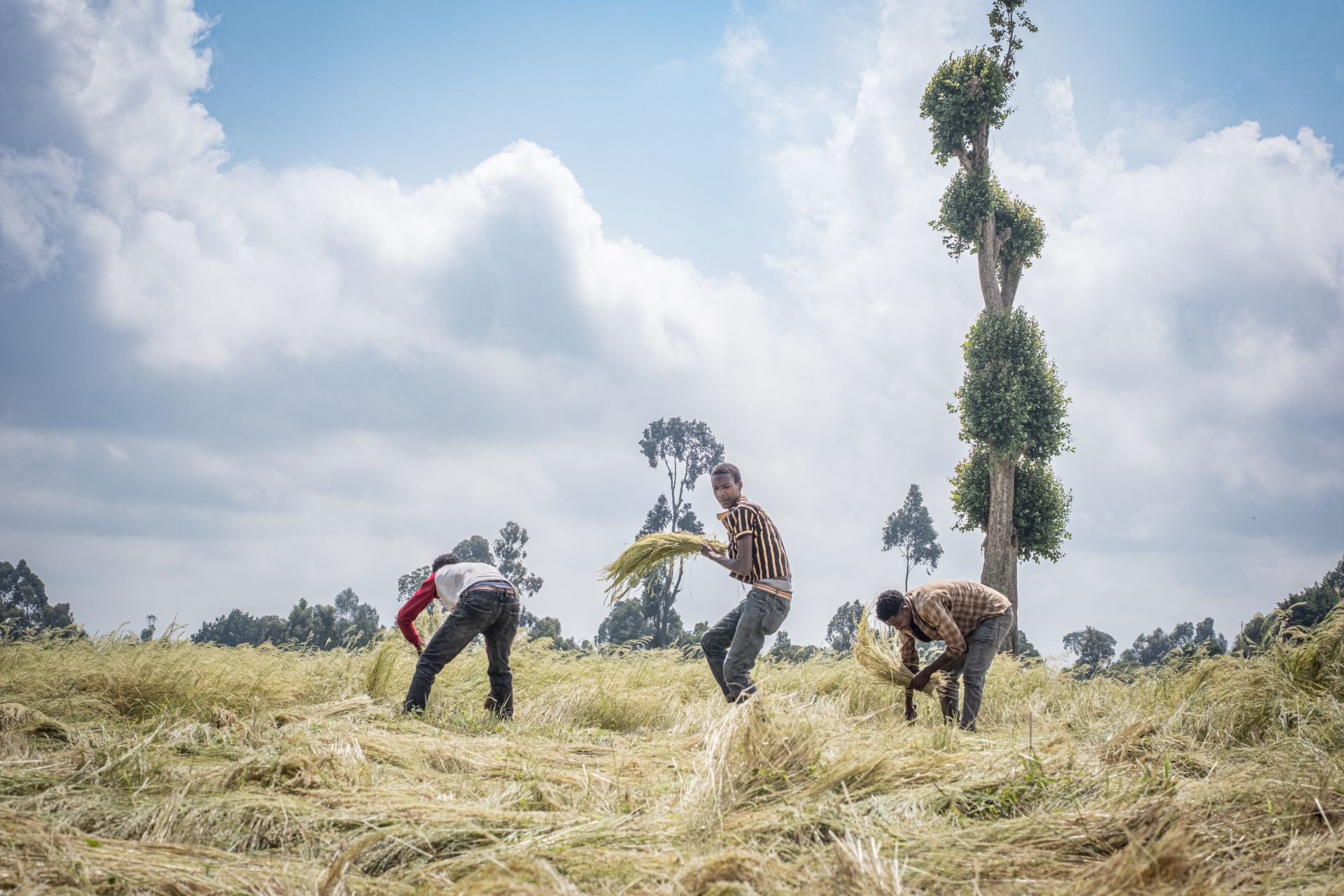
A few months later, officials quietly clarified that “self-sufficiency” did not mean a complete end to imports. Humanitarian agencies, operating in the country since the days of the famine, could still bring in wheat according to operational needs. By then, skepticism had grown over the government’s ambitious production targets. Beyond the statistics and slogans echoing through the streets of Addis Ababa, the reality on the ground told a very different story. New Lines traveled to Ethiopia’s prime agricultural region of Oromia to report on how local farmers are coping with rising input costs, land shortages and government reforms, as they persist in the subsistence farming that still dominates rural life. Their farms, and their way of life, are far from the large-scale, mechanized monocultures — vast single-crop plantations — envisioned by the state. In the country’s agricultural heartlands, the government’s narrative of abundance often sounds as illusory as the refrain of “Do They Know It’s Christmas?” — a reassuring fiction that masks a much harsher reality.

About 155 miles south of Addis Ababa, amid a patchwork of fields and small settlements, the gap between propaganda and reality takes on a human face. For Roba Bariso, 56, the story of vanishing farmland is painfully familiar. Sitting beneath the toolshed on his plot in Elemo, a village near Shashamane in Oromia, he recalls watching his father work the land as a child. Their family farm was generous: a mix of maize, sorghum and enset (the “false banana”) for home use, interspersed with grazing areas for cattle. Each month, his father guided the herds across the fields, rebuilt the traditional round fences and let the animals naturally fertilize the soil. “In my father’s time, agriculture was sustainable. He didn’t have to pay for chemical inputs,” Roba says.
Most of the land back then was devoted to grazing, with only a small portion cultivated to meet the family’s daily needs. Life followed the rhythm of the seasons and the livestock, not the market. Words like “self-sufficiency” and “food security,” now central to government rhetoric, were once simply a local reality. When Roba was born in the 1970s, Ethiopia was at the beginning of a massive population surge, from about 28 million to nearly 135 million today. This explosive growth has placed immense pressure on small farms, and has transformed traditional practices and reshaped rural communities.
“Everyone wanted a piece of land,” recalls Benura Walde, a retired Ministry of Environment employee and forestry expert in Shashamane, who remembers when cattle herding was the Oromo people’s primary livelihood. “With population growth, grazing land has disappeared and forests have been cleared, leaving little space for the cattle that were once central to our way of life.”
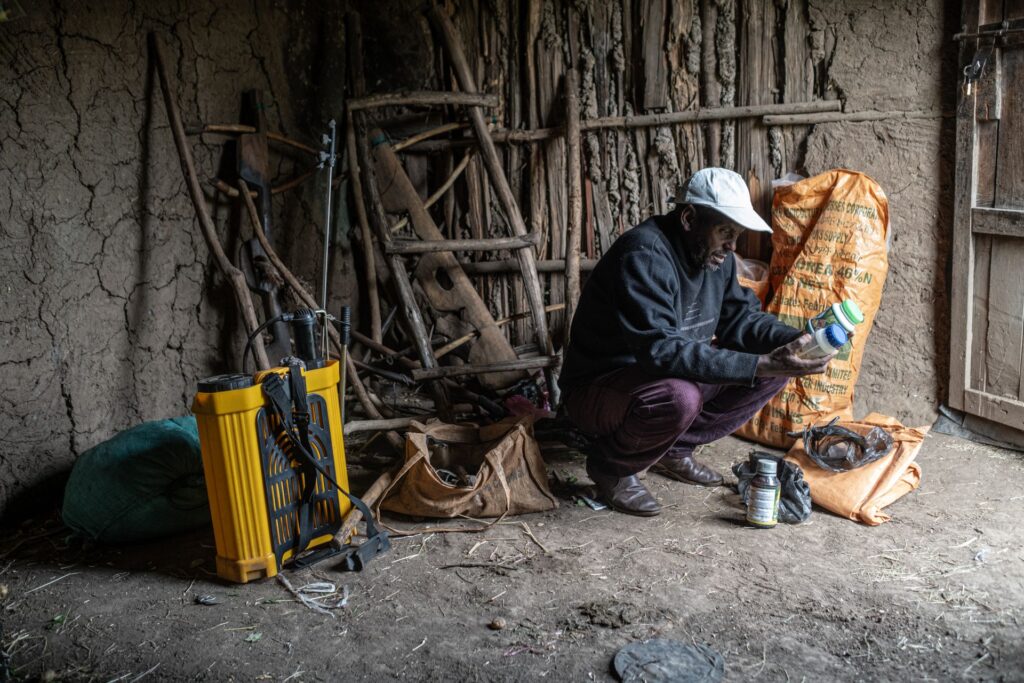
Today, Roba’s field looks very different from how he remembers it. After his father’s death, the family estate was divided among 13 brothers. What was once a vast, productive farm became a patchwork of small parcels. Roba’s own share is only about 5 acres. The fragmentation of his father’s land mirrors a nationwide challenge: parcelization. Walking along the borders of his field, Roba traces the lines that separate his plot from his brothers’. “Today, everyone survives on their own small piece. I am one of the lucky ones. Some people around here have only a quarter of a hectare,” about half an acre. According to the World Bank, average farm sizes in Ethiopia have steadily declined and, today, typically range between 1 and 2 acres.
Family wealth was once counted in livestock, and fields were measured by the length of a plough’s furrow. Now, in Oromia, those traditional units for measuring fields and livestock have given way to standardized, market-oriented measurements. While echoes of the past remain, the commercialization of agriculture, championed by Abiy, has reached even Roba’s rows of cabbages and potatoes. With the rise of cash crops, land has become one of the few reliable sources of income, as farmers sell vegetables to traders or at local markets. Combined with rapid population growth, this shift has created a web of informal intermediaries who buy and resell seeds and produce from smallholder farmers — those who manage less than 25 acres — tying rural livelihoods to volatile market forces and eroding purely subsistence farming.

Not far from Roba’s plot, 22-year-old Debiso Dakebo tends onions under the sun. His farm is even smaller than his neighbor’s, measuring just a quarter of an acre. As part of the younger generation, his inheritance has shrunk with each division of family land. “I farm onions, a good cash crop. I keep a small portion for my family and sell the rest to local traders. This is how I survive,” he explains. A medical student, Debiso hopes to become a doctor but struggles to cover living expenses. “I cannot even afford machines or fertilizers, so I have had to learn how to make compost. Without fertilizers, my income is never secure because productivity is strongly affected by the weather.” Shorter rainy seasons have added to his uncertainty. At the end of each season, Debiso barely saves 10,000 birr (roughly $65) after covering the costs of seeds, labor and land preparation. For many young farmers like him, such slim margins mean surviving one harvest at a time.

Faced with a profound crisis in rural areas driven by land fragmentation, the government under Abiy seized the opportunity to push agricultural production in a direction that is highly beneficial to state coffers, but not necessarily to small subsistence farmers like Debiso. The prime minister launched a rural reform aimed at shifting toward a more export-oriented agricultural model, with a focus on expanding domestic wheat production. Abiy revived a vision of Ethiopia as a major cereal producer — a homegrown echo of fascist Italy’s old colonial dream of turning the country into the breadbasket of Rome. His plan officially seeks to boost agricultural productivity, integrate rural populations into the global economy and reduce poverty and youth unemployment. Yet the reform also raises questions that go beyond how the soil is used, touching on identity, heritage and the centuries-old bond between people and their land.
In Oromia — Ethiopia’s cereal belt and a region historically at odds with the central government — land reform is difficult and deeply contentious. In 2018, land disputes tied to the expansion of the capital, Addis Ababa, triggered deadly clashes that claimed at least 23 lives, according to the Ethiopian Human Rights Commission. “In some areas, production only resumed after years of resistance,” recalls a priest in Herero village in the southeastern highlands of Oromia, about 125 miles from Addis Ababa. “Farmers destroyed newly planted fields, protested or let their animals graze on them.”
The Ethiopian land system, inherited from the socialist government that ruled the country from 1974 to 1991, historically protected the rural majority from mass dispossession. Likewise, the Fascist Italian occupiers failed to realize their colonial ambition of turning the country into a vast grain reserve for Rome. While colonial powers elsewhere in East Africa — in Kenya, Tanzania and Uganda — reshaped the land in favor of monocultures, the Italians’ attempt to exploit the Ethiopian highlands was thwarted by their defeat in 1941, after only five years of occupation. The federal constitution of the 1990s continues to restrict private land sales, allowing farmers to inherit or lease plots but not sell them outright.
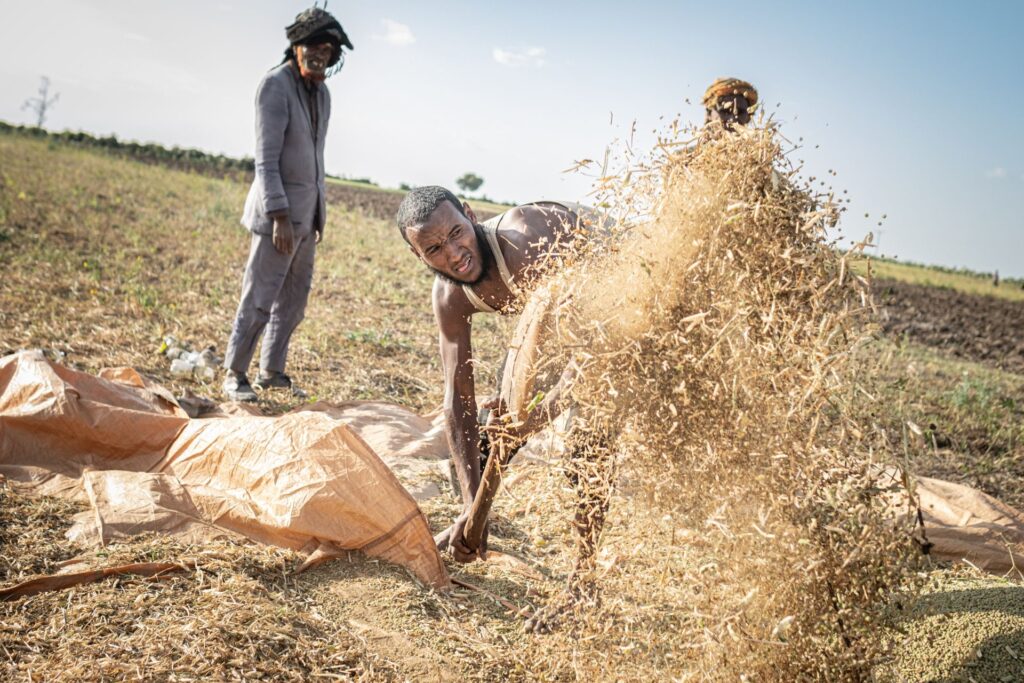
Building on this legacy, Abiy introduced the idea of “cluster farms,” groups of smallholders reorganized into large, mechanized units. By pooling their plots, farmers gained access to machinery, fertilizers and pesticides subsidized by the state. In return, they were required to adopt the improved seeds provided by the government, often converting their traditional crops. Taxes on imported equipment were waived, irrigation networks were expanded and new tracts of land were brought under wheat cultivation. The policy promoted a shift from subsistence to commercial farming, ensuring access to inputs that would otherwise be out of reach for most smallholders. Some farmers have seen their yields and income rise, but for others the system has been precarious, deepening dependence on volatile markets and expensive inputs while undermining livelihoods once rooted in family labor and ancestral knowledge.
Although smallholders’ land rights have historically limited large-scale commercial investment, Abiy’s reforms have repurposed state-managed farms inherited from the socialist era. Around the village of Herero, open fields and farmland extend for miles. It is here that Herero Farm produces enhanced wheat varieties, such as Mandoyu and Kingbird, which are gradually replacing traditional local types. “State seed companies reproduce these improved varieties,” explains Driba Tesfaye, coordinator of Cluster Farming and Seed Multiplication at Madda Walabu University in Bale. “Research centers develop and release them, and cluster farms receive priority access.”
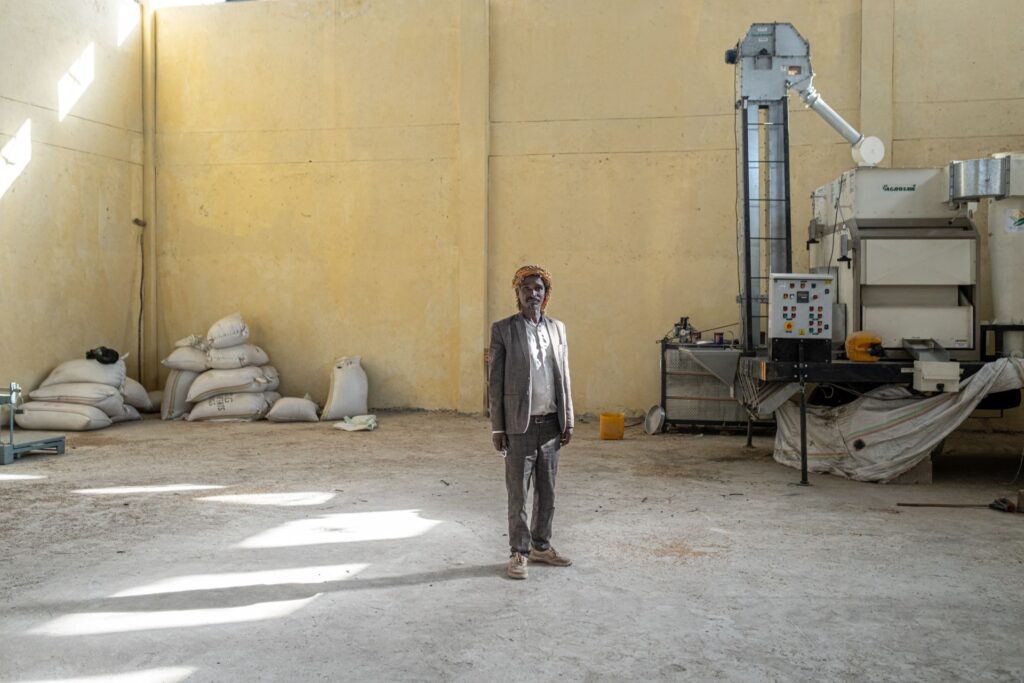
In the plains near Madda Walabu University, farmers affected by land fragmentation have formed the first clusters. Inside a half-empty warehouse in Ilu Sanbito village, sacks of enhanced, state-backed wheat varieties are stamped with the cooperative’s logo. The crop has steadily displaced traditional varieties once grown by subsistence farmers. The cooperative now includes 252 farmers, cultivating plots ranging in size from just over half an acre to 5 acres, for a total of roughly 1,186 acres. At the center of the warehouse stands a government-funded seed-cleaning machine. “Our goal is to industrialize agriculture,” says a technician from the Bale Zone Agricultural Office. “Farmers once planted seeds for food. Now, we plant to fight poverty. In the future, they will work together to export.”
Inside the warehouse, 52-year-old cooperative leader Abduro Ahimad gestures to a production chart illustrating the growth of wheat output over the years. Wearing a jacket, tie and orange headscarf, he points to posters of pesticides and fertilizers displayed on the wall, including Glymax, a potent herbicide. “We received government training on how to use these chemicals,” he says, holding up a printed manual that defines terms such as “maximization” and “productivity.” To combat the soil acidity characteristic of this region, which limits the uptake of chemical nutrients, the cluster has had to adopt an agroecological approach, rotating crops between wheat and peas. The cooperative also pays farmers according to each member’s field performance, aiming to compensate for income lost due to land fragmentation. Yet amid the quiet warehouse, the sacks of wheat and the sharp smell of fertilizer, one question lingers: Who truly benefits from this wheat boom?
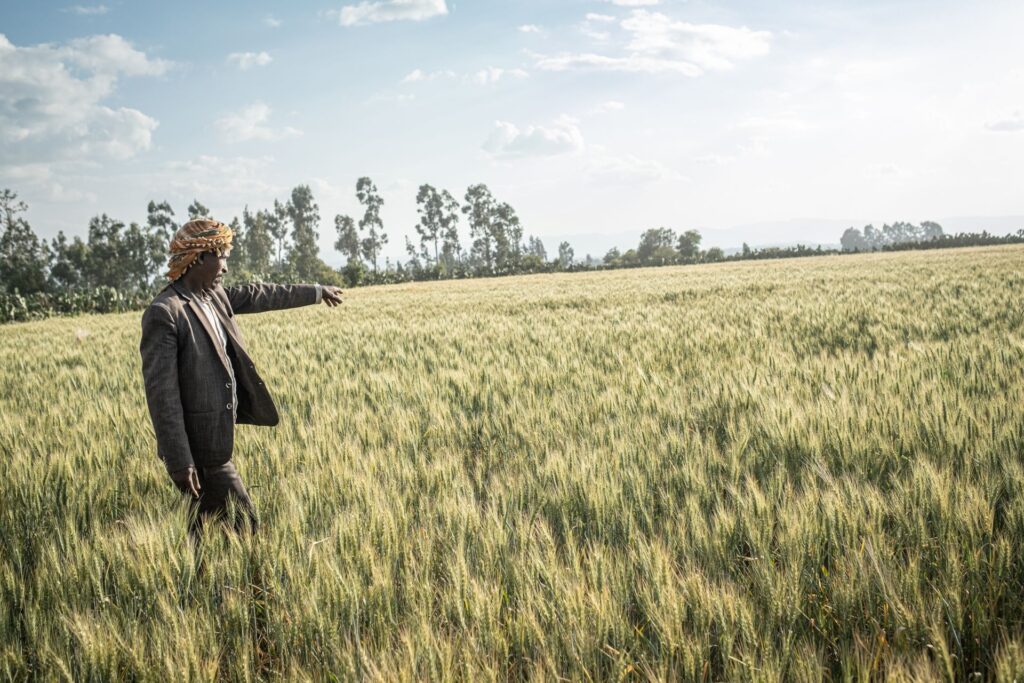
Outside Ilu Sanbito village, tractors queue for hours, stalled by a national fuel shortage that hampers mechanized farming and cuts productivity. These blockades, common across rural Ethiopia, underscore why the government is pushing wheat production: to earn foreign currency. Exports remain largely land-based — coffee, seed oil, dried legumes and cut flowers bring in most revenue, with gold a minor player. Yet in 2024, Ethiopia faced a $13.6 billion trade deficit, putting the state finances under pressure. Wheat has become a symbol of national revival, a way to turn the country’s main asset — its land — into GDP.
Although Ethiopia continues to import wheat through humanitarian aid and nutrition programs for marginalized communities, buyers for potential future harvests are already lining up. In 2022, Djibouti, the country’s vital maritime outlet, announced plans to import Ethiopian wheat. Addis Ababa also secured export deals with Kenya and signed a $2.5 billion agreement with Nigeria’s Dangote Group to build one of the world’s largest urea fertilizer plants in Gode. In September 2021, the Moroccan group OCP and the Ethiopian government signed an agreement to construct an industrial fertilizer complex in Dire Dawa, a special-status city in eastern Ethiopia administered directly by Addis Ababa. The complex will use local natural gas and Moroccan phosphoric acid, with a planned production capacity of more than 2.5 million tons of fertilizer per year. Officials hail these initiatives as proof that “Africa has the capacity to feed itself” and can “achieve a food-secure future.”
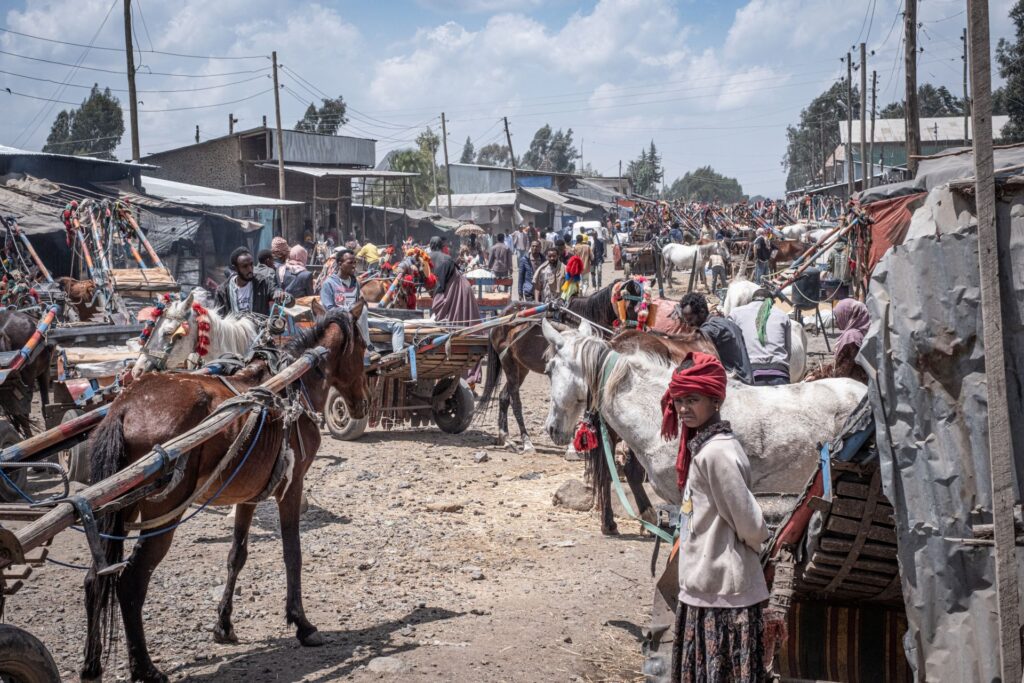
Yet on the ground, smallholders still struggle with fragmented plots, costly inputs and unpredictable rains, casting doubt on the long-term sustainability of Ethiopia’s wheat ambitions. The government’s drive to balance exports and imports, promoted as a path toward food security and global integration, often puts pressure on the very communities it aims to support, eroding local food sovereignty. “Cultivating enset in your own field is an ancestral tradition that ensures families always have something to eat. Plant two or three in your garden, and you won’t face hunger. Every part of the plant is edible, and you can even make bread from it,” explains Benura Walde in Shashamane, highlighting the value of local knowledge of the land. Yet these traditional crops now risk being displaced by monocultures, leaving farmers dependent on commercial crops and exposing soils to degradation.
According to academics working with the government program, cluster farms were introduced to counter land fragmentation and improve efficiency. “This is an undeniable advantage,” acknowledges Dejene Mengistu, a researcher at the International Livestock Research Institute. “However, from a diversification standpoint, it has drawbacks. Farmers plant the same variety and crop. If that variety is hit by pests or disease, the entire cluster can be wiped out.” Researchers therefore urged the government to adapt production to local climates through crop rotation, avoiding the exclusive planting of wheat. “The government now tries to replicate the cluster model while aligning crops with regional agroecologies,” Tesfaye says. The program currently targets 10 key commodities, including barley, teff, sesame and avocado.
Nutritional concerns remain largely overlooked. “The main goal is increasing production. Once we reach food sufficiency, then we’ll address nutritional sufficiency,” Tesfaye explains. Mengistu adds, “Cluster farming isn’t nutrition-sensitive. The aim is the system’s self-sufficiency, not people’s. Cereals become commodities: Export them, earn dollars, then import other foods to ensure diversity and expand market access.”
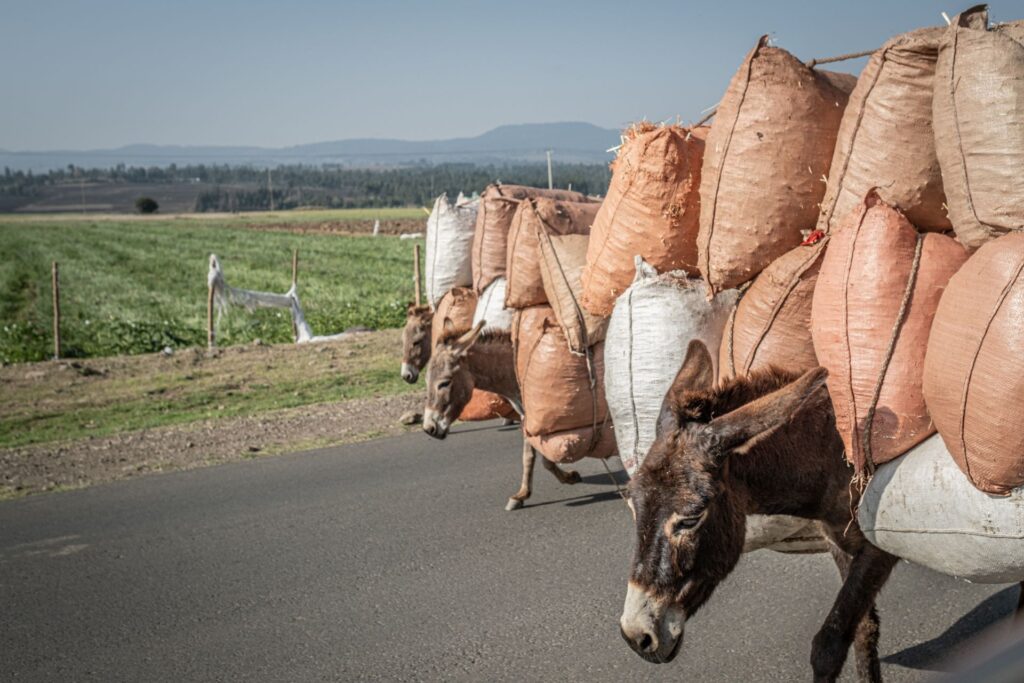
The people, however, are still the ones managing Ethiopia’s fields today. For nearly 60% of the rural population, farming remains the only source of livelihood. Moving away from subsistence agriculture risks leaving behind a vast workforce and would require a complete overhaul of the country’s industrial base. Although Abiy was awarded the Nobel Peace Prize in 2019 for resolving the long-standing border conflict with Eritrea, the country remains far from calm, which has affected both local and foreign investment. Efforts to expand textiles and agrifood processing were further derailed by the war between federal forces and the Tigray People’s Liberation Front in Tigray from 2020 to 2022. Conflict continues to cast a long shadow: Fighting in Amhara, simmering tensions in Oromia and renewed hostilities in Tigray make a stable national agricultural cycle a distant hope.
Meanwhile, traditional farming systems, seed diversity and centuries of local knowledge persist in Oromia’s fields, where 6.8 million farmers share 28.7 million acres of agricultural land. Yet for these communities, the government’s cluster program and impressive macroeconomic figures remain little more than a hollow refrain, one that does nothing to ease their daily struggle.
Become a member today to receive access to all our paywalled essays and the best of New Lines delivered to your inbox through our newsletters.