


“It makes me very afraid to talk about these things,” confides a photographer from Caracas, referring to recent U.S. military actions targeting Venezuela and his waning hopes for a democratic future. He quickly deletes his voice messages after sending them and asks to remain anonymous, fearing government repression.
He yearns for a democratic government after over a quarter-century of nominally socialist, increasingly authoritarian rule. Yet he rejects and fears U.S. military intervention in his homeland.
Since Sept. 2, U.S. President Donald Trump’s administration has attacked 15 vessels allegedly involved in drug trafficking in the Caribbean Sea and the eastern Pacific Ocean, killing more than 60 people. American forces have ramped up their Caribbean presence, deploying some 10,000 troops and at least eight major warships, and are sending the world’s largest and most advanced aircraft carrier, the USS Gerald R. Ford, to the region. Trump has also placed a $50 million bounty on the Venezuelan leader Nicolás Maduro’s head and authorized CIA operations inside Venezuela.
The U.S. military escalation stirs both hope and fear among Venezuelans. Debates about the use of foreign military force to topple Maduro divide Venezuelans at home and across the diaspora of nearly 8 million who have fled the country. Some Venezuelans, exhausted after years of failed attempts to remove Maduro through elections, protests and international sanctions, now see military action as the only option left. Others are more skeptical, fearing that those who remain inside the country will bear the cost of military attacks that unleash violence and chaos, without any guarantee that democracy will follow.
Still, many Venezuelans now openly support a U.S. military invasion, even if they remain wary of U.S. involvement in the region. There’s widespread unease that military force is not the ideal path to a change of government, but it may be the only one left. An October poll by the DC Consultores polling firm surveyed 1,103 Venezuelans across Venezuela, of whom 86% supported Trump’s current actions in Venezuela, 49% thought Trump should capture key regime officials from Maduro’s government and 17% thought Trump should intervene militarily inside Venezuela.
It remains uncertain whether Trump’s escalation is saber-rattling intended to scare Maduro into resigning, or whether he plans a military intervention inside Venezuela. Polymarket, a blockchain-based betting platform, put the odds of a U.S. military invasion before the year’s end at between 13% and 14%, as of late October 2025.
While much of the world watches Venezuela in anticipation of military intervention and regime change, the mood inside the South American nation feels more muted. “Things always look worse from the outside, I try to live a normal life,” says a shop owner whom I met at an opposition rally in Caracas last year, before the disputed 2024 presidential election. Such rallies have been met with heavy repression by Maduro’s security forces, leading to the detention of over 2,000 people involved in protests, political opposition activities and human rights work in the days after the election. A United Nations fact-finding mission on Venezuela has repeatedly concluded that government authorities have committed crimes against humanity in their crackdown on dissent.
Maduro claimed victory for a third term, but tallies from polling stations showed opposition candidate Edmundo González winning 67% of the votes and Maduro winning just 30%. González was appointed as the opposition’s presidential candidate after the wildly popular leader and winner of the 2025 Nobel Peace Prize, María Corina Machado, was barred by Venezuela’s Supreme Court from running. Her replacement, Corina Yoris Villasana, was also barred from running, leading Machado to appoint González just a few months before the elections.
Back then, the shop owner was hopeful about democratic change, but now his outlook has dimmed. “From my perspective, the [current] situation [involving the U.S.] doesn’t change much from what we have always lived,” he says, referring to the many failed attempts to replace Maduro in the past. Like everyone New Lines spoke with inside Venezuela, he asked to remain anonymous out of fear of government reprisals.
The Caracas photographer says information in Venezuela is scarce and heavily filtered. “Remember, we have a communications blockade here — most of the information we receive comes from the diaspora,” he explains. Maduro and his predecessor, Hugo Chávez, shut down or blocked hundreds of local and international media outlets. “Information here in Venezuela is always ambiguous. … We have no media outlets — the few outlets that exist work for the government,” he says.
“There is censorship and self-censorship,” he adds. He only dares to speak about politics with trusted friends and close colleagues.
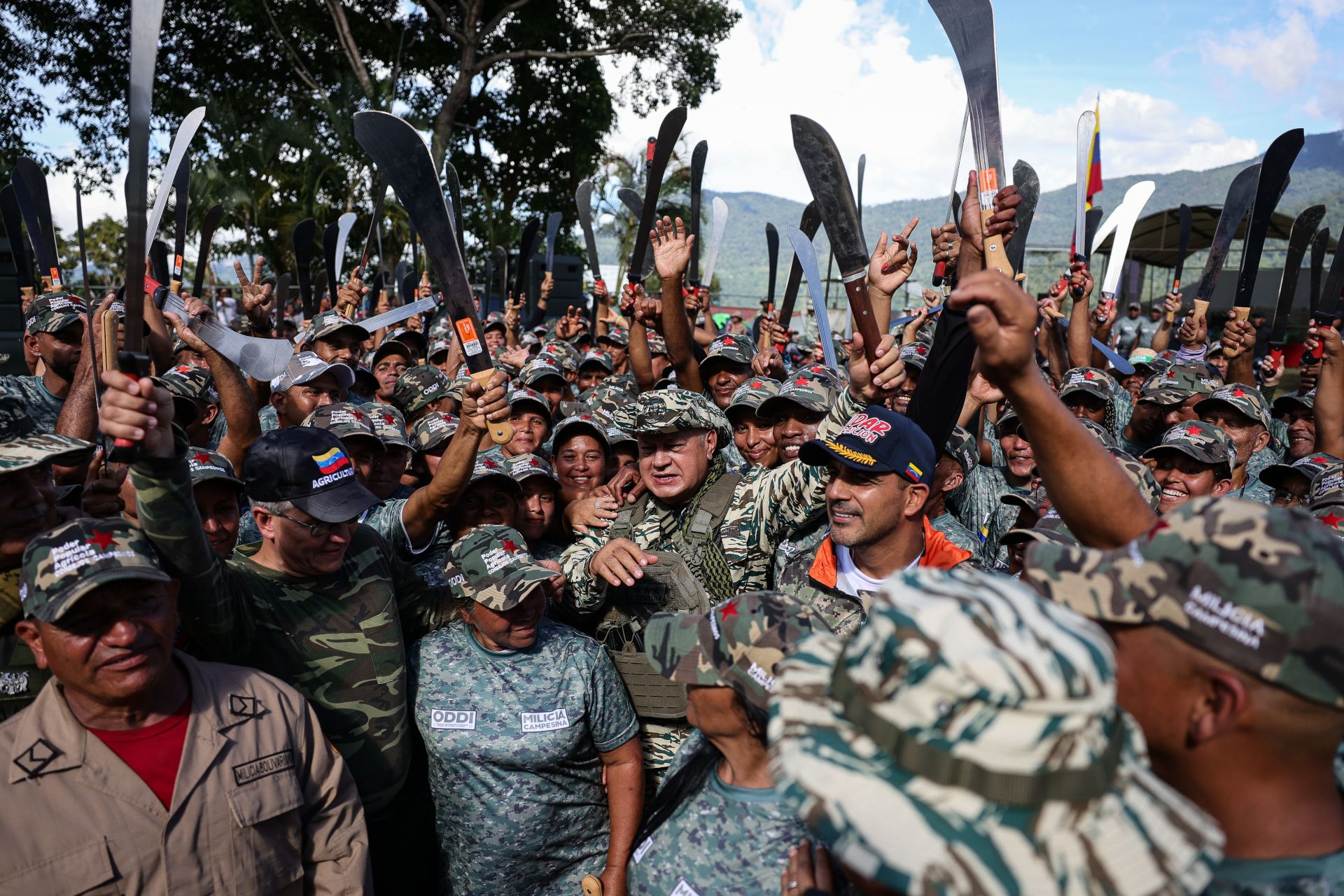
To the outside world, Maduro has tried to project strength. For instance, he ordered two F-16 fighter jets to fly over Trump’s warships and claimed to have mobilized over 4.5 million civilian militia members to defend the country against a U.S invasion — a figure that most experts dismiss as exaggerated. Domestically, he is trying to maintain an illusion of normalcy.
“The government tries to maintain a sense of calm — perhaps a false one,” says the photographer. He notes that the government is still doing public works on the highways and “supposedly there are concerts in Caracas.”
National attention has been elsewhere. Inside Venezuela, many have celebrated the recent canonizations of José Gregorio Hernández and Carmen Rendiles, Venezuela’s first saints. The canonization created friction between the Venezuelan government and the Catholic Church, as the government sought to leverage the event to improve the country’s image and signal national unity, while senior Vatican officials and a Venezuelan cardinal urged the Venezuelan government to address human rights and political prisoner issues. “We have been in a bubble about this canonization,” the photographer says.
As another distraction, Maduro declared early Christmas in Venezuela from Oct. 1. “Right now, we’re in Christmas mood, everything is full of Christmas in Caracas,” the photographer told New Lines. Maduro has used this move in previous years, too, trying to inject cheer and consumer spending into a struggling economy and distract from ongoing crises.
A human rights defender in Caracas, who also asked not to be named due to fears of government reprisals, says Maduro’s government is bent on “engineering its own reality.” On Oct. 1, schools asked children to bring Christmas ornaments — although this is not customary in Venezuela — while government tax agents went through commercial establishments in Caracas, ordering businesses to decorate for Christmas, or else they would be sanctioned, the human rights defender explains. “This is not only to prevent protests, but also so that citizens go along with the government’s parallel version of reality,” he says.
More than politics or U.S. interventions, what preoccupies many inside Venezuela are the economic problems wrought by the government.
“The most serious issue is the economy,” the photographer says. The Venezuelan bolivar, he explains, has fallen abruptly against the U.S. dollar — widely used in the country — while “dollar bills have disappeared,” making it hard to meet even basic needs. Venezuela has suffered the biggest economic collapse outside wartime in about half a century. Inflation is expected to reach 270% by the end of 2025, according to the International Monetary Fund.
“There’s a lot of tension, a lot of fear, and yet everyone is just trying to live as normally as possible — to bring food home,” the photographer says.
The human rights defender agrees that Venezuelans who remain inside the country are more focused “on trying to survive” than on politics. “People are very desperate because of the economy,” he says. “It has gotten much worse; inflation has been terrible.”
Trump’s military campaign began in the Caribbean Sea, seemingly to exert pressure on Maduro’s government, but the U.S. campaign has since expanded to neighboring Colombia. U.S. attacks have struck boats off Colombia’s Pacific coast, killing Colombian nationals. Trump has also ended all U.S. aid to Colombia and labeled Colombian President Gustavo Petro “an illegal drug leader,” sanctioning him, his close family and allies.
While experts agree that calling Petro an illegal drug leader is baseless, Trump has rightly pointed out that cocaine production in Colombia has reached record levels under Petro’s presidency. Trump accuses Petro of doing “nothing to stop” drug production. Reactions in Colombia are mixed, with some applauding Petro for standing up against Trump, while others blame him for provoking a serious diplomatic crisis.
“We are very concerned that Petro has been placed on the OFAC list [the U.S. Treasury Department’s Office of Foreign Assets Control sanction list] and has been accused of being linked with drug trafficking,” says Gimena Sánchez-Garzoli, the director for the Andes at the Washington Office on Latin America. She argues that, since the Trump administration now equates drug trafficking with terrorism (“a completely flawed and unjustified concept,” she says), the U.S. could also take actions against Colombia. She says the Trump administration’s actions are “a threat to the entire region — not just Venezuela and Colombia.”
In both countries, Sánchez-Garzoli says, “what is needed is a diplomatic effort, this won’t be resolved militarily”.
The Trump administration has broadened its definition of terrorism to include “narco-terrorism,” a move Sánchez-Garzoli calls “very questionable.” She notes that Trump has not obtained congressional approval for this, and that drug shipments in the Caribbean Sea do not constitute an immediate threat to the United States and could instead be handled through criminal indictments. She says Trump is signaling to his domestic base that he is tackling a problem that harms Americans by attacking drug traffickers.
Yet Andrés Preciado, the director of conflict and security at the Ideas for Peace Foundation in Colombia, argues that these actions are not truly about protecting U.S. citizens. Indeed, fentanyl — the main killer in the U.S. overdose crisis — is not produced in South America, which has been the focus of Trump’s military campaign. Instead, fentanyl primarily comes from labs in Mexico. Besides, targeting boats mainly in the Caribbean barely dents drug trafficking to the United States. “As always, organized crime will adapt” and adjust its drug trafficking routes to find a way to the U.S. market, Preciado says.
Sánchez-Garzoli agrees that militarized counternarcotics is the wrong approach. “You can’t solve a public health crisis with military force,” she says. Most experts see Trump’s true aim as pressuring Maduro’s regime. Preciado believes the attacks are “testing the waters,” gauging which insiders might “jump ship” if open conflict erupts.
According to Phil Gunson, a senior analyst for the Andes at the International Crisis Group, “It wouldn’t be difficult to topple the [Venezuelan] government.” He believes that the real challenge would be to maintain internal security afterward, since “there are so many armed groups in Venezuela with an interest in maintaining the status quo — including particularly the Colombian ELN [the National Liberation Army, a Colombian guerrilla group] — that peace-keeping could be a very long-term commitment.”
The armed groups entrenched in Venezuela are partly the byproducts of decades of regional conflict, criminal opportunity and state decay. Chief among them is the ELN, a Marxist guerrilla movement that has crossed into Venezuelan territory, finding refuge and profit in illegal mining, extortion and other criminal activities. With parts of the Venezuelan security forces turning a blind eye — or cooperating — the ELN and other armed groups, as well as local Venezuelan militias, like the government-supporting “colectivos,” have flourished in Venezuela.
María Beatriz Martínez, president of the Venezuelan opposition party Primero Justicia, rejects suggestions that a U.S. intervention would spark civil war in Venezuela, saying Maduro simply does not have enough backers for that to happen.
“I am very pessimistic that Trump’s actions will bring about a regime change in Venezuela,” says a university professor in Caracas, who, like others, requested anonymity due to fear of government persecution. “What I observe is that Trump uses the issue of Venezuela and the ‘Cartel of the Suns’ [an alleged Venezuelan drug-trafficking organization involving high-ranking military and government officials] as a propaganda tool that serves him politically in his own country. Deep down, he’s not really interested in a regime change in Venezuela. I highly doubt that these actions will bring about any political change.”
She supports the opposition movement but shuns the idea of U.S. invasion: “It’s worrying because people who have nothing to do with it could be killed or injured,” she says.
“Too many things have to come together in just the right way for that [a democratic transition] to happen. The best chance of restoring democracy to Venezuela is through a negotiated, gradual transition,” Gunson says.
There are no signs that Maduro would be willing to relinquish power, however. In the meantime, he is presenting himself as a victim of U.S. attacks on Venezuelan sovereignty. He has requested the United Nations Security Council to investigate U.S. attacks on vessels off Venezuela’s coast and declare the operations illegal, considering them extrajudicial killings and attacks on sovereignty. But he will likely have limited luck in the Security Council, where the United States has veto power.
The photographer shares the hope for regime change but doubts it could — or should — stem from a U.S. invasion. “I don’t think it’s as simple as that. I don’t think Venezuela deserves war.” He is afraid of a war breaking loose in Venezuela. “That’s something I’ve never wanted. I stayed here for my family — for my mom, for my dad. I have a child who’s studying and growing up in this country. Can you imagine my child, and so many of our children, going through something so traumatic?”
He tells me that, when he hears fireworks, he gets scared. “I feel paranoid in the streets. I’m not a criminal — I’m a photographer, a worker, I have a family. This is all very painful.”
He is wary of judgment from fellow opposition supporters: “If I say that I don’t want an intervention, people think I’m a Chavista [a supporter of Maduro and his predecessor]. I’m not a Chavista.”
The photographer wakes up in the middle of the night, partly from the heat in Caracas and partly because his mind keeps spinning around my questions to him about a possible U.S. invasion. “I think about it a lot,” he says. “Not so much about the political side, but about the human side — about Venezuelans. What would that be like? How would it affect us?”
“What will happen if there’s a change of government? Could it really happen? I don’t know. Will Maduro step down? I don’t know. Who are the people that, in the event of a change of government, would come here? To lead what, and how? Who, and how?” He keeps asking more questions.
The photographer says that forming a democratic government and reconstructing the country will be difficult. In case of a military intervention, he says the country will “be left without [institutional] powers,” referring to the country’s executive, legislative and judicial branches all currently being controlled by Maduro allies. “Which assembly would take charge? Which Supreme Court would assume control?” He is concerned about what would happen to former government officials, too, and to all the organizational structures in the barrios that have supported Maduro, including the colectivos and militias.
“I think about this a lot because I’m Venezuelan and I love my country. I believe Venezuela deserves better leaders, better public officials and an opposition that truly plays by democratic rules. But I don’t want war; I don’t want to live through that kind of trauma,” he says.
“Spotlight” is a newsletter about underreported cultural trends and news from around the world, emailed to subscribers twice a week. Sign up here.